AI for Personalization: Models, Lift and Roadmap
See how AI for personalization picks the next offer, which models fit, what lift published cases show, and how to prove incremental ROI.
October 30, 2026
AI for personalization is best treated as a margin and trust decision, not a contest to collect the most data or predict the next click. McKinsey's 2021 research estimated that moving U.S. companies to top-quartile personalization performance could create more than $1 trillion in value. That's a measure of potential across industries, not a forecast for any one company or implementation.
The operational question is narrower: can your team use permitted signals to make a better decision for a customer, then prove that the decision changed an outcome worth paying for? A recommendation can be accurate yet add no incremental revenue. A message can feel relevant to a model and intrusive to the person receiving it.
Table of Contents
- What AI Personalization Is Worth
- Choose the Model for the Job
- Named Results You Can Compare
- Personalize When Customers Withhold Data
- Prove Incremental Value Before You Build
- How to Roll Out Personalization in Eight Moves
What AI Personalization Is Worth
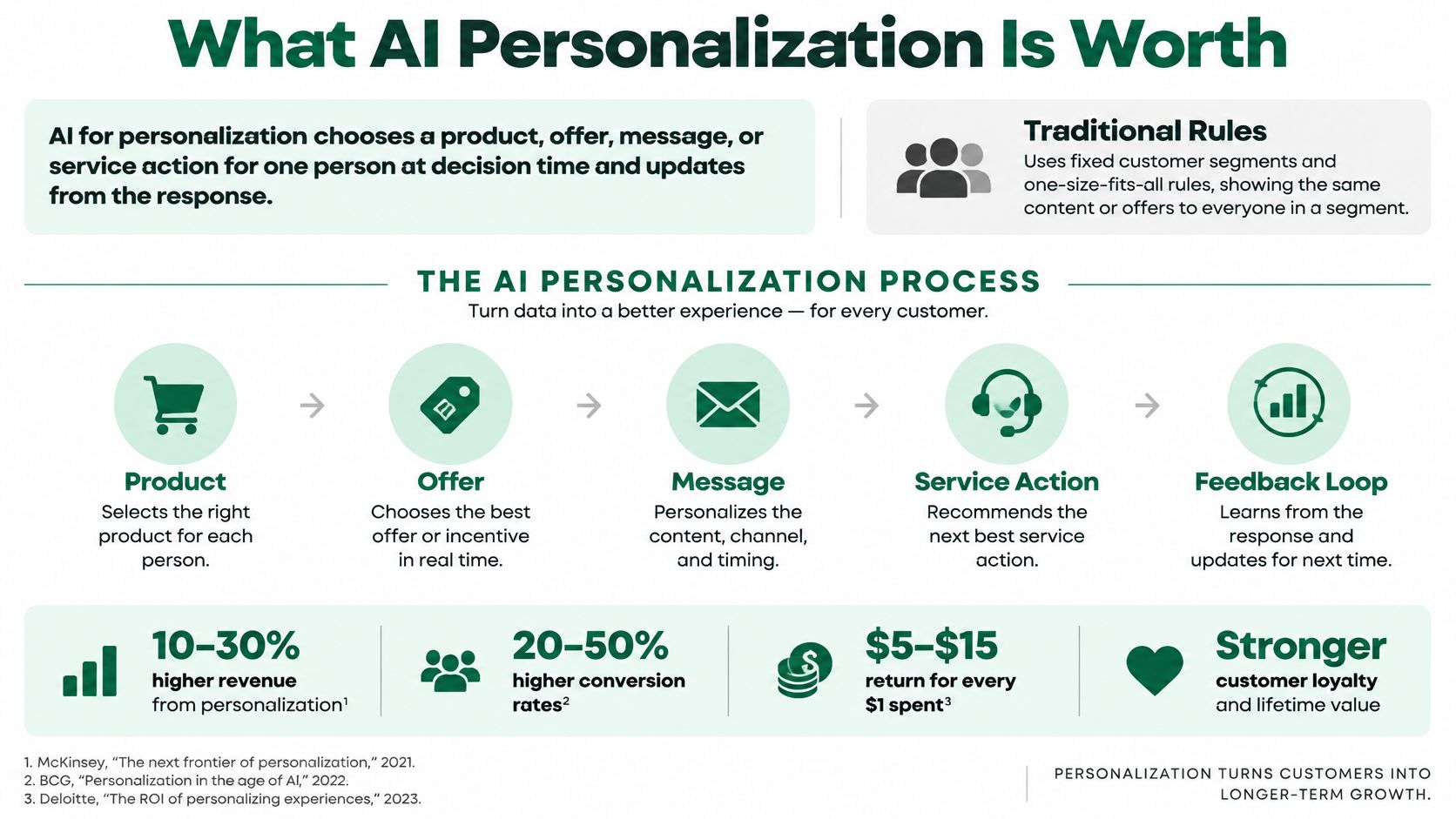
AI for personalization chooses a product, offer, message, or service action for one person at decision time, then updates from the response. A batch message to a demographic segment can't change when its first offer is ignored; a decisioning system can use that response to choose what happens next.
| Personalization value benchmarks from McKinsey 2021 | Figure | What it measures |
|---|---|---|
| Excellent vs. average performers | 40% more revenue from personalization | Value of doing personalization well |
| Faster-growing vs. slower-growing companies | 40% more of revenue from personalization | Share of growth tied to personalization |
| Typical revenue lift | 10–15% | Revenue associated with personalization |
| Company-specific range | 5% to 25% | Sector and execution differences |
| U.S. move to top quartile | More than $1 trillion | Estimated cross-industry value |
What the benchmark does and doesn't tell you
In its 2021 research, McKinsey's analysis of personalization reported that companies excelling at personalization generated 40% more revenue from personalization activities than average performers. Faster-growing companies derived 40% more of their revenue from personalization than slower-growing peers. The study's findings drew on several consumer surveys, including a U.S. sample of 1,013 people and additional surveys totaling more than 4,000 respondents.
The typical revenue lift associated with personalization was 10–15%, while company-specific results ranged from 5% to 25%, depending on sector and execution. Those figures are benchmarks, not a promise that installing a model will raise your revenue by a set amount. A team's baseline, customer journey, offer economics, execution quality, and ability to act on fresh signals all affect what it can achieve.
McKinsey described a connected set of capabilities behind effective personalization: advanced analytics, predictive propensity models, next-best-action algorithms, dynamic content, and AI-driven decisioning. Together, these let a company match offers and messages to individual customers in real time. The business capability isn't just storing more customer fields. It's linking an appropriate signal to a decision, delivering that decision in the right channel, and learning from the result.
For a grounded look at how companies put personalization into ecommerce journeys, ECORN's ecommerce personalization examples offer useful implementation context. The same discipline matters whether a company is choosing a product recommendation, a retention offer, or a service response: define the decision first, then ask what evidence should change it.
The practical map is straightforward: choose a model for the job, match the approach to the journey, compare named outcomes carefully, account for withheld data, prove causal value, and roll out with measurable gates. Value comes from activating data quickly and feeding outcomes back into decisions, not from collecting more fields.
Choose the Model for the Job
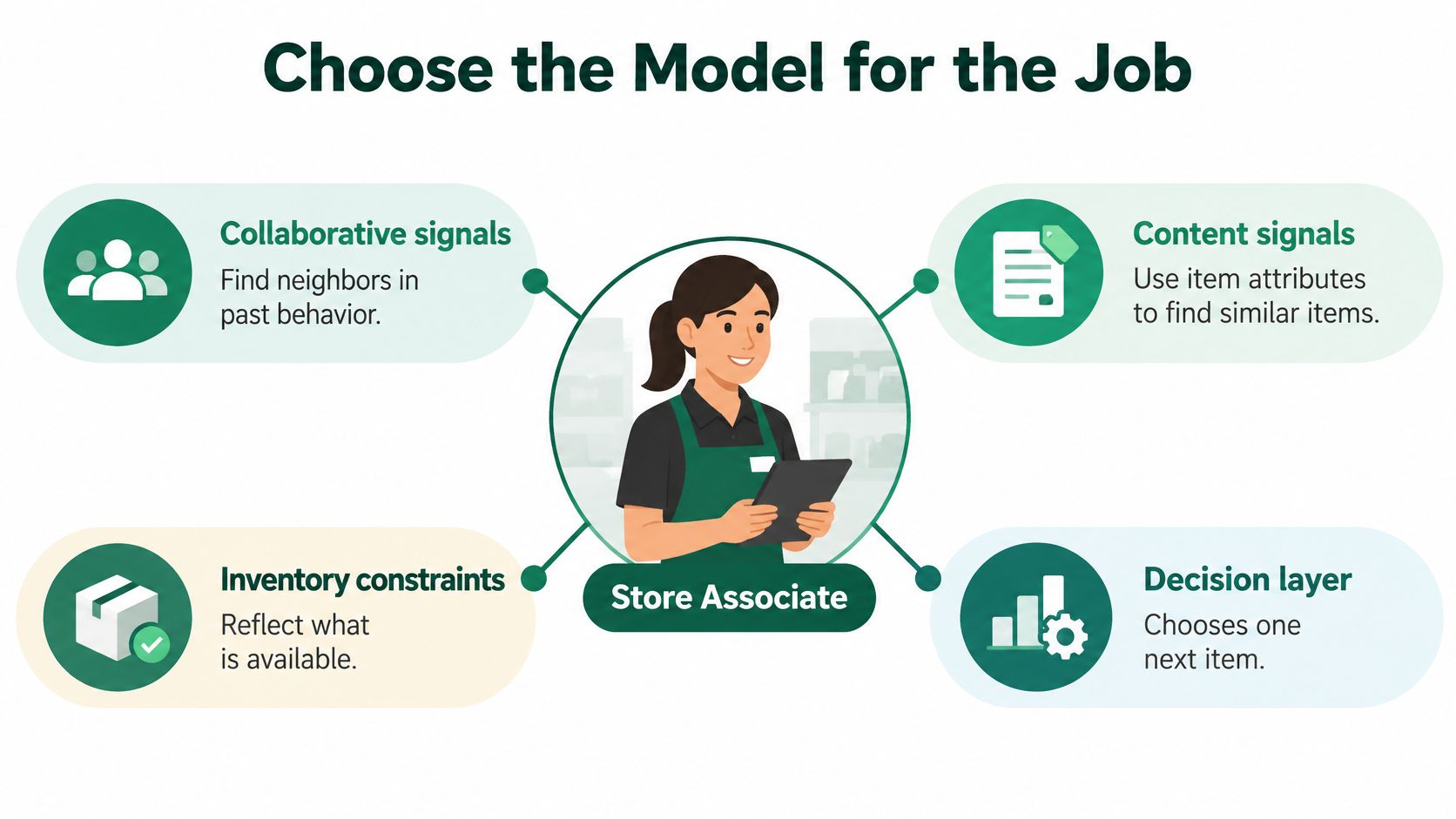
A good store associate notices what a shopper picks up, what they ignore, and what's available, then offers one useful next item. An AI system can reproduce parts of that judgment at scale, but only if the team separates the information it uses from the policy that decides what to do.
Separate signals, predictions, and actions
A practical architecture has four layers. Collaborative signals find neighbors in past behavior, such as shoppers who considered or bought similar items. Content signals use attributes such as product type, topic, or features to find relevant alternatives. Inventory constraints remove choices the business can't fulfill or shouldn't show. The decision layer selects one next item or action, subject to rules for margin, eligibility, contact frequency, and service policy.
That decision layer matters. A propensity model estimates who may buy, click, churn, or accept an offer; it doesn't determine whether the company should send a discount. A next-best-action policy can compare permitted choices and reject a discount if a full-price offer is more appropriate. Generative AI belongs later in the chain: it can assemble or adapt copy after the team has selected the action and supplied accurate product facts and brand rules.
A modeled economic experiment found that recommender systems could increase users' expected utility by as much as 6% compared with a benchmark where people search independently for preferred products, according to the Oxford Review of Economic Policy study. The proposed mechanism is reduced search effort: the algorithm narrows a large choice set to items more likely to match latent demand. Treat that figure as an upper bound from a modeled experiment, not a forecast for your store.
Measure whether the recommendation changes a meaningful outcome. Compare it with a no-recommendation or generic-ranking control, and track incremental purchase, completion, retention, or revenue per session. Clicks can rise without changing the outcome if the customer was going to buy anyway.
Match the approach to the decision
| Personalization approaches and where they fail | Decision logic | Data it needs | Fails when |
|---|---|---|---|
| Rules and segments | If-then audiences and eligibility | CRM attributes and policy flags | Segments are too coarse for the decision |
| Collaborative filtering | People with similar behavior get similar items | Item interactions at catalog scale | Cold start or popularity bias dominates |
| Propensity and next-best-action | Score who will respond and pick an allowed action | Events, offers, outcomes, constraints | Model chases likely buyers or over-discounts |
| Contextual and session models | Rank from the current visit | Context, catalog, consent flags | The session is too sparse to infer intent |
| On-device or federated learning | Score locally or share model updates | Minimal raw data leaving the device | Teams can't debug or explain a bad action |
| Generative content | Assemble copy or creative for a chosen action | Brand rules and product facts | Output invents claims or drifts off brand |
Use rules for regulated decisions or journeys with little behavioral history. Collaborative filtering fits large, repeat-use catalogs, but new users and new items create cold-start problems, while popular products can crowd out less obvious matches. Propensity and next-best-action models are useful when a human or blanket discount would spend money on customers who'd act anyway.
Session models can rank from a current visit without building a durable profile, but a short or sparse session may not reveal enough intent. On-device scoring and federated approaches can limit the movement of raw data, though teams still need a way to investigate and explain an unexpected decision. Generative content can tailor an approved message; it shouldn't invent the offer, product specifications, or eligibility conditions.
Decision rule: Choose the tool class based on data freshness, the share of new or anonymous users, audit requirements, and whether the system is choosing a rank, a price, or a service action.
Teams comparing software categories can use Quikly's guide to ecommerce personalization to orient their evaluation. For a deeper look at recommendation-system mechanics, see AI recommendation engines. Start with a journey where a holdout can finish within a quarter and the decision can change margin, cost, or customer effort.
The video below provides additional context on recommender systems.
Named Results You Can Compare
Published results can help a leadership team set hypotheses, but they don't all measure the same thing. A conversion-rate change in ecommerce, fewer errors in a self-service experience, and faster email localization are different outcomes in different operating contexts.
| Published personalization outcomes by setting | What changed | Reported result |
|---|---|---|
| 35 major ecommerce implementations | Conversion rate | 15.3% average gain; 22.7% in the top quartile |
| Early personalization adopters in that research | Average order value | Up to 20% increase |
| Ecommerce A/B test | Order value and conversion | About 50 KM to 57 KM, about 14%; conversion 4.5% to 6.0% |
| MOO self-service shopping | Page errors, abandonment, browsing | Errors down 67%; abandonment down 12%; two-product views up 12% |
| Swarovski email and localization | Opens, clicks, production speed | Opens up 17%; click-through up 7%; localization 10 times faster |
Read each result at its actual scope
A study of 35 major ecommerce implementations found an average conversion-rate improvement of 15.3% after advanced recommendation systems were deployed, with a 22.7% gain in the highest-performing quartile. The same study reported that early personalization adopters could increase average order value by up to 20%. These are findings from the review of major ecommerce recommendation implementations, not a commitment that a new system will reproduce the average.
In a separate ecommerce A/B test, average order value rose from approximately 50 KM in the control group to 57 KM in the personalization group, while conversion increased from 4.5% to 6.0%. The study reports both differences as statistically significant at p < 0.05. Its personalized-recommendation A/B test provides a comparison within that test setting, not a transferable forecast for another catalog or customer base.
MOO used behavioral session insights to improve its AI-personalized self-service shopping experience. After identifying previously unseen rage clicks and dead clicks, the company reduced errors on a beta product page by 67%, lowered checkout abandonment by 12%, and increased the share of visitors viewing at least two products by 12%, according to FullStory's account of MOO's work.
Google Cloud reports that Swarovski's AI-personalized email campaigns generated 17% higher open rates and 7% higher click-through rates. AI-assisted translation and asset adaptation made campaign localization 10 times faster, alongside AI-supported ticket triage and real-time agent assistance, as described in Google Cloud's Swarovski case study.
These outcomes belong to different channels and should remain separate in a business case. A retail email result doesn't predict performance in customer service, and a page-error reduction isn't a revenue forecast. Use the Applied library to compare implementations by company, industry, business function, tools, and quantified outcome before borrowing a benchmark for a different workflow.
A conversion lift can hide discounting that reduced margin. A speed gain can hide more frequent customer contact. Ask what changed for the customer and what it cost the business, not only which headline metric improved.
Personalize When Customers Withhold Data
Personalization has a trust gap: customers may value relevance while remaining unsure how an organization uses their information. In Deloitte's 2025 survey of 3,524 U.S. consumers, concern about data privacy and security rose from 60% to 70% in one year. Only 20% said technology providers were very clear about data collection and use, 27% had high or very high confidence that their data was protected, and 48% said online-service benefits outweighed privacy concerns, according to Deloitte's 2025 consumer survey.
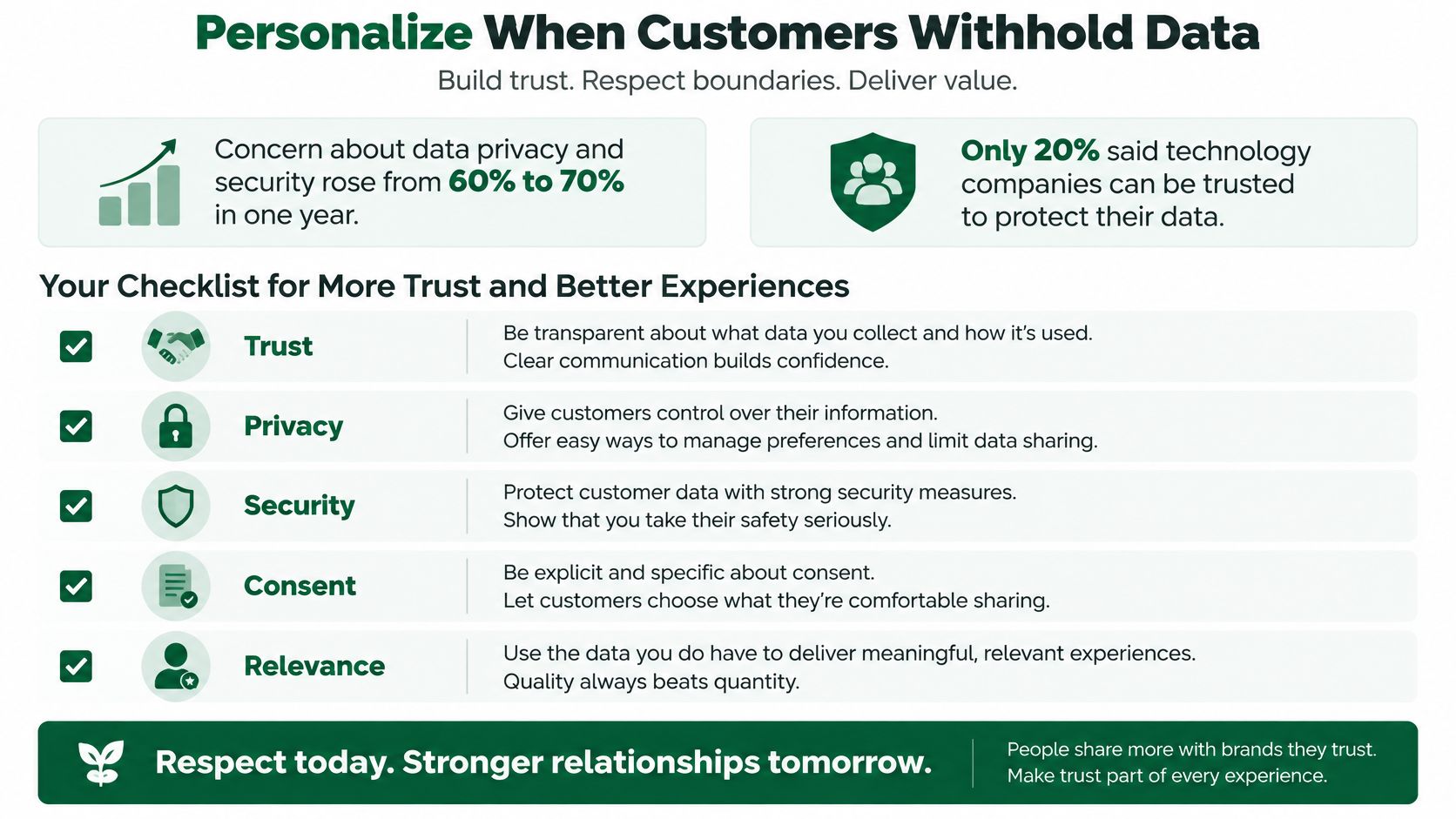
A more accurate model can still lose if the experience feels like surveillance. A customer may opt out, complain, or stop sharing information; the business then loses permission to use signals that could have helped it make a useful decision. So data minimization isn't only a compliance step. It's part of the product design.
Keep relevance without a hidden profile
When someone refuses to share sensitive fields or requests deletion, a team can still use contextual signals from the current interaction and declared preferences supplied directly by the customer. Both can support useful choices without inferring a broad personal profile. Set short retention limits so a score doesn't follow someone longer than the decision requires.
On-device scoring can keep raw events on the customer's device, while federated learning can share model updates rather than centralizing each person's raw activity. Synthetic data can help test pipelines and failure handling, but it shouldn't be treated as evidence of what a real customer wants. Teams working through those distinctions can consult synthetic data generation.
A preference center should make choices understandable. Let customers select purposes, channels, and topics, then carry those choices into the decision pipeline so suppression happens automatically. Treat a recorded opt-out as a successful system outcome: the system respected the customer's instruction.
Track opt-outs, complaints, and deletion requests alongside revenue and long-term value among customers who continue to engage. If those indicators worsen while targeting accuracy improves, the organization may be buying short-term relevance at the expense of durable permission. If the personalization can't be explained in one sentence, don't launch it.
Prove Incremental Value Before You Build
A ranking model can perform well and still create little new value. It may shift a purchase from one product to another, give a discount to someone who was ready to pay, or take credit for a conversion that would have happened anyway. Decide how you'll prove the effect before exposing customers to the treatment.
Adobe's 2025 Digital Trends research surveyed more than 3,200 marketers and customer-experience professionals plus 8,000 consumers, with data management and consumer expectations among its implementation concerns, according to Adobe's Digital Trends report. The operating gap is not just choosing a KPI. It's separating a personalization effect from seasonality, promotion activity, channel mix, and existing purchase intent.
Design for persuaded customers, not easy conversions
Uplift evaluation separates people into four behavioral groups:
- Likely to act either way: They convert with or without the recommendation. Don't count their purchase as incremental impact.
- Persuaded by the recommendation: They act because the relevant recommendation or action changed their decision. This is the group to reach when measuring incremental response.
- Act only when it's absent: The recommendation may be a poor fit, displace a better choice, or create friction. Track whether the treatment suppresses action.
- Unlikely to act either way: More recommendations may add exposure without creating a useful outcome.
Randomized holdouts can estimate the difference between people who receive personalization and a comparable group that doesn't. Where customer-level assignment isn't practical, use a geo-experiment or a time-boxed comparison, while accounting for changes in promotions and channel mix. For journeys that influence later purchases or service behavior, keep the measurement window and attribution rules consistent.
Freeze a scorecard before launch. It should include incremental revenue or margin, repeat purchase, churn, customer effort, unsubscribe and opt-out rates, fairness across segments, and operating cost. Add a cannibalization check when one recommendation can displace another product or action. For service journeys, measure whether the system reduces effort or repeat contact, not only whether it suggests an answer quickly.
A lower-accuracy model can be the stronger business choice if it reaches incremental customers, reduces dependence on discounts, or protects retention without increasing contact frequency.
Before a build starts, write down the control group, the decision being tested, and the margin or effort metric that determines success. A project can use an AI proof of concept to structure a focused test, but the test still needs a causal comparison and a pre-agreed decision rule.
How to Roll Out Personalization in Eight Moves
A personalization rollout should end with a clear operating decision: scale, fix, or stop. The team needs one accountable owner, a defined customer choice, and consent rules built into the path from data to action.
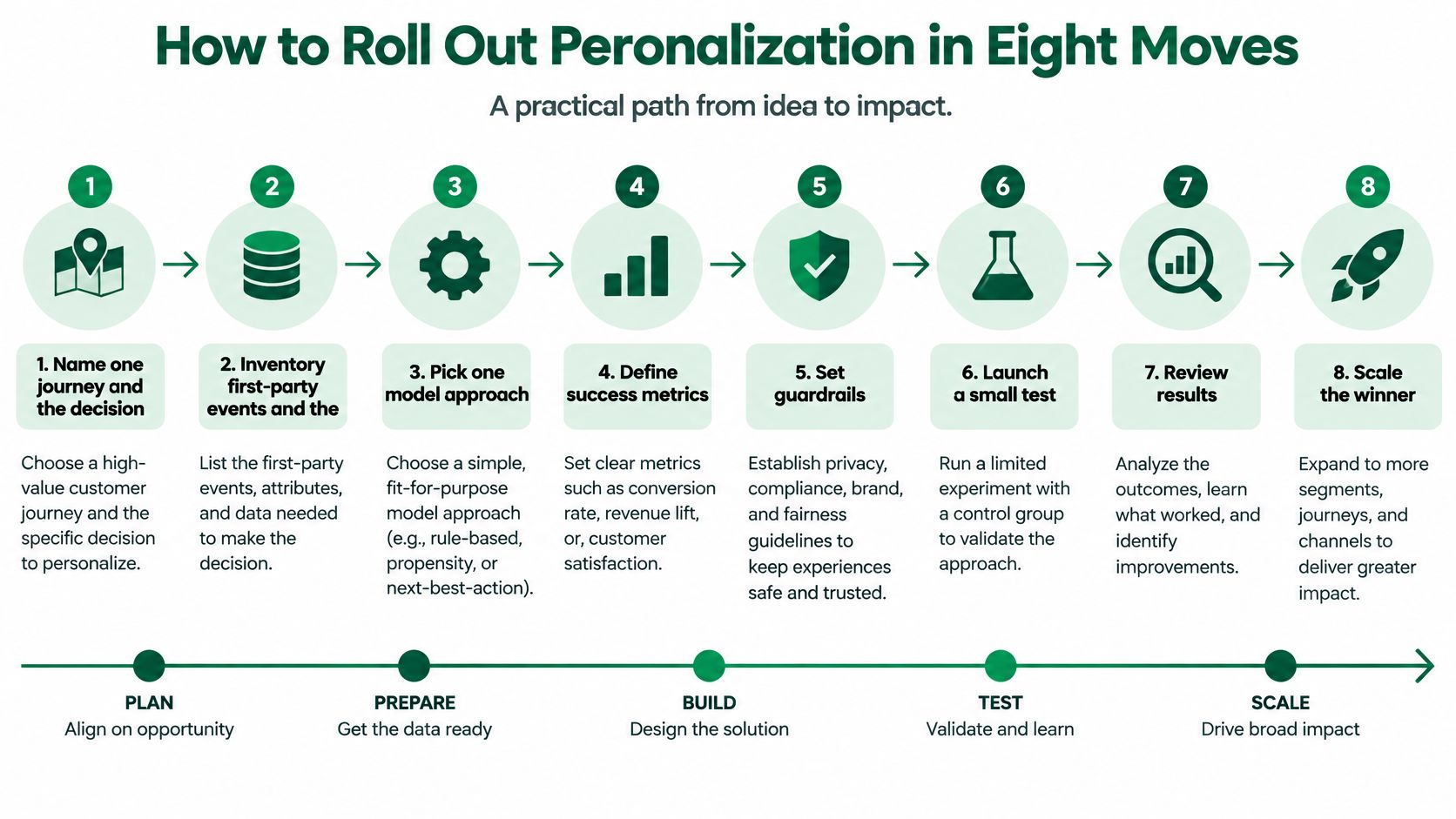
Name one journey and the decision. Choose a specific action, such as which product, offer, article, or agent next step to present. Define what the model should change. “Personalize the customer experience” is too broad to guide a build or a test.
Inventory first-party events and identity keys. List the events and identifiers the team can join for this use. Exclude fields nobody can explain to a customer. The system should use signals that are relevant and permitted, not every field available in storage.
Pick one model approach. Match the approach to data maturity and the share of new or anonymous users. Rules may fit when policy or limited history drives the decision. A behavior-heavy model may not fit a journey with little behavioral data.
Build the minimum decision path. Connect event collection, a feature pipeline, a rules or model service, an offer or content catalog, and a channel API. Test the full route to the customer. A score that never reaches the live channel cannot change the decision.
Freeze success metrics and the holdout. Agree on the control, the primary margin or effort measure, and the guardrails before treating any traffic. Keep the success measure fixed once results arrive.
Put consent and deletion into the pipeline. Carry consent state, preference-center choices, and a deletion path into the system that selects actions. A separate manual suppression step can be bypassed if the decision service does not enforce customer choices.
Assign an owner and review the same signals weekly. Give one person responsibility for the decision and a shared readout with channel, data, and legal stakeholders. Review lift, opt-outs, complaints, and run cost together. That makes trade-offs visible to the people who can change the action or its guardrails.
Make a scale, fix, or stop decision. Expand to another journey only after two consecutive readouts beat the control on incremental margin or effort saved. Scale when that benefit holds. Fix the system if it mainly reallocates demand or discounts customers already likely to buy; stop if opt-outs or complaints erase the gain. A click result alone is not enough to justify expansion.
Organize around decisions, not model handoffs
A decision council can bring the channel owner, analytics, operations, and the teams responsible for consent and customer experience into one review. The group can then change the action, tighten a guardrail, or stop a journey without treating the model as an untouchable deliverable.
Measure service use cases against the job they perform. A system choosing an agent's next step may affect handle time, resolution, or repeat contacts rather than conversion. Include customer effort so a faster workflow does not transfer work to the customer.
Before committing budget to a stack, compare verified deployments in the Applied library by company, industry, business function, tools, and quantified outcome. Create a free account to access the full library and its advanced filters. Use relevant examples to sharpen the test plan, then fund implementation only when the holdout shows a result leadership is prepared to scale.
Applied catalogs verified AI implementations, tools, and measured outcomes across industries and business functions. To compare deployments relevant to personalization, visit Applied and explore the library before choosing a use case.