Synthetic Data Generation: A Practical Guide for 2026
Learn how synthetic data generation works, which techniques fit which use cases, and how to validate privacy and quality before deployment in real systems.
October 21, 2026
Under strong privacy constraints, a model trained on synthetic text can retain only about half the performance it would have achieved on real data. That single result reframes synthetic data generation from a convenient workaround into an engineering trade-off you have to price, test, and govern. You're not buying realistic looking records. You're deciding how much signal you can afford to lose in exchange for safer access.
Table of Contents
- Why Synthetic Data Generation Matters Now
- How Synthetic Data Generation Actually Works
- Matching Techniques to Real Workloads
- Measuring Quality Beyond How Real the Data Looks
- The Privacy-Utility Trade-Off You Cannot Ignore
- Validating Disclosure Risk Before Release
- Engineering Synthetic Data into MLOps Pipelines
- Practical Applications and a Decision Checklist
Why Synthetic Data Generation Matters Now
A data science team asks for customer transactions to train a fraud model. Legal restricts the export, security restricts the join keys, and the labeled fraud cases are too scarce to learn from. The project stalls not because the modeling idea is weak, but because the usable data never arrives.
That pattern explains the breadth of recent work. A 2024 survey reviewed 417 synthetic-data-generation models developed over the preceding decade, covering multiple model families, tasks, and improvement strategies. That's not a single technique looking for a use case. It's a crowded field responding to the same operational constraint across industries.
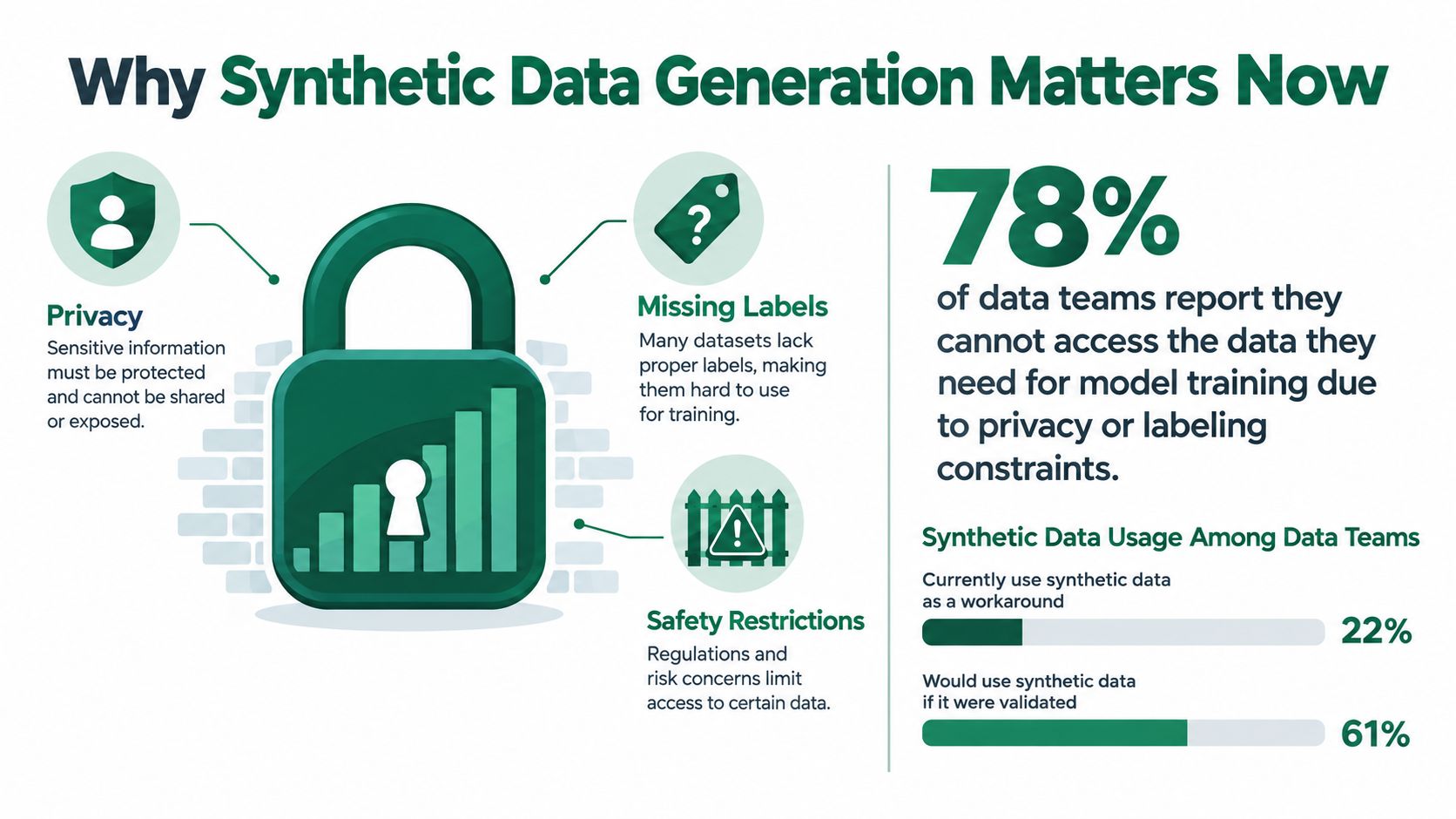
Three Pressures Are Forcing the Decision
Privacy is the first pressure. Regulated teams in healthcare, finance, and the public sector can't move identifiable microdata between teams, vendors, and test environments just because a model would benefit. Synthetic records let analysts and engineers work with the structure of a problem while reducing direct exposure to source records, provided the release is properly tested.
Labels are the second pressure. Computer vision teams historically turned to artificial scenes because collecting and manually labeling enough real photographs was slow and expensive, especially when suitable datasets were limited. A generator or simulator can produce examples with known annotations built in, which changes labeling from a human bottleneck into a design decision about scene coverage.
Safety and Rarity Create the Third Pressure
Some events are too dangerous, uncommon, or costly to wait for. Crashes, equipment failures, fraud patterns, and rare clinical presentations don't arrive in balanced training sets. Teams use synthetic data generation to create controlled examples of those cases, then test whether a system recognizes them before production encounters them.
- Locked data: Privacy rules block access to records that contain the signal a team needs.
- Missing labels: Real examples exist, but annotation capacity doesn't match the training timeline.
- Unsafe collection: The scenario matters most precisely because staging it in reality would create risk.
Synthetic data is useful when it removes a specific access, labeling, or safety constraint. Without a named constraint, it's usually extra engineering work.
Treat a generator like any other production dependency. You'll need to know what distribution it learned, which relationships it preserved, what privacy risk remains, and how a downstream model performs on real held-out data. Vendors and internal teams often lead with sample quality because it's easy to show. Operators should lead with measurable trade-offs because those determine whether the dataset can be released and whether the resulting model deserves trust.
How Synthetic Data Generation Actually Works
Modern generators look new, but the underlying idea is older than deep learning. Researchers have long modeled a process, sampled from that model, and used the resulting artificial examples to study a system they couldn't observe directly or couldn't share safely. Today's families differ mainly in how they learn or specify that process.
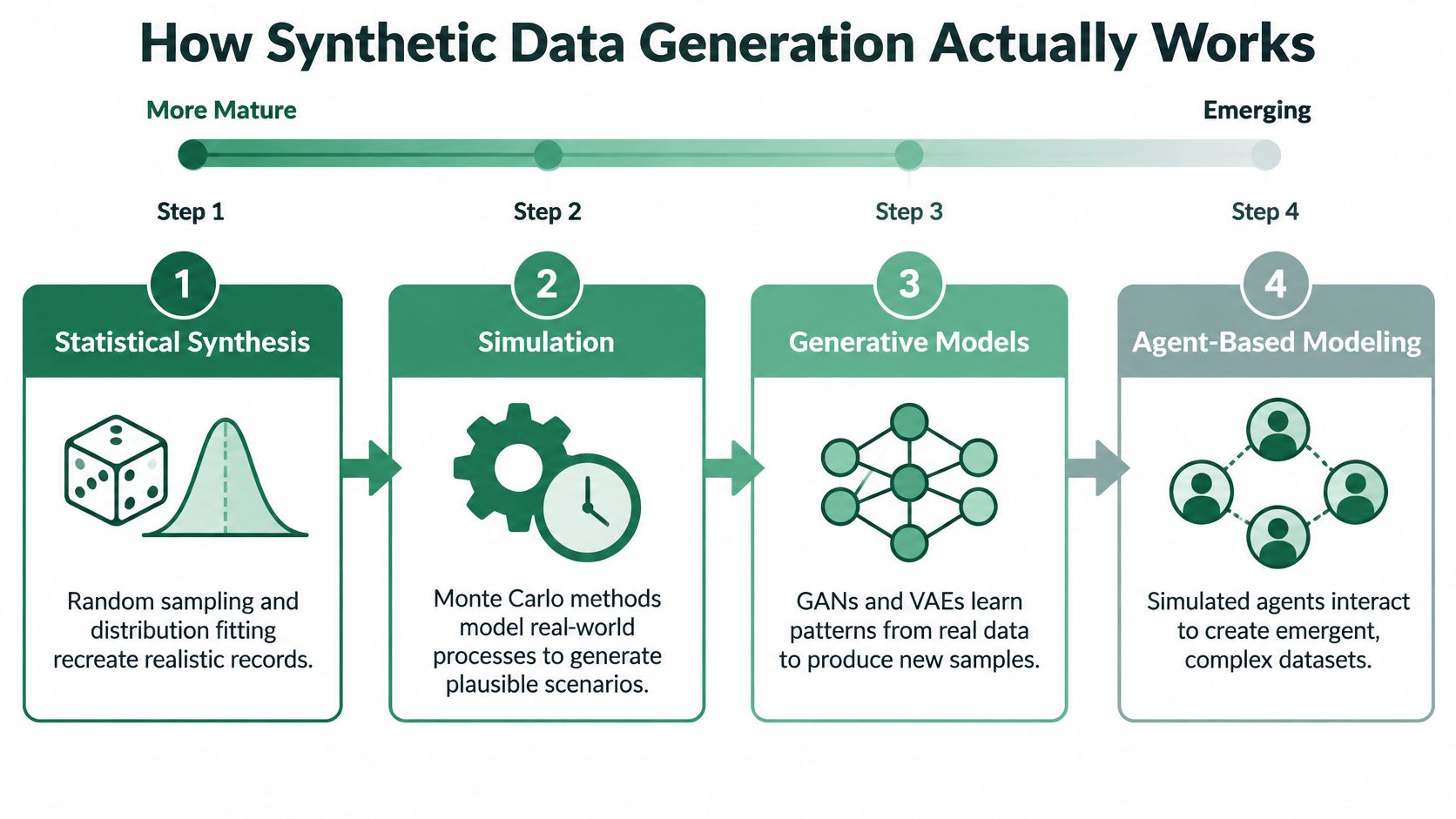
The visual below orders those families by maturity, from explicit statistical models to newer learned generators.
Statistical Synthesis and Simulation Came First
Think of statistical synthesis as a recipe. Analysts estimate distributions and relationships from source data, then draw new records from that fitted model. The U.S. Census Bureau describes confidential data being modeled and then sampled to create artificial records that preserve important statistical relationships, connected to differential privacy, introduced by Dwork and colleagues in 2006.
Simulation works more like a stage set. Engineers define the environment, rules, and actors, then run the system repeatedly to generate scenes or events. Monte Carlo methods developed by Stanislaw Ulam and John von Neumann in the 1940s used repeated random sampling to study complex problems. Later researchers generated artificial geometric scenes for machine perception and simulated roads for autonomous driving research when real driving data was scarce.
Augmentation Expands What You Already Have
Programmatic augmentation applies rules or transformations to existing examples. A team might rotate images, paraphrase text, interpolate minority class examples, or vary known parameters in a transaction generator. It's the least conceptually ambitious family, and often the most practical, because the output stays close to records the team already understands.
The limitation is coverage. Augmentation can recombine and perturb known patterns, but it cannot reliably invent a pattern that is not represented in the source data or encoded in the transformation rules. That distinction matters when leaders expect a small dataset to become exhaustive by making it larger.
This walkthrough shows how a contemporary generation workflow connects source material, generation, and filtering in practice.
Learned Generators Trade Control for Expressiveness
A GAN works like two forgers arguing. One network generates samples and the other tries to distinguish them from real records, pushing the generator toward more plausible output. CTGAN adapts that contest to tabular data, while image GANs learn visual distributions. The results can be convincing, but training instability and mode collapse can narrow the variety of examples produced.
Diffusion models work more like a sculptor starting from noise. They gradually transform random noise into a structured sample by reversing a learned noising process. Foundation models extend the same principle through large pretrained representations, especially for text and increasingly for tabular records. These methods can capture complex, high dimensional patterns, but they give operators less direct control over individual relationships and can memorize source patterns in ways that simpler models don't.
Matching Techniques to Real Workloads
A generator that looks impressive in a demo can still fail the workload it was bought for. The better selection question is which properties the downstream task consumes: accurate counts and joins for reporting, rare edge cases for safety testing, extra volume for class balance, or high dimensional structure for text and images.
| Workload | What must survive generation | Reasonable starting point | Validation burden |
|---|---|---|---|
| Reporting and analytics | Counts, distributions, joins, pairwise relationships | Statistical or marginal based synthesis | Check marginals, breakdowns, and correlations against the source |
| Safety scenarios and rare events | Specified conditions and edge cases | Simulation and Monte Carlo methods | Measure transfer from simulated to real observations |
| Class balance and resistance testing | Representative records in greater volume | Programmatic augmentation | Confirm transformed records add coverage without staying too close to source rows |
| Complex unstructured data | High dimensional relationships | GAN, diffusion, or foundation models | Compare against simpler baselines and test for memorization |
The table sets the starting point. Each row implies a different amount of validation work, and that work should enter the decision before a generator is trained rather than after deployment is already planned.
Statistical and marginal based approaches expose exactly which distributions were modeled, so failures can be explained to analysts instead of discovered inside a black box. For reporting workloads, that transparency is often worth more than expressive power. Simulation fits a different situation: engineers can specify road geometry, weather, sensor behavior, and actor decisions, then produce corner cases on demand. Its limit is scope. A simulator only produces what its designers modeled, so comparison against real distributions stays required even when the synthetic output looks convincing.
Augmentation sits between those poles. When representative data already exists and the gap is volume, balance, or known variation, transforming real records is cheaper to implement and easier to audit than training a deep generator. The privacy limit is equally clear, because transformed rows can remain close to their sources and need separate disclosure testing.
When Deep Generators Earn Their Cost
GAN, diffusion, and foundation model approaches make sense when relationships are too high dimensional to specify by hand. Images, free text, and complex sequences can justify that complexity. Tabular reporting usually cannot, since basic counts and correlations matter more than novel looking rows, and the benchmark evidence covered elsewhere in this article shows why model sophistication alone is a weak reason to choose a generator.
Selection frameworks keep this comparison honest by forcing the choice onto workload characteristics, constraints, and measurable outcomes instead of familiarity. Up North Media's algorithm selection framework offers a useful structure for that evaluation. For synthetic data, extend the usual accuracy and cost criteria with privacy posture and release risk so the winning option survives both validation and deployment.
Measuring Quality Beyond How Real the Data Looks
A synthetic table can look plausible in every column and still break the analysis it was built to support. Ages fall in range, transaction amounts look credible, and categories use the right labels. Then a downstream model fails because the relationship between income and default, or between diagnosis and treatment, didn't survive generation.
Benchmark evidence makes that risk concrete. Marginal based methods consistently outperformed GAN based approaches on one dimensional distributions, pairwise correlations, and downstream classification accuracy in a benchmark of differentially private tabular generators. The same benchmark found GAN based methods often failed to preserve even basic one dimensional statistics. Greater model sophistication didn't guarantee analytical fidelity.
Evaluate in Three Levels
Start with marginal distributions. Compare each variable's distribution in the synthetic dataset against the baseline dataset using appropriate tests for continuous and categorical fields. If a generator can't reproduce basic frequencies, ranges, missingness, and central tendencies, there's little reason to trust more complex claims about it.
Move next to pairwise relationships. Correlations, conditional distributions, cross tabulations, and temporal dependencies reveal whether the generator learned structure or merely produced believable columns independently. Reporting workloads often fail here first, because business questions are usually about segments and relationships rather than isolated fields.
Finish with task specific performance. Train on synthetic data and test on held out real data, commonly called Train-on-Synthetic, Test-on-Real or TSTR. Compare that result with a model trained on real data and tested on the same holdout. The gap tells you what the organization pays, in predictive terms, for using the synthetic substitute.
Aggregate Scores Hide the Failures That Matter
Break TSTR results down by subgroup, rare class, and decision threshold. A generator can preserve overall accuracy while destroying recall for the minority cases that justified synthetic data generation in the first place. Calibration matters too. A risk model can rank cases reasonably while assigning probabilities that lead to poor operational decisions.
Practical rule: Approve a synthetic dataset for a named use case, not in general. A release that's adequate for software testing may be unsafe or analytically useless for model training.
Your evaluation protocol should therefore document the intended task, the holdout, the baseline, and the acceptable performance gap before generation begins. That discipline aligns with broader AI model evaluation practices because the generator is only one component in the system being tested. Quality isn't a global realism score. It's evidence that specific downstream work remains reliable when real records are replaced or supplemented.
The Privacy-Utility Trade-Off You Cannot Ignore
In one membership inference benchmark, Llama 3.3 70B used for tabular synthesis produced a true positive rate up to 54 percentage points higher than the safest deep learning baseline, at a 1% false positive rate. The exposure was worst in low-data settings, which is where teams most often reach for a generalist generator.
None of the standard distance checks flagged it. Common distance-to-closest-record metrics failed to detect privacy leakage that membership inference attacks revealed across Bayesian networks, CTGAN, and diffusion generators. A synthetic dataset can sit at a comfortable gap from every real record and still carry information learned from real people, transactions, patients, or customers. Removing names and account numbers does not settle the question.
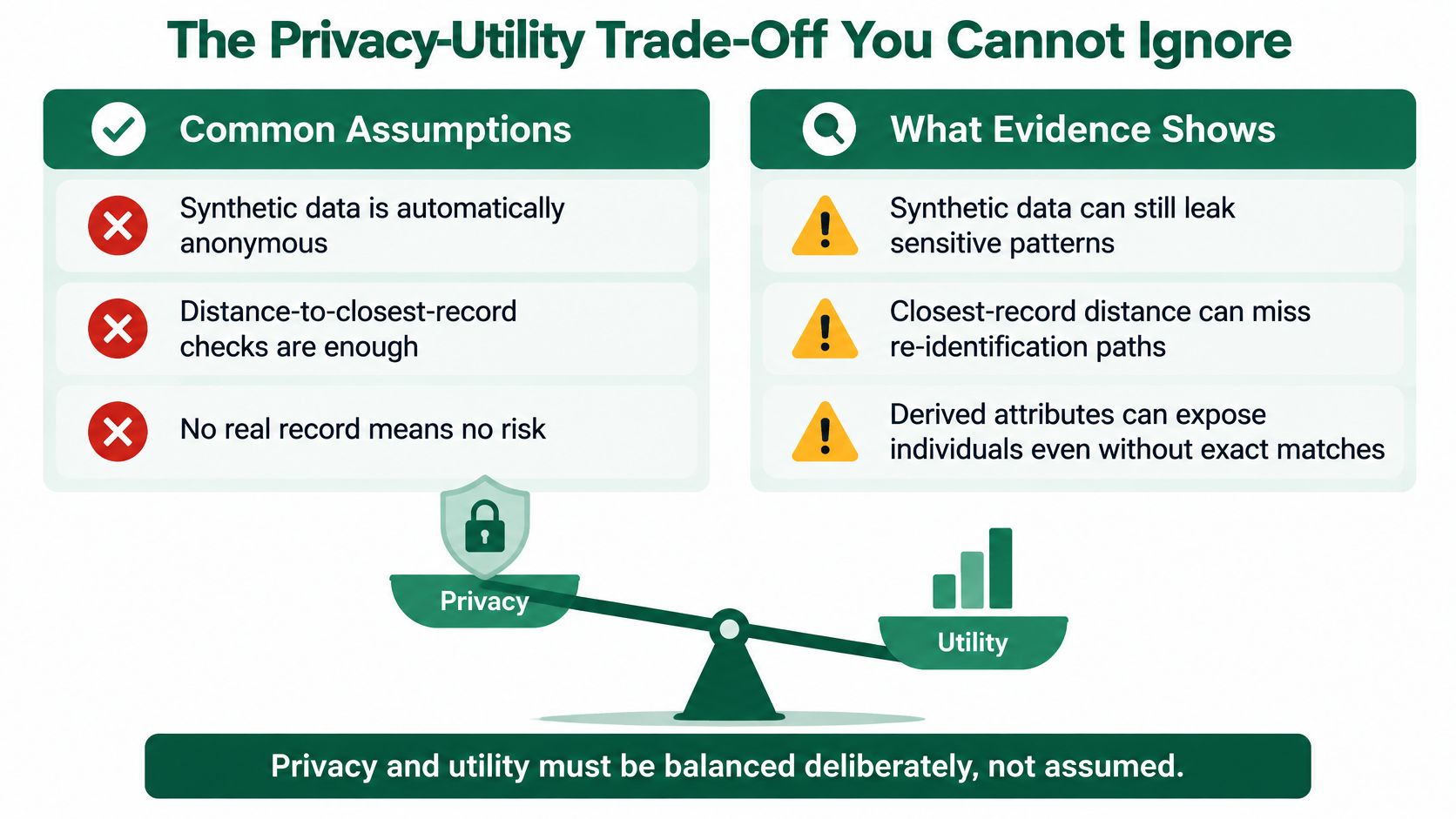
The assumptions behind most releases, the evidence against them, and the validation each one demands break down as follows.
| Release assumption | What attack based evaluations found | Validation before release |
|---|---|---|
| Records far from real ones are safe | Distance metrics missed leakage that membership inference exposed across Bayesian networks, CTGAN, and diffusion generators | Run membership and linkage attacks; keep distance scores as diagnostics only |
| Generalist generators memorize less | Llama 3.3 70B showed the highest membership exposure in the benchmark, concentrated in low-data regimes | Test each generator and each data regime separately |
| Text outputs carry less risk than tables | Attacks using only generated text reached AUC scores of 0.71 on SST-2 and 0.66 on AG News | Extend attack testing beyond structured data |
The same question follows generated assets outside classical tabular releases. Product imagery, customer interactions, and merchandising examples all inherit patterns from source material. A guide for fashion ecommerce brands shows generated models already in commercial use, which makes provenance and source data governance relevant even when every pixel in the output is new.
What a Privacy Guarantee Costs
Differential privacy bounds how much one person's record can influence an output by adding mathematically calibrated randomness. The guarantee is real, and so is the invoice. Under strong privacy constraints of ε ≤ 4, downstream model performance on synthetic text averaged roughly 50% of performance obtained with real data across domain specific datasets. Differentially private CTGAN variants can also collapse during training. Engineers can reduce the injected noise to recover convergence, but each reduction weakens protection against membership inference and linkage.
The release gate therefore runs one connected decision, reported together:
- Record ε and δ with the reasoning behind them, because a budget chosen after the fact only documents a decision already made.
- Monitor convergence through training, since collapse and weak noise can hide behind the same metrics.
- Run the attack suite at the chosen budget and score utility on the task the dataset will serve.
- Reject both failure modes: a dataset that leaks is unsafe, and a dataset that destroys the signal is useless.
When either side fails, the release needs a different method, a narrower dataset, tighter access, or no external release at all. Folding bounded risk and sufficient utility into one reassuring score only hides which side broke.
Validating Disclosure Risk Before Release
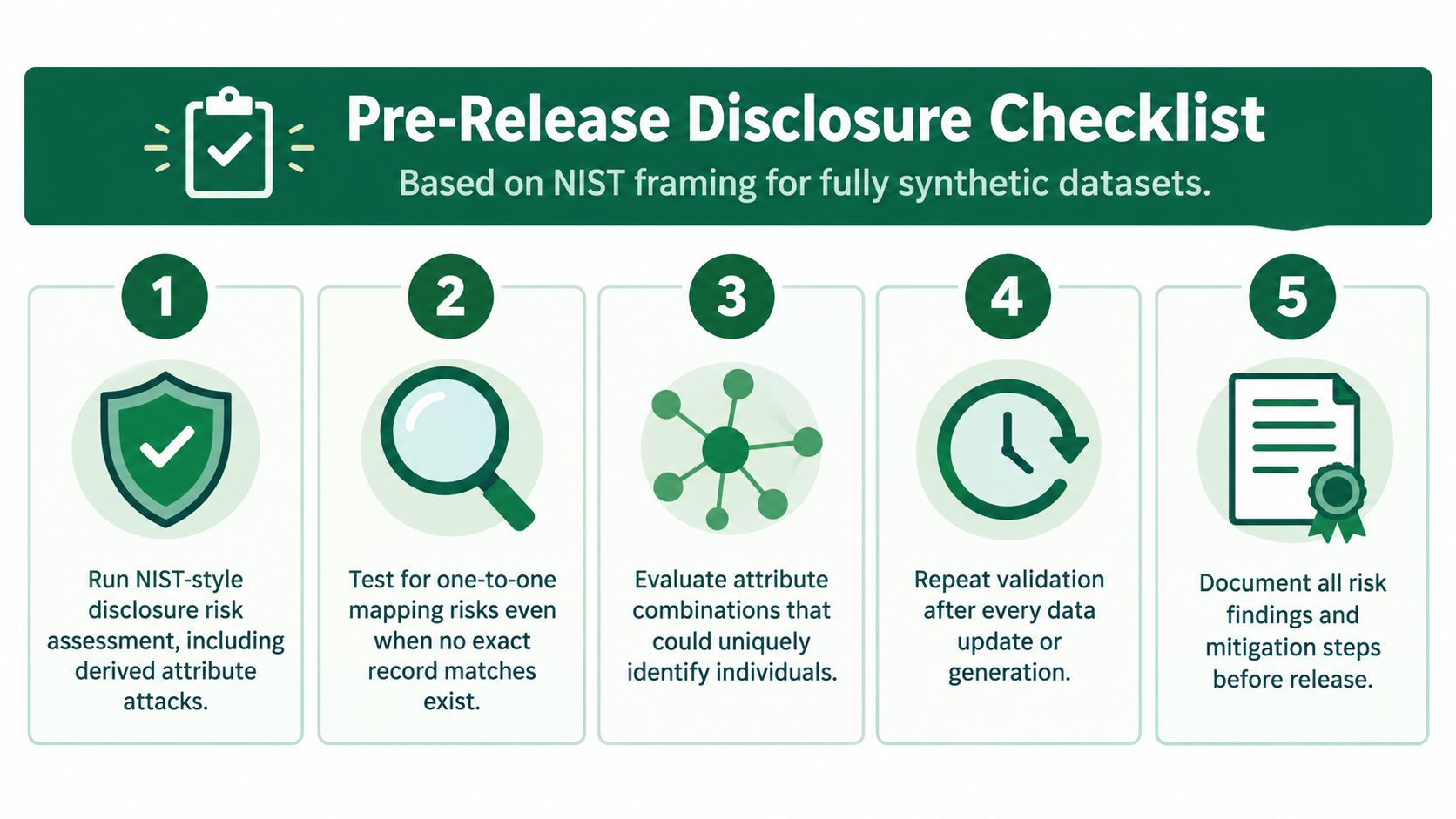
NIST defines a fully synthetic dataset as one with no one-to-one mapping between original and released records. That definition doesn't make the release safe by construction. The dataset can still disclose information derived from real individuals, especially when a generator preserves rare combinations too faithfully.
Use the checklist below as the structure for a documented pre release review.
Run Three Operational Tests
First, compare unique combinations of key variables in the synthetic dataset against unique combinations in the source data. A synthetic record that's unique and matches a unique real record can create perceived or actual disclosure risk, even though it was algorithmically generated. Pay special attention to geography, dates, demographics, rare diagnoses, job titles, and other quasi identifiers that become identifying in combination.
Second, run membership inference and attribute inference attacks. Membership inference asks whether an adversary can tell that a particular record was in the training data. Attribute inference asks whether generated data helps reveal a sensitive field about a known individual. Test both under realistic assumptions about what external information an attacker could possess.
Third, stress test linkage and rare record exposure. Join synthetic records against plausible external datasets using shared variables, then inspect whether unusual cases become easier to isolate. This test matters for operational data because customers, suppliers, facilities, and devices can be identifiable through patterns even when direct identifiers are absent.
Release Size Is a Privacy Decision
Publishing more rows gives attackers more generated evidence about the source distribution. Packet trace research reported that sharing more synthetic data increased measured leakage by 59% on average, while differential privacy either failed to block attacks or sharply reduced fidelity in that setting. Bigger isn't automatically better for utility once marginal analytical gains are weighed against greater exposure.
Document the threat model, attacker capabilities, external linkage assumptions, attack results, release size, and approved audience. Define re evaluation triggers such as regeneration, new source data, broader distribution, or a change in intended use. Those artifacts belong inside a broader AI risk management framework, not in an analyst's notebook that disappears after launch.
Release approval should name an accountable owner. If nobody can explain who is authorized to accept residual disclosure risk, the dataset isn't ready for release, regardless of how strong its utility metrics look.
Engineering Synthetic Data into MLOps Pipelines
A model retrains on Monday and its fraud recall drops. The generator team changed nothing that week, the source snapshot looks identical, and the privacy parameters match the last approved release. Without lineage, that investigation can run for days before anyone notices the training set was regenerated from a different seed. A dataset stops being a notebook experiment the moment other teams train models, build reports, or test software against it, and from that point it needs versioning, lineage, validation, and retirement rules like any other dependency.
Every release should carry the generator version, code revision, source data snapshot, random seed, configuration, and privacy parameters. Record which fields were modeled, which were excluded, and whether formal privacy methods were used. NIST notes that synthetic datasets generated without formal privacy models such as differential privacy may be vulnerable to privacy attacks and recommends differentially private algorithms as a safeguard. That record does double duty. When a downstream metric shifts, engineers can separate source drift from a generator update, a new privacy budget, or a sampling decision, instead of debugging a model when the actual change happened in its training data.
Promotion should run through automated gates rather than a review meeting. Three checks belong in the pipeline, each with defined thresholds and a failure response:
| Gate | What it checks | What happens on failure |
|---|---|---|
| Utility | Marginals, pairwise relationships, and TSTR against a protected real holdout | Block promotion, retrain or resample |
| Distribution of harm | Subgroup and rare class results against approved thresholds | Block or route back for reweighting |
| Disclosure | Membership inference, attribute inference, uniqueness, and linkage tests | Block, reduce release size, or add formal privacy |
A dataset cannot pass on utility while skipping privacy review, because all three gates sit inside the same promotion step.
Monitoring continues after release. Population changes, product launches, policy updates, and sensor changes can make an older synthetic dataset misleading even if it was valid when generated. Define the drift signals that trigger regeneration, and separate those from the conditions that demand a full privacy re assessment rather than a routine refresh.
Ownership should be explicit across data engineering, modeling, privacy, and product teams. The generator owner maintains the method, the data owner approves source use, and the release owner accepts residual risk for a stated purpose. That separation fits naturally into an enterprise AI architecture where synthetic datasets are governed artifacts rather than informal extracts shared between teams.
If a synthetic dataset can't be reproduced, audited, and retired, it shouldn't become a training dependency.
Practical Applications and a Decision Checklist
Fraud analytics shows why skew must be measured before synthesis. One reviewed fraud dataset contains 6,362,620 transactions, including only 8,213 fraudulent transactions, or about 774 legitimate transactions for every fraudulent one. Generating minority class examples may help, but overall accuracy can hide poor fraud recall, so evaluation has to focus on the rare class.
Autonomous driving shows why volume alone isn't value. Curriculum learning improved performance over a vanilla Deep-Q Learning approach, while replay buffers were detrimental in most tested combinations in a peer reviewed study of synthetic scenarios. How examples are sequenced and sampled can matter more than how many scenes a simulator produces. Similar discipline applies when a retail team uses a Price monitoring app and needs synthetic test cases that reflect real pricing patterns without exposing sensitive commercial logic.
Before approving a synthetic data generation project, confirm the workload, generator family, evaluation metrics, privacy budget, attack tests, release size, lineage, governance owner, and re evaluation triggers. If any item is undefined, you're not making an engineering decision yet. You're hoping realism will substitute for evidence.
Create an account with Applied to explore its library of AI use cases, tools organized by industry, business function, and measurable outcome. Compare how organizations in finance, retail, healthcare, tech, manufacturing, and media document synthetic data and broader AI deployments, then use those verified examples to benchmark your own roadmap. Subscribe to keep access to new cases and research as your team moves from evaluation to implementation.