AI Recommendation Engines: How They Actually Work in 2026
Learn how AI recommendation engines work in 2026, from collaborative filtering and deep learning to cold-start fixes, evaluation metrics, and real ROI.
October 15, 2026
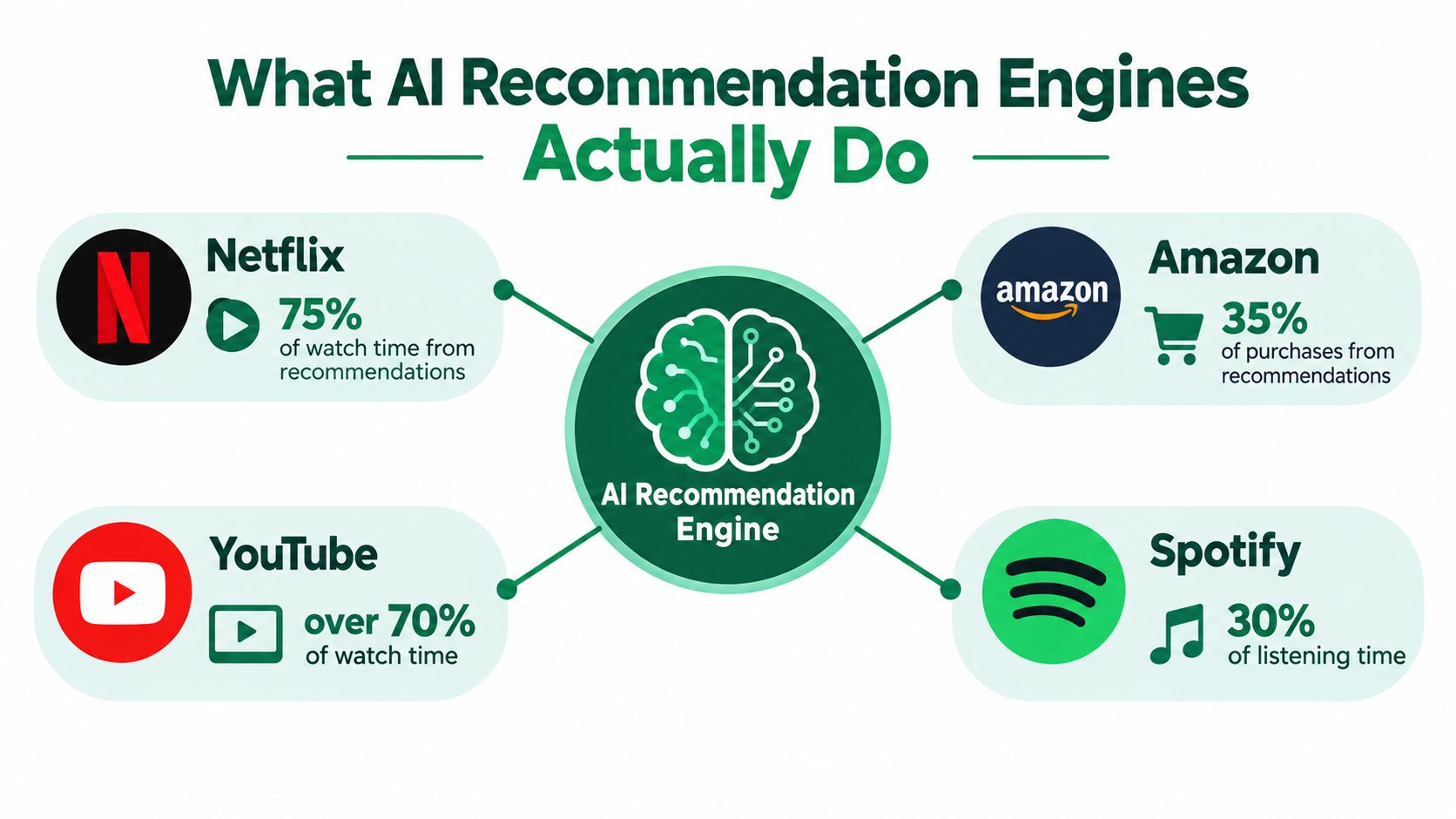
Approximately 75% of the content viewed on Netflix is algorithmically recommended, while the corresponding figure for Amazon is 35% of pages visited, according to the Oxford Review of Economic Policy. That should change how you think about AI recommendation engines. They aren't decorative personalization layers. They increasingly decide what users notice, compare, watch, buy, and return to.
The hard part in 2026 isn't choosing the most fashionable model. It's deciding which signals deserve trust, where an LLM belongs in the serving path, how the system behaves with no history, and which metrics predict durable business value instead of short-lived clicks. A recommender that ranks brilliantly in a notebook but misses its latency target, overexposes a narrow part of the catalog, or gives users no meaningful control isn't production-ready.
Table of Contents
- What AI Recommendation Engines Actually Do
- From Information Filtering to the Netflix Prize
- The Five Algorithm Families and When Each One Wins
- The Two-Stage Architecture That Actually Ships
- Cold Start Is the Evidence Problem Before the Ranking Problem
- Evaluating Beyond Accuracy With Latency and A/B Tests
- Trust, Fairness, and Privacy in AI Recommendations
- A 90-Day Launch Plan and Where to See Real Builds
What AI Recommendation Engines Actually Do
An AI recommendation engine takes information about a user, a catalog, and the current situation, then returns an ordered shortlist. In practical terms, it answers a constrained question: which items should this person see next, and in what order?
The scale of that decision is easy to underestimate. Netflix has estimated that around 75% of viewed content is recommended by its algorithms, while research cited in the Oxford review puts Amazon's figure at 35% of pages visited. Those figures describe different journeys, but they point to the same operational reality. Recommendation systems sit inside the main path through a digital product.
The three input layers
Most systems combine three kinds of signals:
- User behavior: clicks, purchases, skips, saves, completion, repeat visits, ratings, and sequence order. These signals reveal interest, but they don't all mean the same thing. A quick click can indicate curiosity, while a completed purchase or repeated use usually carries stronger intent.
- Item attributes: categories, text, images, price, creator, brand, availability, and other metadata. These features let a system reason about items that have little or no interaction history.
- Context: device, session activity, time, location, channel, inventory state, and business constraints. Context prevents a long-term profile from overwhelming what the user appears to want right now.
The output is a ranked list. Each candidate receives a score, and the serving layer applies eligibility rules, diversity constraints, business policies, and sometimes controlled exploration before displaying the final results.
Recommendation isn't the same as search. Search starts with an explicit query and tries to satisfy it. Recommendation starts with inferred intent, often before the user has formulated a request. It also isn't the same as editorial curation. Editors can select items for cultural, commercial, or strategic reasons, while a model estimates what is likely to be relevant for a particular context. Many mature products combine both.
Teams often start by thinking about recommendation as a feature. In practice, it replaces a large amount of manual merchandising. That makes catalog quality, event instrumentation, feature freshness, serving reliability, and governance just as important as model selection. For a clear non-technical overview of the components, Tagada's recommendation engine guide is a useful companion.
From Information Filtering to the Netflix Prize
The core idea behind recommendation engines predates modern machine learning. In the 1960s, researchers discussed selective dissemination of information, a way to filter large streams according to an individual's interests. In 1987, Information Lens proposed a personal email-processing system that used user-defined interests to help manage incoming messages. The problem was already recognizable: too much information, too little attention.
The field then developed across information retrieval, machine learning, human-computer interaction, marketing, and physics. Early systems relied heavily on rules, profiles, and explicit preferences. Those approaches could work, but they struggled to infer subtle patterns from large volumes of implicit behavior.
The moment recommendation became measurable
Netflix changed the field's trajectory in 2006 when it launched the Netflix Prize. The company released a training dataset containing 100 million real customer ratings and offered a $1 million prize to the first team that could improve its internal algorithm by 10% on root mean square error, a standard prediction metric. More than 5,000 teams registered, and Netflix awarded the prize in 2009. These facts are documented in the Communications of the ACM history of recommender systems.
The competition mattered because it turned personalization into an explicit prediction problem. Teams could compare methods, measure error, and improve a defined objective instead of arguing only about editorial taste. Matrix factorization and ensemble learning became important techniques for large-scale recommendation, particularly when the system had many users, many items, and a rich interaction matrix.
The practical lesson still holds. Modern systems didn't replace earlier filtering ideas overnight. They layered behavioral data, statistical estimation, representation learning, ranking models, and product constraints on top of them. That history explains why a dependable recommender is rarely just one model. It's a pipeline that turns incomplete evidence into a decision under time and business constraints.
The Five Algorithm Families and When Each One Wins
Algorithm choice should follow the data and serving requirements, not the other way around. A model with weak signals usually loses to a simpler model with reliable events, fresh features, and a well-designed evaluation loop.
| Algorithm family | Data it needs | Biggest failure mode | When it earns its complexity |
|---|---|---|---|
| Collaborative filtering | User-item interactions, ratings, clicks, purchases | Cold start and sparse users or items | Warm users and catalogs with dense behavioral history |
| Content-based filtering | Item metadata, text, images, categories | Narrow recommendations and weak discovery | New items, sparse behavior, or explainable similarity |
| Hybrid systems | Interactions plus content and context | Feature integration and calibration complexity | Most production environments with mixed signal quality |
| Deep learning models | Rich sequences, context, embeddings, and substantial training data | Operational cost, drift, and hard-to-debug behavior | Sequential intent and high-volume systems where context matters |
| Graph-based recommenders | User, item, creator, supplier, and relationship edges | Expensive graph construction and serving | Marketplaces, social products, and many-to-many catalogs |
Collaborative filtering
Collaborative filtering learns from what similar users did or what items were consumed together. It remains a strong default for warm users because the interaction graph captures preference patterns that metadata often misses. Its weakness is obvious when a new customer arrives or a new product has no interactions.
Content-based filtering
Content-based systems compare item characteristics with a user's observed interests. They can recommend a new article, product, or document as soon as its metadata is available. They also tend to over-specialize. If a user interacted with one narrow topic, the system may keep returning close variants and fail to create useful discovery.
Hybrid systems
Hybrid recommenders combine behavioral, content, and contextual signals. In production, this is usually the sensible answer because each signal covers another's blind spot. Content features support cold start, collaborative signals capture taste, and context handles the current session.
Deep models earn their cost when the order and timing of events matter. A sequence model can distinguish a user's long-term preference from a short-lived session intent, but training and serving become harder to inspect. Graph approaches are valuable when the product is naturally relational, such as a marketplace connecting buyers, products, sellers, categories, and creators.
Practical rule: Choose the simplest family that meets the required relevance, coverage, explainability, and latency targets. Add complexity only when an experiment shows what the simpler system cannot capture.
For teams building vector retrieval, Pinecone's tool page can help clarify where a managed vector layer fits, but a vector database isn't a recommender by itself. You still need event definitions, candidate policies, ranking logic, evaluation, and operational ownership.
The Two-Stage Architecture That Actually Ships
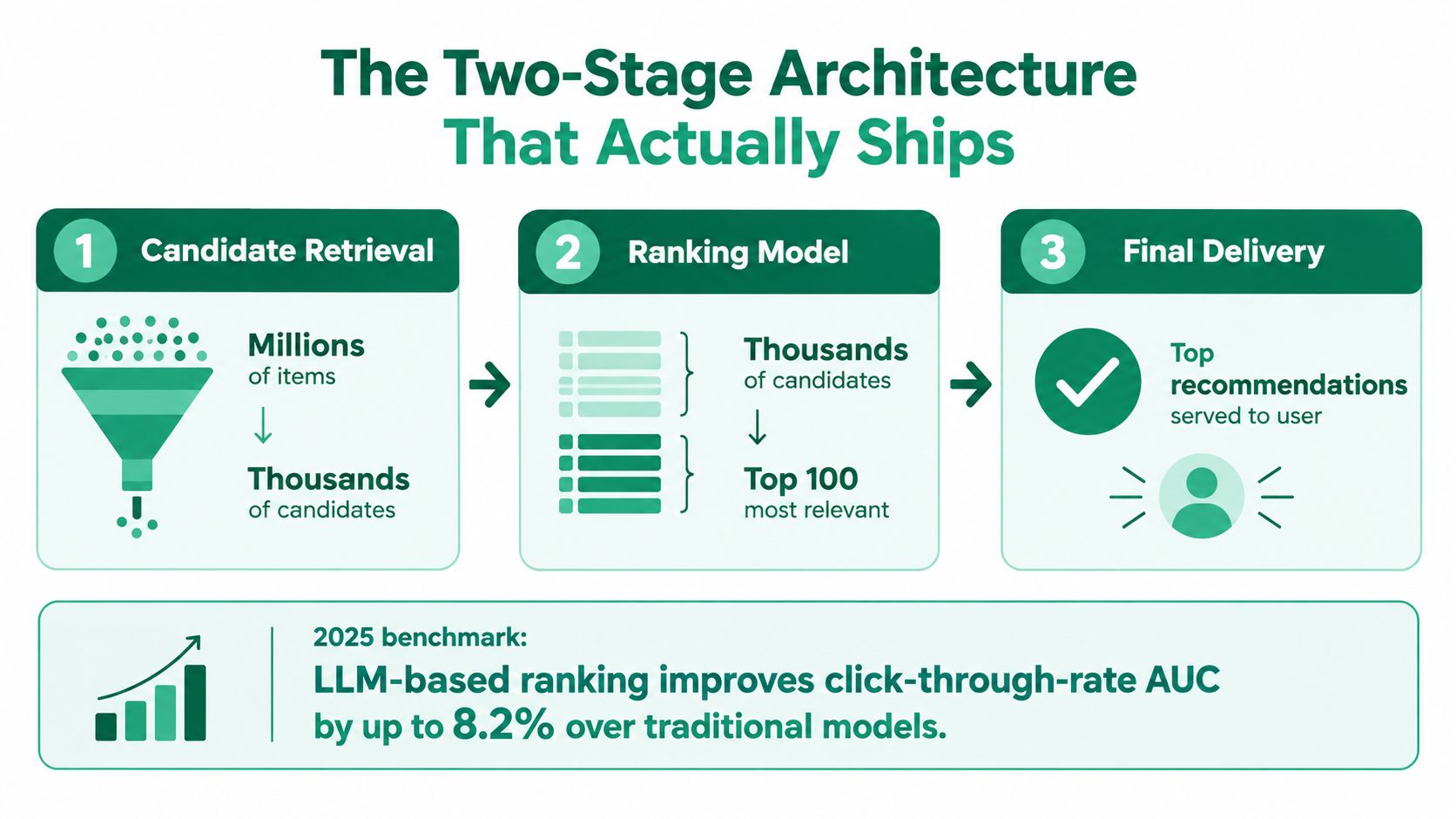
Production recommenders usually separate candidate retrieval from ranking. Retrieval reduces a large catalog to a workable set using embeddings, approximate nearest-neighbor search, collaborative methods, popularity, business rules, or several channels together. A ranking model then scores those candidates with richer features, such as recent behavior, item quality, context, and business constraints.
This split is mainly an engineering decision. Detailed ranking features are affordable across a small pool, while applying an expensive model to every catalog item on every request can exceed latency and infrastructure budgets. It also makes failures easier to isolate: retrieval controls coverage, and ranking controls ordering.
Where LLMs fit
LLMs can improve semantic understanding and sequence modeling, but their serving cost changes the design. A 2025 benchmark comparison found improvements in click-through-rate AUC of up to 5% and sequential-recommendation NDCG@10 of up to 170% over conventional systems. Inference was approximately 1,000 to 3,000 times slower than deep-learning recommendation models.
That gap makes an LLM in every online request a poor default for high-volume products. Response-time variance, hardware cost, queueing, and failure recovery all affect the user experience. The useful question is where language understanding removes enough uncertainty to justify those costs.
Practical placements include:
- Offline enrichment: extract topics, attributes, entities, or summaries before new items enter retrieval.
- Cold-start representation: describe a product or document before interaction history exists.
- Small-pool reranking: apply deeper reasoning to selected candidates rather than the whole catalog.
- Explanation generation: produce a reason that matches the ranking features used.
- Feature creation: convert unstructured text into signals a conventional ranker can serve quickly.
The same comparison found that hybrid systems retained roughly 95% of standalone-LLM accuracy while keeping the speed profile of traditional recommenders. Retrieve, rank, and selectively explain is therefore a more practical production boundary than replacing the stack with a generative model.
Cold Start Is the Evidence Problem Before the Ranking Problem
A recommender with no behavioral history has an evidence problem before it has a ranking problem. New users, products, mobile applications, and enterprise workflows may lack the interactions that collaborative methods need, so even a capable ranker can still make poorly grounded choices.
Research defines cold start as the difficulty of producing reliable recommendations when users or items have little historical interaction. A 2025 study presents active learning as a way to request a small number of carefully chosen ratings. A separate survey found that cold-start research has concentrated heavily on entertainment datasets, with less attention to mobile applications, education, and academia. The CODIT 2025 paper provides that context.
The first production decision is which signal can arrive soon enough to matter.
- Onboarding questions: Use a short preference picker when deliberate setup is acceptable. Ask about categories, goals, or constraints that can change ranking, rather than trivia.
- Contextual signals: Use device, time, location, workflow stage, or current-session behavior when immediate intent matters more than a historical profile.
- Content metadata: Start with descriptions, categories, entities, images, and structured attributes when the catalog is rich but interaction history is thin.
- Active learning: Request feedback when each response has high information value. A carefully selected question can teach the system more than a long passive session.
- Privacy-preserving profiles: Retain signals users understand and the product can justify. Sensitive environments need a clear boundary between personalization and unnecessary surveillance.
- Human-curated defaults: Offer transparent collections, popular starting points, or role-based defaults when trust matters more than individual precision.
A new enterprise user may respond better to clear role-based starting options than to an uncanny profile inferred from a few actions. A new mobile app can combine context and onboarding while event history accumulates. More personalization is not automatically the right first move.
A few high-value questions, or transparent defaults, often outperform premature model complexity when data is sparse.
Evaluate cold-start performance separately from warm-user results. Track first-session relevance, time to a useful recommendation, opt-out behavior, and outcomes for new users. Aggregate metrics can hide a weak first experience, precisely when the product must establish enough relevance for the user to continue.
Evaluating Beyond Accuracy With Latency and A/B Tests
Offline accuracy is a filter, not a deployment decision. A model may improve NDCG while worsening tail latency, narrowing catalog exposure, or surfacing items users ignore. Production evaluation must connect ranking quality to response time and a business outcome.
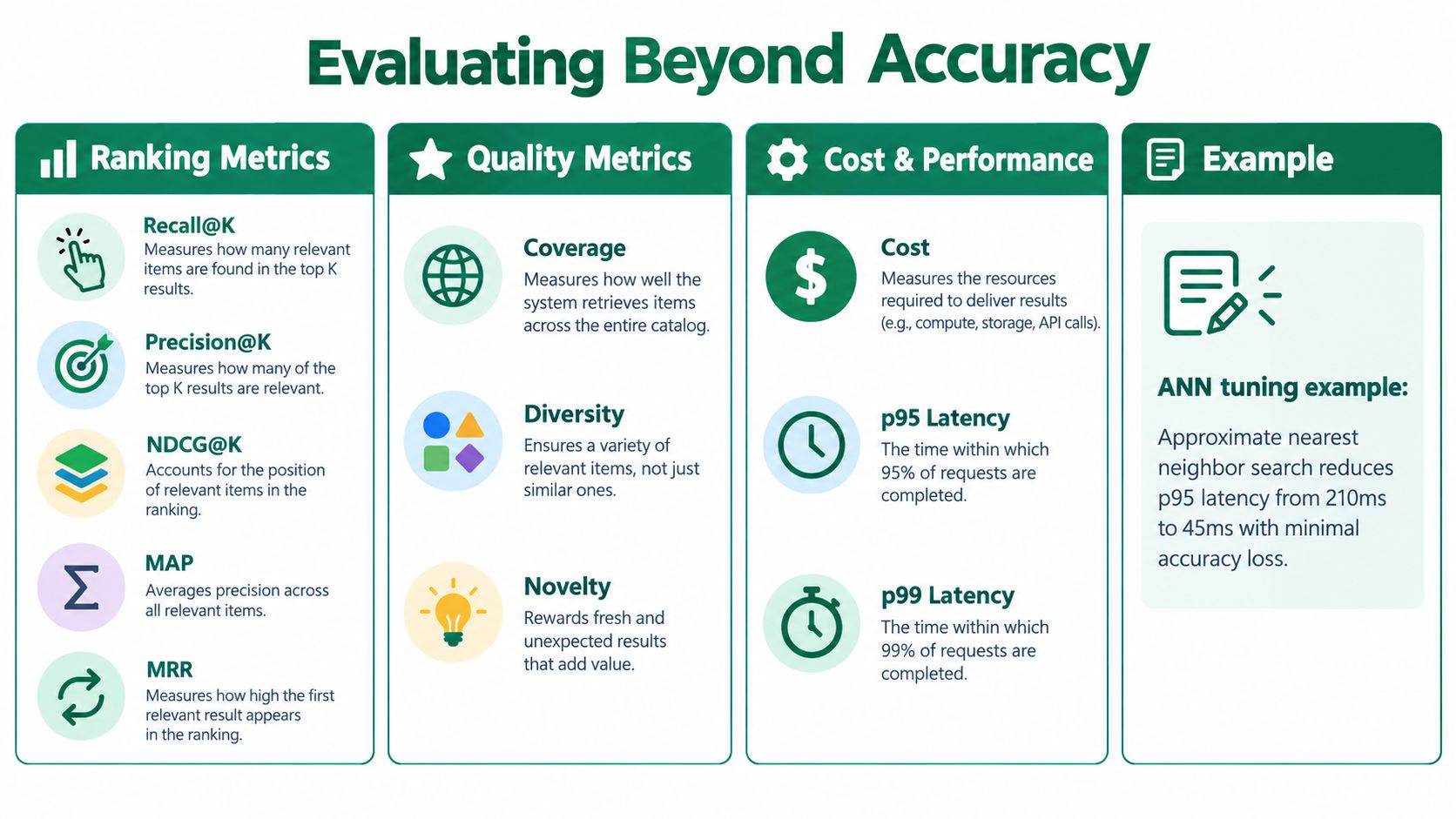
Start with Recall@K, Precision@K, NDCG@K, MAP, and MRR. Add coverage, diversity, novelty, cost, and p95 and p99 latency. These measures expose different failure modes: recall checks whether relevant items reached the candidate set, NDCG checks their order, coverage measures catalog exposure, and tail latency captures the slowest requests users experience.
Tune the system as a budget
An approximate-nearest-neighbor configuration with nprobe=8 achieved Recall@100 of 0.890 at 18 ms p95 latency in a large-scale sequential e-commerce study. The full model reached 97 ms p95, compared with 86 ms for SASRec, 93 ms for GRU4Rec, and 158 ms for BERT4Rec, as reported in the sequential recommendation evaluation.
These figures are examples of a trade-off, not universal targets. More search effort can recover relevant candidates, but it consumes time needed for feature retrieval and ranking. An offline recall gain has limited value if the service misses its latency objective. A slightly less accurate model that responds consistently may produce better results.
Set the operating rules before tuning:
- Define a latency SLO: Establish the response-time boundary first.
- Plot recall against ANN effort: Increase search work until added retrieval quality no longer justifies its cost.
- Separate offline and online results: Treat ranking gains as hypotheses for an experiment.
- Add a business guardrail: Track clicks with conversion, retention, margin, task completion, or another product outcome.
- Inspect catalog exposure: Check whether recommendations concentrate attention or suppress useful long-tail inventory.
Offline nDCG does not guarantee more clicks, conversions, retention, or marketplace diversity. Run an online A/B test, measure the primary outcome and guardrails, and account for feedback loops because changed user behavior becomes future training data. A recommendation engine earns its place through reliable service and measurable value, not a leaderboard score.
Trust, Fairness, and Privacy in AI Recommendations
Recommendation quality isn't only about predicting what a user may click. It also includes whether the system can explain its choices, respect user controls, protect sensitive data, and distribute exposure responsibly.
Recent research on AI personalization identifies interpretability, privacy, and algorithmic bias as persistent concerns. LLM-based recommenders add risks such as hallucination, bias, and inefficiency, while the European Parliament describes overlapping transparency obligations under the AI Act, Digital Services Act, and Digital Markets Act for relevant recommender contexts. Leaders evaluating these systems should also consider the practical reasons for AI skepticism, particularly when users can't tell why a result appeared.
Fairness has two directions
Inter-user fairness asks whether the system treats users or demographic groups equitably. Inter-item fairness asks whether products, creators, suppliers, or content items receive equitable exposure. A system can serve each individual accurately while consistently underexposing a particular group of sellers or creators.
Privacy introduces another trade-off. A threshold policy can give items above a preference threshold a high recommendation probability while showing lower-ranked items with lower probability, adding controlled randomness. Differential-privacy constraints reduce the risk of exposing personal information, but research reports that stronger privacy protection can reduce consumer surplus when prices are fixed because matches become weaker. Privacy isn't a checkbox. It's a product and optimization choice with measurable consequences.
Differentially private collaborative filtering can also produce disparate impact when engagement levels differ across user groups. A study of the DP-Fair approach, evaluated on Amazon datasets and Etsy user-history logs, reported better combined accuracy and group fairness than vanilla differentially private stochastic gradient descent across shallow and deep recommendation models.
A recommendation that maximizes short-term engagement can destroy long-term value if it narrows exposure, promotes unsuitable content, or can't explain its selection.
Audit explanations against actual model features rather than generating plausible stories after the fact. Expose controls such as “why this,” diversity preferences, and suppression or override options. Track relevance alongside novelty, coverage, complaint and override rates, fairness measures, explanation faithfulness, retention, and task completion. The AI trust and safety guidance offers a broader governance lens for these controls.
A 90-Day Launch Plan and Where to See Real Builds
A practical launch starts with measurement, not model shopping.
During the first month, define the catalog, the eligible item rules, the user signal, the event taxonomy, and the latency SLO. Instrument Recall@K and p95 latency, then stand up an A/B harness with a business-level guardrail.
During the second month, ship a baseline collaborative or two-tower retrieval system behind a thin API. Tune approximate-nearest-neighbor parameters against recall curves, cache what can be cached, and gate every ranking change behind an experiment. The Pinterest recommendation implementation is a useful example of why serving architecture matters at scale.
During the third month, address cold start, fairness, privacy, and explanation quality. Add LLMs only where they improve item understanding, feature enrichment, reranking, or explanations without putting the entire online path at risk.
A credible launch document should state what the system recommends, which users it serves, what it refuses to recommend, how latency is protected, and which result would make the team roll back. That discipline matters more than a fashionable model name.
Applied helps teams study verified AI use cases, tools by industry and business function, and measurable outcomes from real implementations. Visit Applied to explore practical examples and find patterns you can adapt to your own recommendation-engine roadmap.