How to Build an Effective Communications Strategy
A practical effective communications strategy: map stakeholders, set one behavior each, run a manager cadence, and measure adoption on AI rollouts.
October 29, 2026
An announcement doesn't change behavior. It tells people something happened, then leaves managers to improvise answers, frontline teams to guess what changed for them, and leaders to wonder why adoption stalls. An effective communications strategy works differently. It's an operating system that segments audiences, names one behavior per group, separates facts from unknowns, and measures whether people acted. For AI rollouts especially, enthusiasm without evidence backfires. People need verifiable limits, a human review rule, and a manager who can translate the update into this week's work.
Table of Contents
- The Five Stage Loop That Replaces a Launch Memo
- Stakeholder Segments and One Behavior Each
- How to Build the Strategy Before Any Announcement
- Manager Cadence from Briefing Kit to Live Questions
- A Dashboard for Adoption Not Activity
- When AI Trust Lags the Rollout
- Pick a Proof Point Before the Next Briefing
The Five Stage Loop That Replaces a Launch Memo
Respondents at companies where senior managers communicated openly and across the organization about a transformation's progress were 8.0 times more likely to report that the transformation had succeeded, and continuous communication from senior managers made success 12.4 times more likely for enterprise-wide transformations, according to McKinsey's work on culture and change. That's correlational, not proof that communication alone causes success. The scale still tells you how to design the work.
Three rules follow. Communication stays continuous after launch, not a single memo. Senior leaders speak across boundaries instead of leaving the whole job to corporate communications. Progress numbers sit next to the original vision, so people can see whether the initiative is moving and how their work contributes.
The loop you complete before writing copy
Don't start with wording. Start with structure, because most failed messages were well written for the wrong audience, the wrong behavior, or no measurable outcome at all.
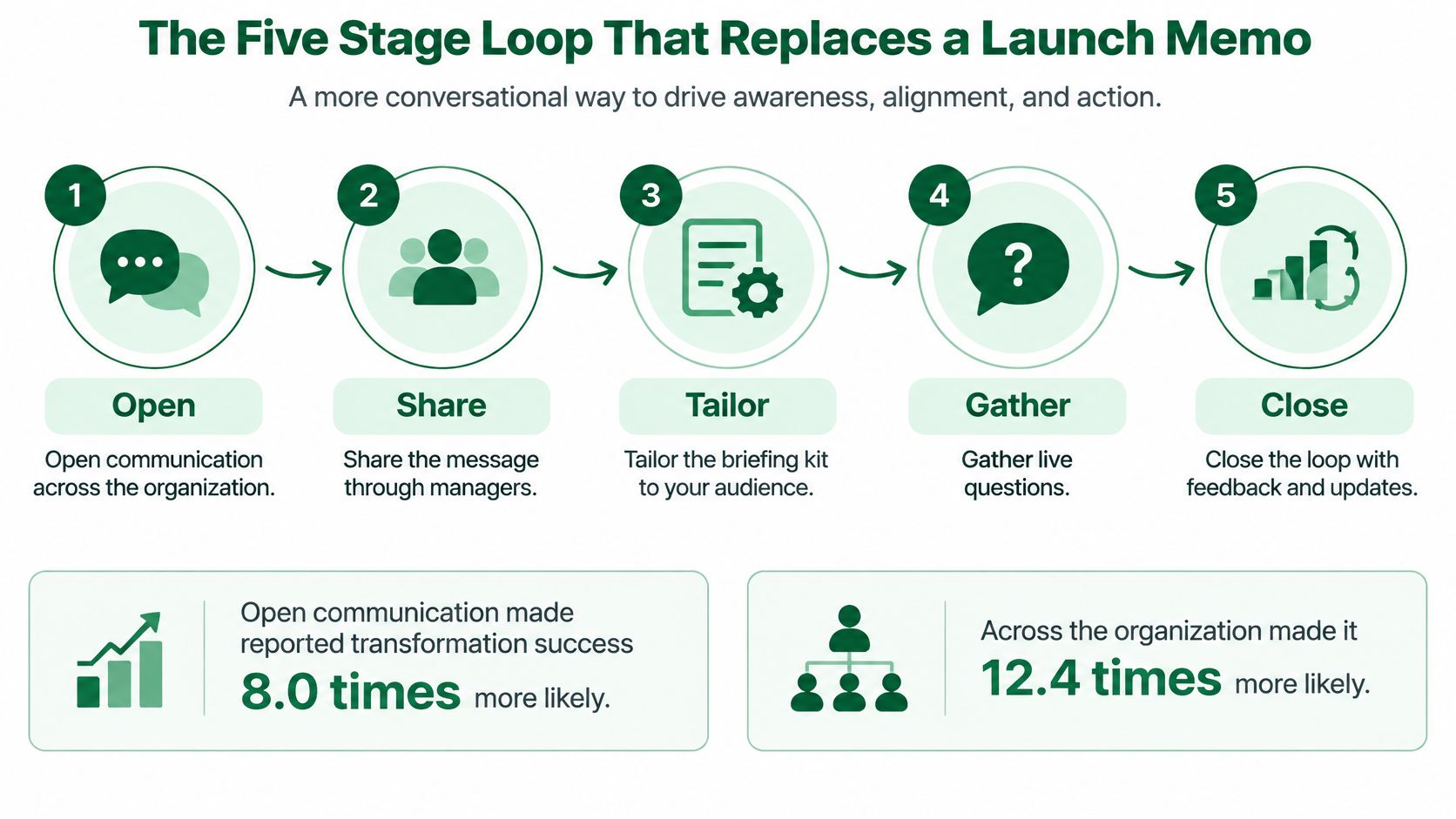
Five stages of an effective communications strategy
| Stage | Output | Owner | Done when |
|---|---|---|---|
| 1 Segment | Authority, information need, resistance | Program lead with HR or change | Every affected role is on one map |
| 2 Behavior | One observable action per segment | Function owner | The action can be counted, not just recalled |
| 3 Message | Core claim, evidence, owner, call to action, escalation | Executive narrator | Unknowns are listed separately from facts |
| 4 Channels | Cadence, manager cascade, single source of truth | Comms lead plus direct managers | No segment relies on a single channel |
| 5 Measure | Reach plus behavior versus a baseline | Analytics owner with the sponsor | Weekly revision changes copy or the rollout |
Stage one forces a hard question. Who can fund, block, execute, or route around this change? Segment by decision authority, information need, and likely resistance, not by org chart alone. Stage two is where most plans get vague. I would reject any behavior you can't observe, such as "engage with AI" or "be aware of the new process." Accept, verify, escalate, approve, and publish are behaviors. Awareness isn't.
Stage three locks the message architecture. One core claim, the evidence behind it, a named owner, a clear call to action, and an escalation path when the claim doesn't match reality. Stage four pairs channels so no segment hears the story only once, and stage five compares reach and behavior against a baseline you've already recorded.
The anti-pattern to avoid
The common alternative is one all-hands, a principles page, and an open-rate dashboard. It looks organized and proves almost nothing. People attended, the deck was polished, and nobody can say what they should do differently on Monday or who owns the risk when the tool is wrong.
Draft all five stage outputs on one page before you write a sentence of launch copy. If a cell is empty, you're not looking at a writing problem. You're looking at a missing decision, a missing owner, or a missing measure, and copy won't fix any of those.
Stakeholder Segments and One Behavior Each
One memo to everyone guarantees the wrong message for most readers. Executives don't need a feature tour, frontline operators don't need portfolio theory, and risk teams don't need launch enthusiasm. Each segment gets one behavior, one message focus, and one named owner so cascade doesn't mean everyone and no one.
Message architecture by stakeholder segment
| Segment | Power | One behavior | Message focus | Owner |
|---|---|---|---|---|
| Executive sponsors | Fund and unblock | Restate progress monthly in their own words | Avoided cost and who owns risk | Function leader |
| Line managers | Staffing and local rules | State this week's change and what is unknown | When to use AI, when to verify, permission to dissent | Direct manager |
| Frontline operators | Daily execution | Do the new step or escalate the exception | Role impact and how feedback changes rollout | Supervisor plus FAQ |
| Engineers and data teams | Build and review | Publish limits, errors, and human review | Evidence trail and accountability | Tech lead |
| Risk, legal, works council | Constraints | Approve data-use language before wider send | What data is used and what is excluded | Named spokesperson |
| External users if affected | Trust and recourse | Read a plain disclosure | What the system decides and what a person decides | Product or comms |
How one initiative splits six ways
Say you're rolling out a customer-operations copilot. Sponsors hear about handle time and leakage, plus the cost already avoided and the person who owns residual risk. Their behavior isn't to applaud the demo. It's to restate progress monthly in their own words, which forces them to understand it.
Supervisors hear which queue steps are now suggested versus mandatory. Agents hear when to accept a draft and when to rewrite it, and exactly how their feedback can change the rollout rather than disappear into a form. Security hears log retention and what's excluded from the tool entirely. Same initiative, six different jobs, and treating them as one audience is how agents end up hearing sponsor language while sponsors never hear about the exception queue.
Engineers and data teams carry a specific burden here. Their behavior is to publish limitations, error handling, and the human-review rule before anyone is asked to trust an output. If that row is missing, every other segment is communicating confidence nobody has earned yet. The people and culture implications of that gap are real, which is why teams working through people and culture questions around AI adoption should treat the engineers' row as a communications deliverable, not internal documentation.
Two edge cases that break a global note
External users change the standard. When a system touches customers, they need a plain disclosure of what the system decides and what a person still decides, written without internal vocabulary. Geography changes it too. AI familiarity and comfort are uneven across countries, so a global note that assumes the same starting point everywhere will sound naive in high-use markets and rushed in low-trust ones.
End with a simple test. Ask someone in each segment to point to their one behavior. If they can't, the message is still a broadcast, no matter how many channels carried it.
How to Build the Strategy Before Any Announcement
An announcement can only promise what the operating plan can deliver. Set the outcome, boundaries, baseline, pilot, message, communicators, and follow-up cadence first. If one is missing, the first questions will expose the gap.
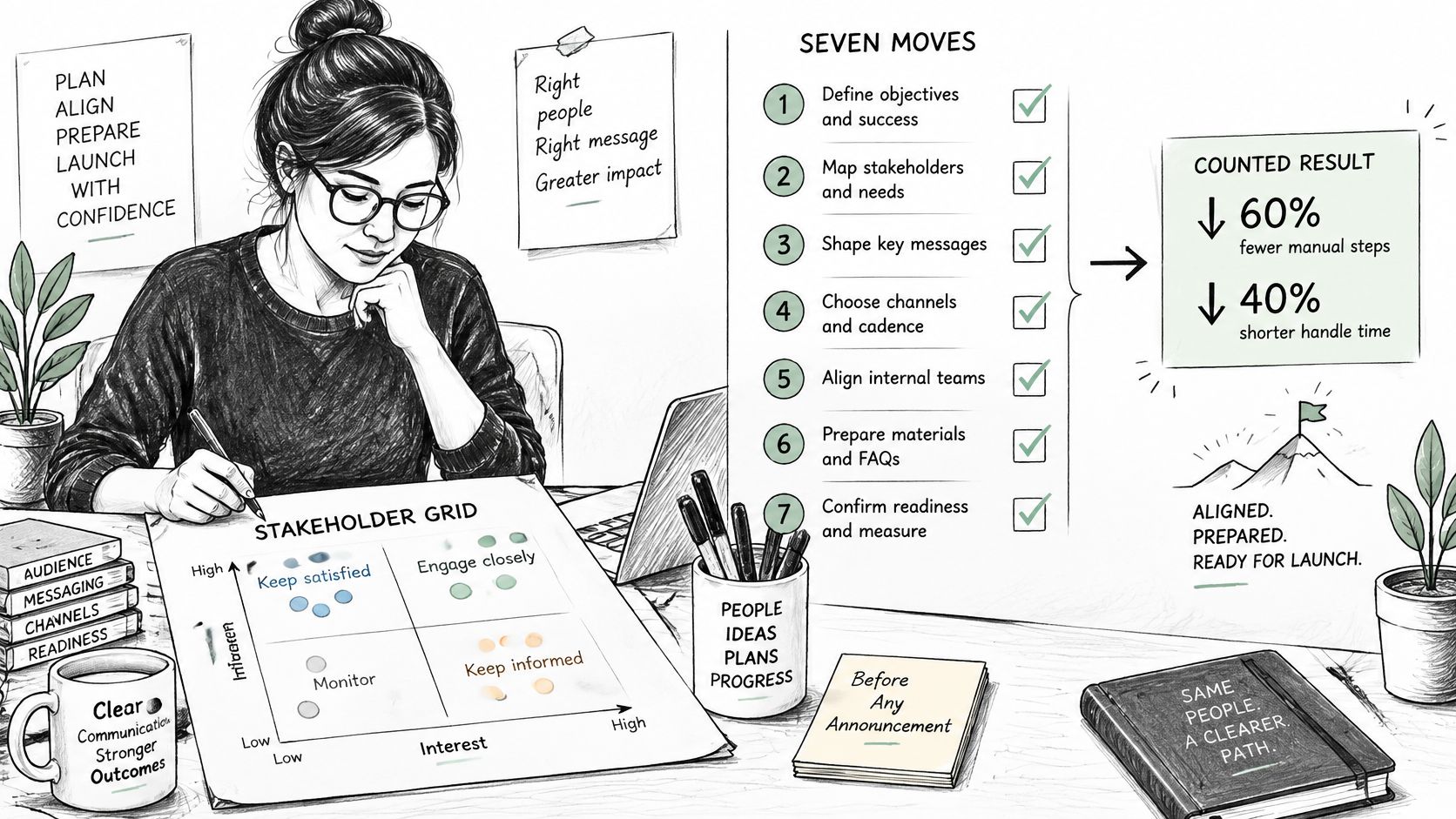
The seven pre-launch moves
- Define a measurable outcome. Choose a result such as shorter handle time, fewer manual steps, or fewer exceptions. “Adopt AI” is too broad to measure.
- Separate settled decisions from open ones. State what is fixed for the next 90 days and what remains undecided. This gives leaders a clear answer when questions arise.
- Record a baseline week. Measure tool use, cycle time, ticket volume, or exception rate before the announcement. Without a baseline, later change is hard to interpret.
- Choose one 30-day pilot segment. Use the behavior already assigned to that stakeholder group. A focused pilot makes it easier to see what is working and where the process breaks.
- Draft the core message. Include verified facts, named unknowns, the human-review rule, and what data the tool does and does not use. Support the evidence line with a quantified deployment from a published library of AI case studies, rather than a vendor slogan.
- Name two communicators. An executive carries progress across organizational boundaries; a direct manager translates it into staffing and permissions for the week. Without both, the message lacks either authority or local meaning.
- Set the cadence before send day. Schedule a weekly live forum, a manager cascade within 48 hours, a same-day FAQ, and one source of truth that every channel points to.
Why the front line is inside the procedure
In McKinsey's research on the people power of transformations, 3% of respondents at organizations that failed to engage line managers and frontline employees reported success. The reported success rates were 26% when line managers were engaged and 28% when frontline employees were engaged, according to the research. In the same research, about two-thirds of respondents at successful transformations said they had regular access to progress information, compared with 28% at failed transformations.
Employees closest to customers and operational constraints can identify where a plan fails in practice. Give them a way to see progress and report problems; otherwise, a polished announcement can coexist with weak adoption. For teams spread across locations, guidance on building a distributed workforce communication strategy can help address the added challenge of reaching people through different channels.
The video below shows how planning discipline shapes what an announcement can credibly promise.
AI change management turns the communication plan into an operating decision: proceed only when the baseline, pilot segment, labeled unknowns, and cadence owner are in place. If one is missing, delay the announcement until the gap is closed. A launch date is easier to reset than trust.
Manager Cadence from Briefing Kit to Live Questions
The town hall isn't the center of gravity. The direct manager is. In PwC's 2025 global workforce research, covering nearly 50,000 workers across 48 major economies, 58% said they trust their direct manager and can speak openly with them, while trust in top management was lower in the Singapore results, at 41%. Workers with the highest trust in their direct managers were 72% more motivated than those with the lowest trust in that research.
That gap should change where you spend effort. Executive visibility matters, but the person who translates an abstract priority into staffing decisions, queue rules, and permission to raise risks is usually a manager two or three levels down.
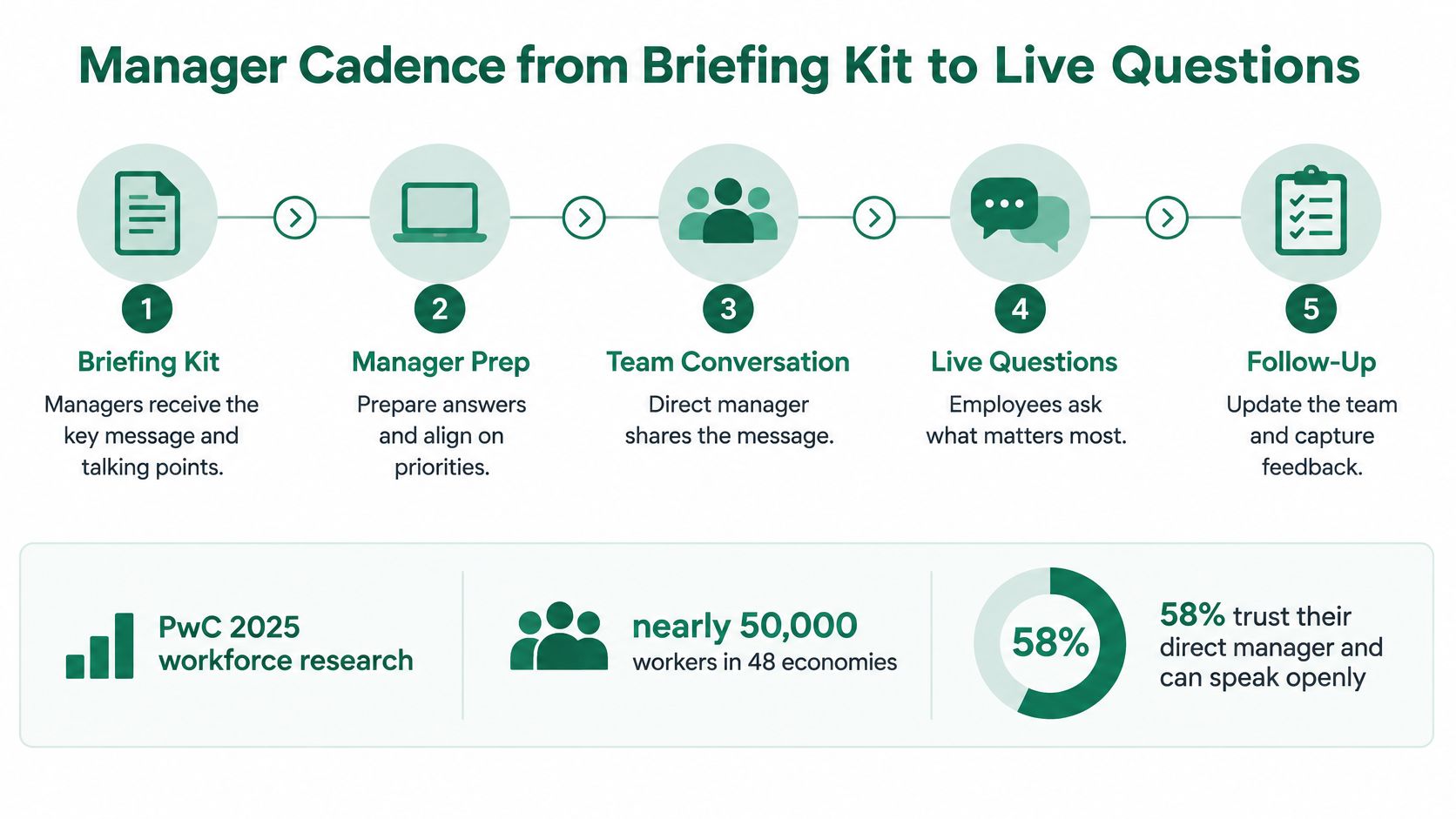
What the briefing kit contains
Give managers the kit 24 hours before any all-hands, not during it. It holds the one behavior for their team, three verified facts, three explicit unknowns, the escalation path, and the sentence they must not improvise. That last item matters most. No invented ROI, and no "the model is always right," because a manager who fills silence with certainty creates a correction you'll have to issue later.
The weekly clock
- Monday. Executive narrative with live questions, roughly 20 minutes of update and 20 minutes of Q&A. If leadership can't fill the Q&A, the update was probably too polished to be honest.
- Within 48 hours. Manager huddle that translates the narrative into staffing, queue rules, or code-review rules for that specific team.
- Same day. FAQ updated with unanswered questions still visible, not removed.
- Friday. Short note on what feedback changed in the rollout, even if the answer is that one scope item moved.
Say a software organization is rolling out coding assistance. Managers tell their teams which repositories are in scope, that suggestions still need human review, and that a spike in defects pauses the pilot. Anonymous questions stay attached to the decisions they produced, so dissent is visible instead of absorbed.
A frontline team can say what is changing, what is not yet known, and how feedback altered implementation.
Cascade-only plans fail here. Delivery and recall can look fine while local interpretation is unsafe. The huddle is where comprehension is heard, not assumed, and it's the earliest place you'll learn that a clear executive message produced three different local rules.
A Dashboard for Adoption Not Activity
In 2025, 79% of communications teams reported measuring internal or external communications effectiveness, but only 3% described their measurement practices as mature, according to Ragan Research's 2025 Communications Benchmark Report. That gap is the problem. Teams measure plenty and learn little, because activity metrics dominate and behavior metrics don't.
Employee-engagement surveys are the most commonly used effectiveness measure, used by 59% of organizations, while more than three-quarters report that at least half of employees consume company-wide updates, according to Simpplr's state of internal communications research. Those figures describe exposure. They're necessary, and they're not sufficient.
Communications metrics by what they prove
| Metric | Type | Signal | Failure it catches |
|---|---|---|---|
| Reach | Exposure | Most of the segment saw the update | Silent or missed audiences |
| Open rate or attendance | Exposure | Stable across weeks, not one spike | Wrong channel or fatigue |
| Recall of the rule | Comprehension | People state when to rely, when to verify, who is accountable | Jargon or contradiction |
| Adoption or compliance | Behavior | Pre/post move after the 30-day pilot | Message failed or process failed |
| Decision latency | Outcome | Time-to-decision falls without hidden rework | Incentive or workflow block |
| Ticket or exception volume | Outcome | No confusion spike after launch | Tool or process failure misread as comms |
| Question-resolution time | Feedback loop | Open questions published with a decision | One-way broadcast |
The diagnostic split that makes the dashboard useful
Run it as a method, not a report. Baseline before launch, a 30-day pilot on one segment, a pre and post comparison, then a pulse plus a handful of interviews to find comprehension gaps. Iterate weekly and let leaders visibly answer questions, because a dashboard nobody acts on is just decoration. The internal communication measurement tips from HubEngage from HubEngage, Inc. are useful on the mechanics of pairing survey data with channel data, and adoption signals help separate genuine use from curious first clicks.
Three patterns cover most failures. If reach is high and recall is low, the message failed through jargon, contradiction, or buried unknowns. If recall is high and behavior is flat, look at incentives, access, training, or process design before sending more copy. If tickets spike after a clear message, the tool or workflow failed, and communications should say so plainly instead of absorbing blame that belongs elsewhere.
On contentious updates, also track time to first acknowledgement and question-resolution time. Silence after a hard announcement reads as avoidance, even when the team is busy verifying facts.
Operating rule: a strategy is effective only when the dashboard can tell message failure from capability, incentive, or process failure.
When AI Trust Lags the Rollout
AI use can outpace trust. Stanford's AI Index reports that 58% of employees use AI regularly or semi-regularly, while 53% trust it for work purposes, a five-point gap. In the same research, nearly one-fifth said AI had reduced workplace communication and collaboration, while about two-fifths reported improvements. KPMG's global research found that 54% of respondents are wary of trusting AI, according to Stanford's AI Index chapter on public opinion.
More benefit-focused copy can widen that gap. Employees who doubt a tool may hear enthusiasm as pressure, then respond with quiet workarounds rather than meaningful adoption. Build trust through verifiability: show what the system can do, where it fails, and who is accountable for its output.
Before, during, and after go-live
Before go-live, publish the evidence behind the decision, the human-review rule, known limitations and error patterns, and a plain explanation of data use. During the pilot, show a corrected mistake so employees can see how review works. After wider release, keep a feedback channel tied to decisions about scope. A thank-you message alone does not close the loop.
Set communication by task risk and location. Drafting a summary differs from a benefits determination or a safety-related recommendation, so explain the review and accountability rules for each use. Geography matters too: Stanford's AI Index reports AI use above 80% in several emerging economies, including India, China, Nigeria, the United Arab Emirates, and Saudi Arabia.
Three symptoms signal a trust problem:
- Nobody can name who is accountable. Put the responsible owner beside demos and outputs, not only in the launch deck.
- Managers turn uncertainty into certainty. Give them the current list of unknowns and language for saying “we don't know yet” clearly.
- Collaboration drops. If a tool removes a handoff conversation, review that workflow and say plainly whether the tool's scope will change.
Use one practical test: can a user explain when to rely on an output, when to verify it, and who remains accountable? If not, the communication has not made the operating rules clear.
When confidence breaks, prepare a response sequence: acknowledge the issue, separate verified facts from unknowns, explain immediate actions, name a spokesperson, set the next update time, and maintain one source of truth. A study of 450 employees across 15 organizations reported 40% higher implementation success among organizations combining clear communication, participative change methods, and structured training, according to the study published in Social Impact Studies. Speed matters, but accuracy and tone matter too. A fast, inaccurate, or cold response can deepen the mistrust it is meant to address.
Pick a Proof Point Before the Next Briefing
Your next briefing needs evidence, not another restatement of the vision. Before it, create an account and subscribe to access the library of AI use cases, tools by industries, business functions, and outcomes at Applied, then filter to your function, such as operations, software engineering, customer service, or finance.
Choose one published deployment whose task risk matches your initiative. Steal only its evidence shape: company, situation, tools, and a counted result. Then put that proof inside the message architecture you've already built, stating what changed, what was measured, and what a human still owned.
If no case matches your task risk, say that gap in the briefing. Don't borrow a success from a safer workflow and imply it transfers, because your audience will notice the mismatch before you finish the slide. An honest gap with a pilot plan beats a borrowed proof point every time.
Write the Monday update from three things: one result, one limit, and one question the team can still change. That's a briefing people can act on, and it's short enough for managers to repeat accurately.
The strategy is ready to run when the briefing names four items. The behavior for the pilot segment. The unknown that stays labeled as unknown. The manager who will translate the update within 48 hours. And the metric that will be compared with the baseline after 30 days. Missing any one of them means you're still announcing, not communicating.
Applied catalogs verified AI implementations with the company, situation, tools, and quantified result named for each one, so you can build your next briefing on a counted deployment instead of a vendor claim. Explore the use cases, tools, industries, and outcomes that match your function, then bring one proof point into your message architecture. Visit Applied to create an account and subscribe.