Automated Test Engineering: A Practical Enterprise Roadmap
A practical enterprise guide to automated test engineering covering strategy, CI/CD integration, test data, team roles, flaky-test control, and KPIs that prove
October 23, 2026
A release board can look green while the people who ship the change still hesitate. Overnight jobs reran the red tests. A few got quarantined. A manager asked whether the team should automate whatever is still manual.
That question misses the job. Automated test engineering is the operating system for delivery, not a pile of scripts. It decides which behaviors deserve protection, how fast a change gets an answer you can act on, who owns a failure, and whether a generated assertion checks a business rule or only a happy path.
The field is old and still unfinished. A 2024 study of 339 practitioners in 46 countries notes that automated test generation research reaches back nearly 50 years, to Ramamoorthy, Ho, and Chen's 1976 work on test-data generation. Tools still have to fit real workflows, stay maintainable, and cover meaningful behavior. People still pick targets, read failures, and decide whether a test protects anything.
Table of Contents
- Defining Automated Test Engineering and Its Limits
- Designing Test Architecture and Frameworks
- Integrating Tests into CI/CD Pipelines
- Managing Test Data, Environments, and Team Roles
- Keeping Suites Reliable and Avoiding Flaky-Test Traps
- Measuring KPIs and Business Outcomes
- Choosing Tools and Taking Your Next Step
Defining Automated Test Engineering and Its Limits
Teams often assume automation replaces manual testing. In practice it covers a slice of the portfolio, and that slice is the maturity signal worth managing.
A state-of-practice survey of software test automation found that about half of respondents automated less than 50% of their test cases, while only about 10% automated more than 90%. Treat that spread as a benchmark. Having a program is not the same as high coverage. Selective automation is what most organizations run, and it can be the healthier design.
Where scripts earn their keep
Repeatable regression checks, unit tests, integration tests, and stable high-value workflows are the usual wins. They execute the same way on every build and catch breaks in paths the business already understands.
Work that stays with people is just as deliberate.
- Exploratory sessions: Someone follows a hunch the script was never given.
- Usability and visual checks: Layout, tone, and feel don't collapse cleanly into an oracle.
- Fast-changing scenarios: If the screen or rule moves every sprint, upkeep can cost more than the check.
Set the automation share from risk, not from a round target. List critical paths, mark which ones are stable enough to encode, and publish the share of those paths that run unattended. Then stop managing the raw script count.
A smaller suite aimed at production risk beats a large suite that is brittle, redundant, or disconnected from how the product fails.
Track the proportion of important behaviors covered, execution reliability, defects the suite finds, and the cost of keeping it alive. Hiring for that judgment matters as much as framework skill. A practical IT candidate testing framework helps when you need people who can evaluate tests in an AI-heavy workflow, not only candidates who can generate them.
Designing Test Architecture and Frameworks
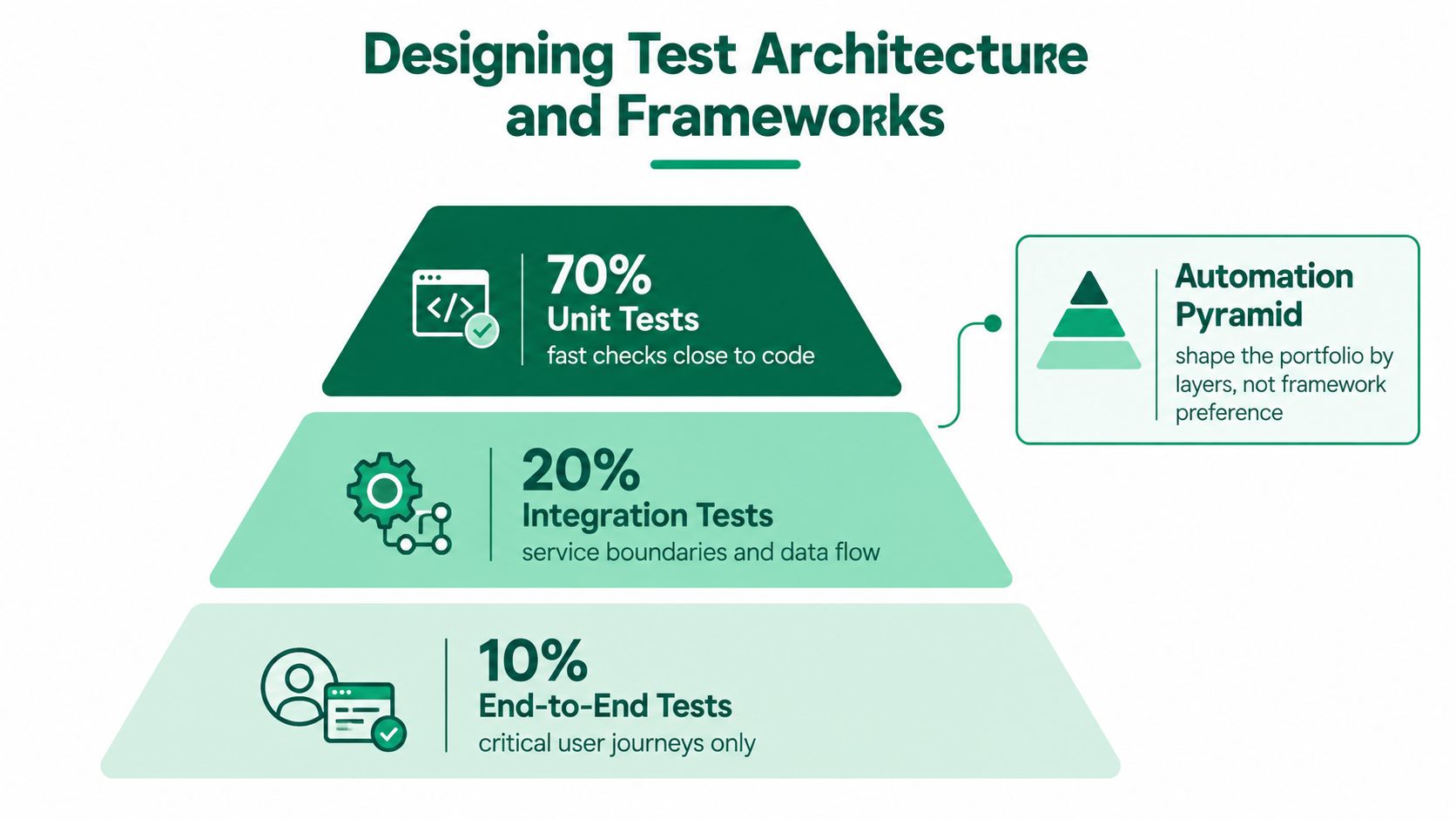
A test portfolio has to fit the team's code, service boundaries, and release risks. Start with the architecture, then select tools that support it. A documented automation-pyramid implementation allocated 70% of tests to unit testing, 20% to integration or contract testing, and 10% to end-to-end testing. Its feedback targets were under 30 seconds for unit tests, under five minutes for integration and contract tests, and under 15 minutes for end-to-end tests. Treat those figures as a reference, not a quota: the right distribution depends on where failures occur and how quickly each layer can return a useful result.
How each layer earns its share
Unit tests sit close to the code. Deterministic mocks keep databases and partner APIs outside the assertion, so failures point more directly to the change. Keep this layer broad enough to give developers fast feedback before they move to another task.
Contract and integration tests check service boundaries and data flow. They cost more to set up and diagnose, so focus them on interfaces where a mismatch can break downstream consumers. Choose a runner that fits the service language and the clients the team already versions.
End-to-end journeys should cover a short list of business-critical paths. In the documented implementation, each end-to-end test ran 100 times, and tests with failure rates above 2% were quarantined. The exercise found 8% of end-to-end tests were flaky. That failure rate makes ownership and quarantine policy part of the architecture, not cleanup work.
| Layer | Share | Feedback target |
|---|---|---|
| Unit | 70% | Under 30 seconds |
| Integration or contract | 20% | Under five minutes |
| End-to-end | 10% | Under 15 minutes |
Pick tools by language expertise, fit with existing code, and who will maintain the tests over time. Playwright or Cypress can handle a thin UI layer; JUnit or pytest can support the base. Keep test ownership connected to requirements and releases through application lifecycle management software, so checks remain tied to delivery decisions rather than becoming shelfware. The operating model matters as much as the framework: teams need to review coverage, flaky-test cost, and any AI-generated tests before trusting them as release evidence.
Integrating Tests into CI/CD Pipelines
A change that waits on a nightly report can reach review without useful feedback. Build the pipeline as a delivery control: put quick, trustworthy checks on the merge path and schedule slower evidence where it informs release decisions.
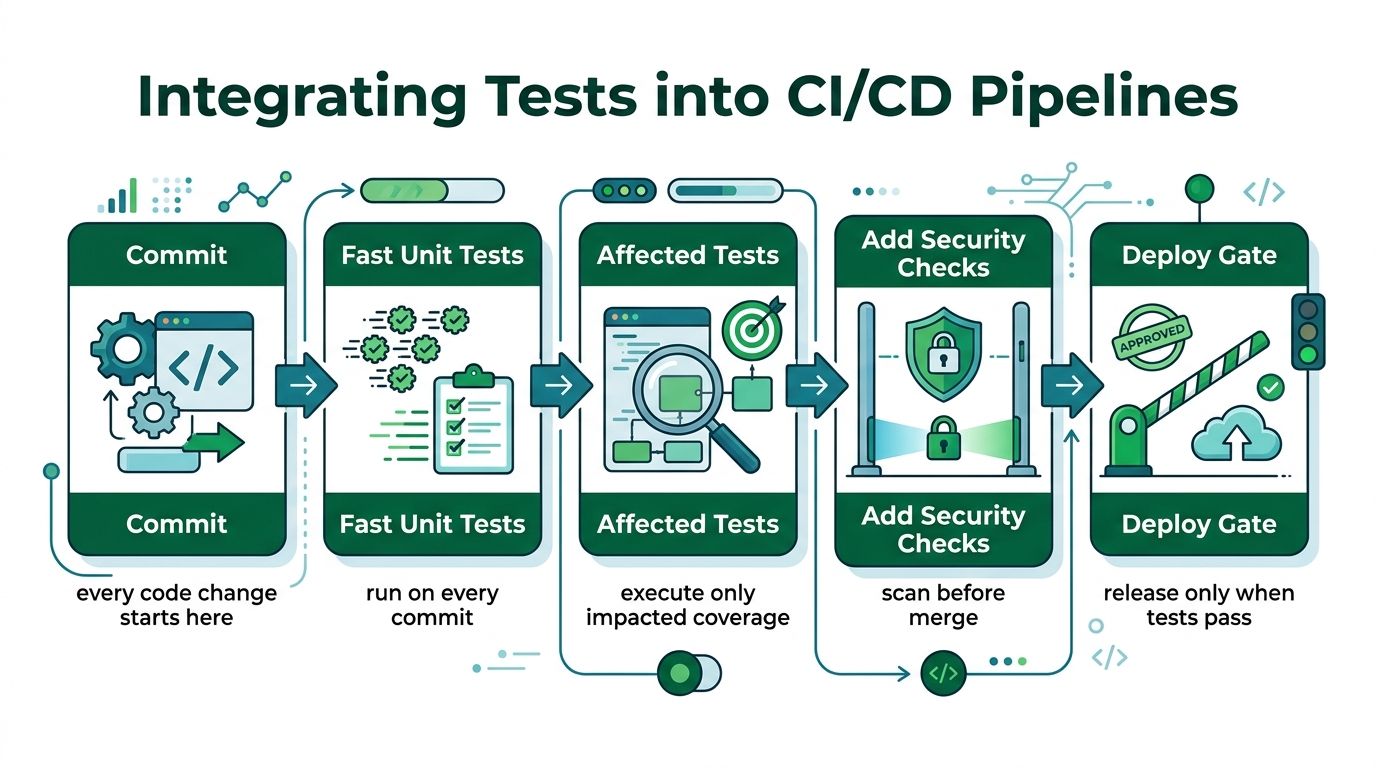
Run unit tests on every commit. Then select tests affected by changed files, rather than replaying the full suite for a small fix. Add contract and integration checks at service boundaries when their results are reliable. Run broader regression tests asynchronously, so they can guide release decisions without blocking minor changes.
What is allowed to stop a merge
Block a merge when a fast-layer test reproduces a product failure. Keep longer runs visible, with an owner and a deadline for action. Ignoring a red result without a policy turns the pipeline into noise.
A 2025 study of automated testing inside CI/CD reported a 40–60% reduction in defect-detection time, a 35–50% increase in testing efficiency, and 75–85% lower remediation cost when defects were caught early. Its measures included code coverage, defects detected per unit of time, and a test-stability coefficient. Coverage alone cannot show whether a gate is useful. Track it alongside the cost of unreliable failures and whether test results change release decisions.
Start with a weekly note on suite duration, defects found before release, and the share of red builds that were not product bugs. Those signals show whether the gate is giving teams actionable feedback or consuming time without protecting delivery.
If a check can't change a release decision, it doesn't belong on the critical path.
Put security scans on the release decision path, too. Pair automated checks with code review automation, so people review the change while checks assess it before promotion. As AI-generated tests enter that workflow, require the same ownership and review as other tests. A generated test that adds coverage but cannot be trusted can slow delivery rather than protect it.
Managing Test Data, Environments, and Team Roles
A red test can point to a product bug, but shared state or an unstable dependency may be the underlying cause. Treat data, environments, and ownership as parts of the delivery system, not as setup work around the test suite.
An analysis of 10,000 test-suite runs across 24 Java projects identified 810 flaky tests, with 75% in clusters averaging 13.5 tests. Intermittent networking and unstable external dependencies were the predominant causes in those open-source projects. One industrial case estimated that developers spent 1.28% of their time repairing flaky tests, about $2,250 a month. Retrying a cluster does not resolve its shared cause. Group failures by co-occurrence, dependency, trace, and environment, then assign someone to address the underlying issue.
Who holds which piece
- Test architects set the layer strategy and risk-based coverage targets.
- Automation engineers build suites and maintain deterministic fixtures.
- Platform or DevOps partners own environment stability and service dependencies.
- Product or domain owners define acceptance criteria for the behavior under test.
Give each run isolated data. Create a fresh record instead of reusing a shared golden user. When production rows cannot be copied, synthetic data generation can keep runs repeatable without bringing live records into the pipeline. The trade-off is upkeep: generated records must still reflect the cases the product needs to handle.
How a red test gets a name
Route the first failure to its layer owner the same day. Classify it as a product defect, test defect, or environment defect, and make the next action clear. Retirement needs an explicit decision: a domain owner and the architect confirm that the behavior is gone or the check no longer reflects risk. Until then, keep the failure visible.
If nobody can retire a test, the suite grows and the signal thins.
Keeping Suites Reliable and Avoiding Flaky-Test Traps
Maintenance is where automation programs go quiet. The suite still runs. People stop believing it.
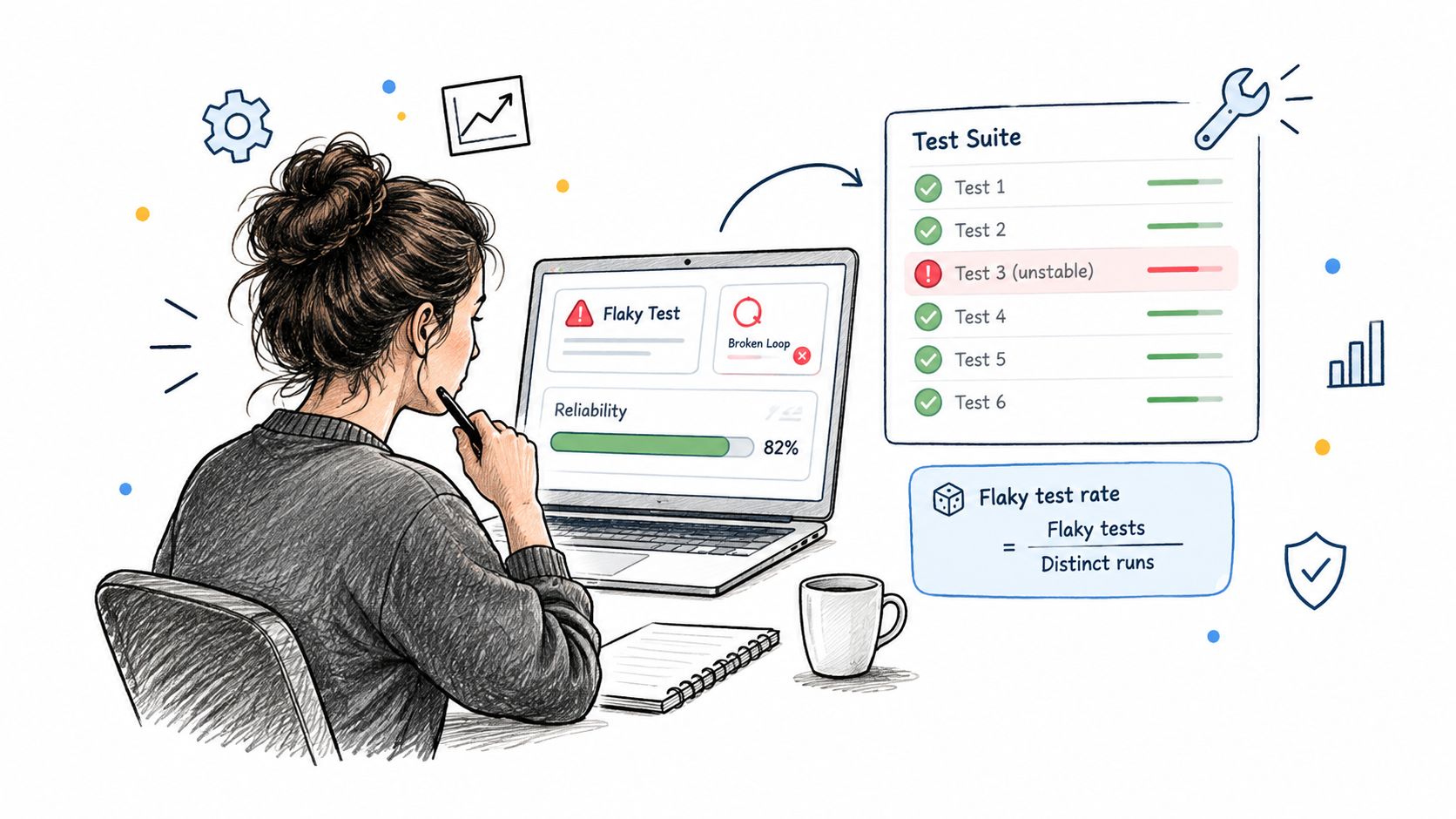
A test is flaky when it passes and fails with no code or configuration change. Track flaky-test rate as flaky tests divided by distinct tests, and flaky-failure rate as flaky executions divided by all executions. A few bad tests can dominate executions, or a wide smear of mild flake can hide inside a low failure rate. You need both numbers.
Write the test so it isn't born broken
In a study of 201 commits across 51 open-source projects, 78% of flaky tests were already flaky when first written, and average repair time was 388.46 days. Deterministic fixtures, explicit synchronization, isolated data, and controlled environment dependencies stop that clock. Quarantine still needs an owner and a service target, because a year-long repair isn't a side task.
Reruns are a weak detector. On 75 developer-repaired flaky-test commits across 31 Python projects, rerunning caught only 40% of cases, and 21% under a cleaner no-noise condition. A green rerun is not proof of correctness. Block merges only on reproducible product failures. Send suspected flake to a queue with history, environment metadata, timing traces, and code-change correlation. Never drop those failures out of the quality metric.
Generated tests take the same gate. A study executing nearly 1.2 million tests found 9,568 flaky tests, with flakiness at least as common among generated tests as among developer-written ones. Suppression in EvoSuite reduced flaky tests by 71.7%. Run each candidate repeatedly in clean environments, reject nondeterministic tests, and check assertions with mutation or behavioral-change tests. One such benchmark applied to only 15.29% of commits, because changed code had to already be executed by a unit test. Don't let a self-healing tool edit a test until it passes.
The rerun-until-green habit is easier to spot when you watch how a result gets discussed, not only how it is stored.
Measuring KPIs and Business Outcomes
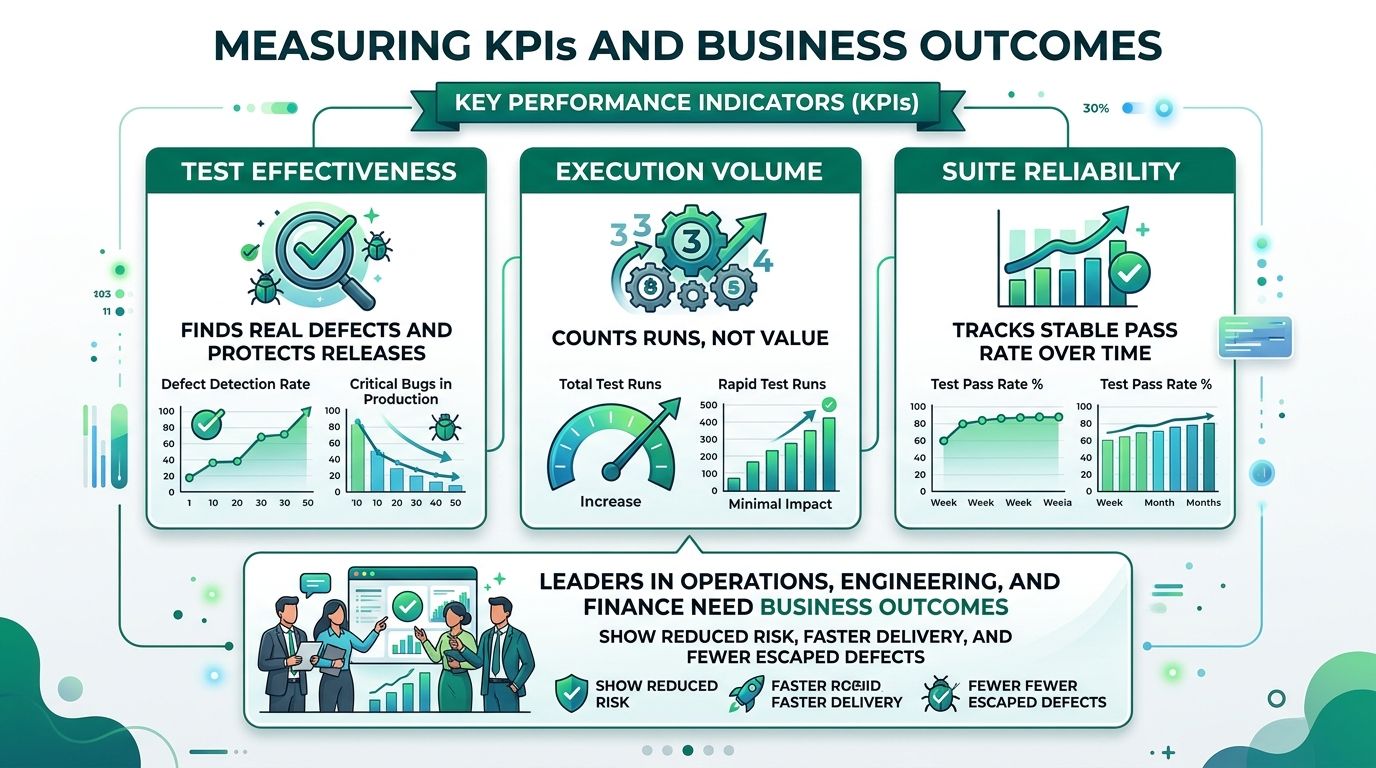
Leaders in operations, engineering, and finance don't buy test counts. They buy shorter risk and a bill they can defend.
Test effectiveness is defects found and releases protected. Execution volume is how often the suite ran. A large passing suite can still hide weak oracles and blind spots. Track duration, failure diagnosis time, defect escape rate, and the flaky rate you already publish. If diagnosis time climbs while the pass rate looks calm, the suite is noisy.
Replay the budget in your own numbers
A study of test-automation economics reported that continuous-testing pipelines can shorten regression cycles from several days to a few hours and reduce time to market by an average of 25–30%. In the worked example, a $500,000 annual quality-assurance budget achieved a 25% cost reduction, about $125,000 a year. Assuming about $60,000 for tools, infrastructure, and training, payback was six to nine months.
Use your regression labor, the wait between code-complete and release, and the cost of escaped defects. Subtract a realistic maintenance load. If payback appears only when you assume zero flake and zero training, the case isn't ready for finance.
A live project that introduced automated testing reported a 50% increase in defect discovery and a 60% reduction in testing duration. It also cites agile-environment research finding automated testing 45% more effective than manual testing for identifying defects, because repetitive manual execution gave way to more frequent regression cycles.
Put detection time and escaped defects on one page. Leave the script inventory in the appendix.
Choosing Tools and Taking Your Next Step
Treat tool selection as an operating decision, not a script-writing exercise. A defensible roadmap connects risk-based coverage to feedback speed, suite maintenance, and release decisions. The right tool supports that system; it cannot compensate for unclear ownership or tests that block on noise.
Score each tool or partner against four checks, weighting them to fit your delivery constraints.
- Pipeline fit: It runs where commits already run, using languages your engineers can diagnose under release pressure.
- Maintainability: Generated and hand-written tests follow the same review standards. If only one person can update the suite, the team has a dependency, not a platform.
- AI governance: Require an audit trail, human approval thresholds, and evidence that each assertion checks a business rule.
- Outcome evidence: Ask for test duration, escaped defects, and flake rates. A logo slide does not show whether the tool improves delivery.
A 2026 survey of more than 300 engineers, QA leaders, and IT decision-makers found that 41% of testing was automated on average. Respondents named test creation and maintenance as bottlenecks, and some reported that updating tests after a critical-system change took days. Quality and reliability concerns also constrained wider AI adoption. The practical lesson is to govern generated tests with review and domain-specific assertions. More test cases do not automatically mean faster releases.
Applied offers a catalog of AI tools and documented implementations across industries, with entries describing the company, use case, tools, and reported result. Its consulting covers AI strategy, education, and hands-on implementation.
Create an account this week and search the library by industry, business function, or outcome. Shortlist a few relevant cases, then test them against the four checks before buying. Keep the decision tied to delivery outcomes: coverage that protects important risks, flake costs the team can tolerate, and clear ownership of AI-generated tests.