AI Marketing Automation: How to Build and Measure It
Learn how to deploy AI marketing automation with proven frameworks, real enterprise results, and clear measurement strategies for enterprise teams.
October 13, 2026
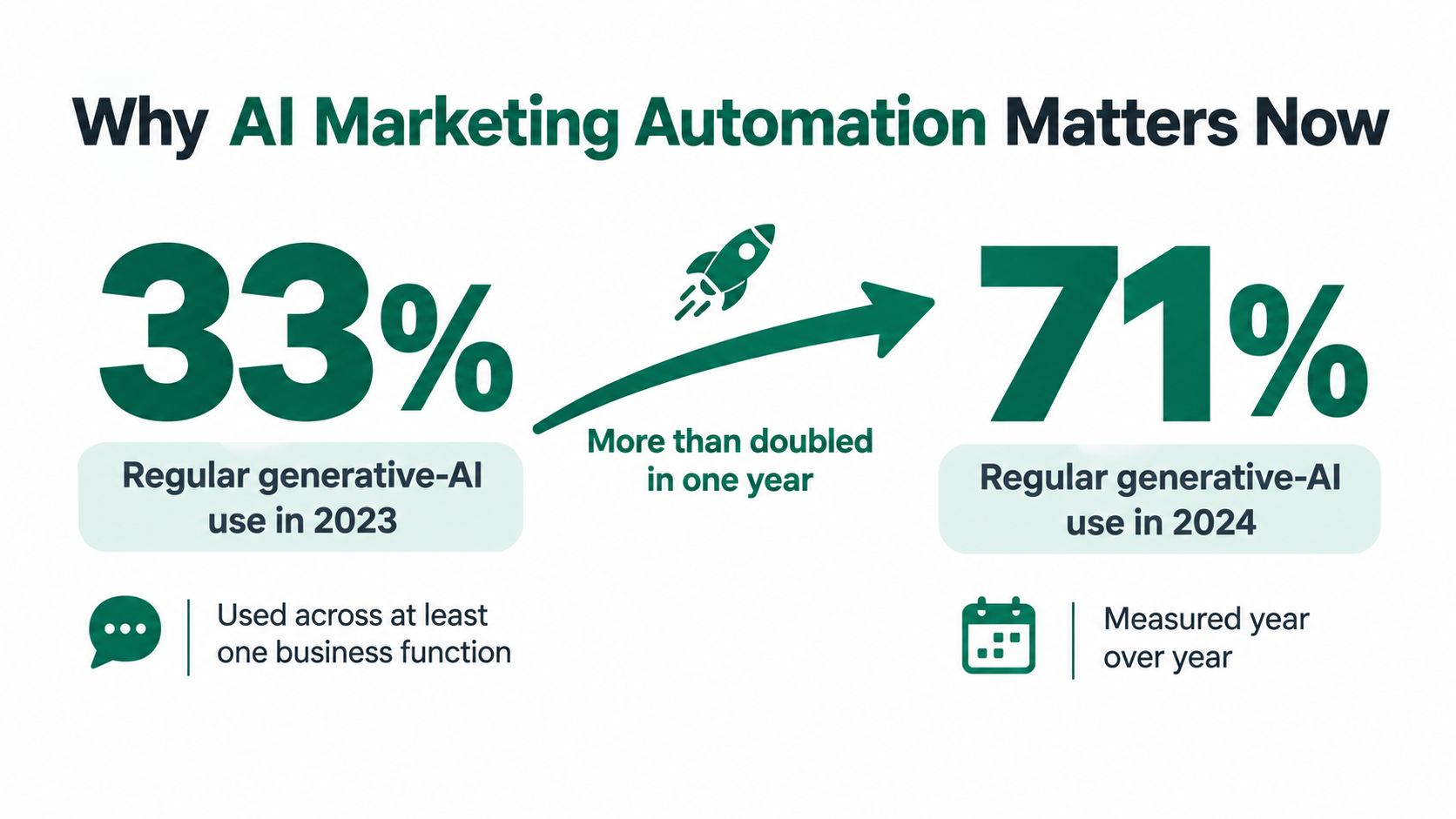
Regular generative-AI use across at least one business function rose from 33% in 2023 to 71% in 2024, more than doubling in one year. That makes AI marketing automation mainstream, but adoption alone doesn't prove that it creates revenue, margin, or durable customer value.
The operational question has changed. Marketing leaders aren't deciding whether their teams should test AI. They're deciding which workflows deserve automation, what the system may do without approval, and how to separate genuine incremental impact from faster production and noisier reporting.
Table of Contents
- Why AI Marketing Automation Matters Now
- Core Capabilities and Architecture Patterns
- Real-World Implementation Cases and Outcomes
- Implementation Approaches and Tooling Considerations
- Proving Incremental Value Beyond Activity Metrics
- Governance, Compliance, and Risk Management
- Enterprise Adoption Roadmap and Checklist
Why AI Marketing Automation Matters Now
Marketing automation is a mature software category, and AI is being layered onto it rather than built from scratch. Motor Intelligence estimated the global market at approximately $6.85 billion in 2024, while Grand View Research estimated $6.65 billion for the same year and projected growth to $15.58 billion by 2030. (Marketing automation market benchmarks) Existing campaign, CRM, analytics, and customer-journey systems provide the infrastructure. AI changes how teams operate those systems.
The practical opportunity extends beyond drafting copy. Marketing teams can apply AI to campaign creation, audience segmentation, personalization, lead qualification, and workflow orchestration. Each use case can increase throughput, but faster execution does not automatically produce more qualified revenue.
That creates a measurement trap. A team may generate more campaign variants, score more leads, and launch more journeys while commercial performance stays flat. Platforms record activity immediately. Revenue, margin, and customer value appear later, and often require a credible comparison to isolate the effect of automation.
The operating shift
AI marketing automation creates value when it changes a decision or removes repeatable manual work. An email draft can reduce production time. A system that selects an eligible audience, applies an approved message, routes it through a permitted channel, and measures the response can influence commercial results.
Use three measures to keep those outcomes separate:
- Activity: prompts run, assets created, leads scored, and messages delivered.
- Efficiency: hours removed, production costs reduced, and campaigns launched sooner.
- Incrementality: additional conversions, revenue, margin, or customer value caused by the intervention.
The third category should govern scale decisions. Adoption shows that a workflow is in use. Measured incremental value shows whether it deserves more investment, needs a different design, or should stop.
Core Capabilities and Architecture Patterns
AI marketing automation creates value when its capabilities work together: copy and image production, audience insight generation, customer targeting, personalization, and campaign testing. A writing assistant can increase output, but isolated tools rarely create a reliable operating system or prove incremental business value.
A stronger design closes the loop. Models generate channel-specific variants, customer data determines eligibility, and controlled experiments feed response signals into the next decision. The objective is not just more content or faster launches. It is a governed sequence that connects a customer event to a decision, an action, and a measurable commercial outcome.
McKinsey reports that properly configured always-on orchestration can improve marketing ROI by 30%, reduce the share of marketers' time spent on execution from roughly 60% to 70% down to 10% to 15%, deliver two- to fivefold creative productivity gains, and reduce creative costs by 10% to 30%. (McKinsey orchestration analysis) These figures describe an integrated operating model, not the expected result of adding a writing assistant to a campaign team.
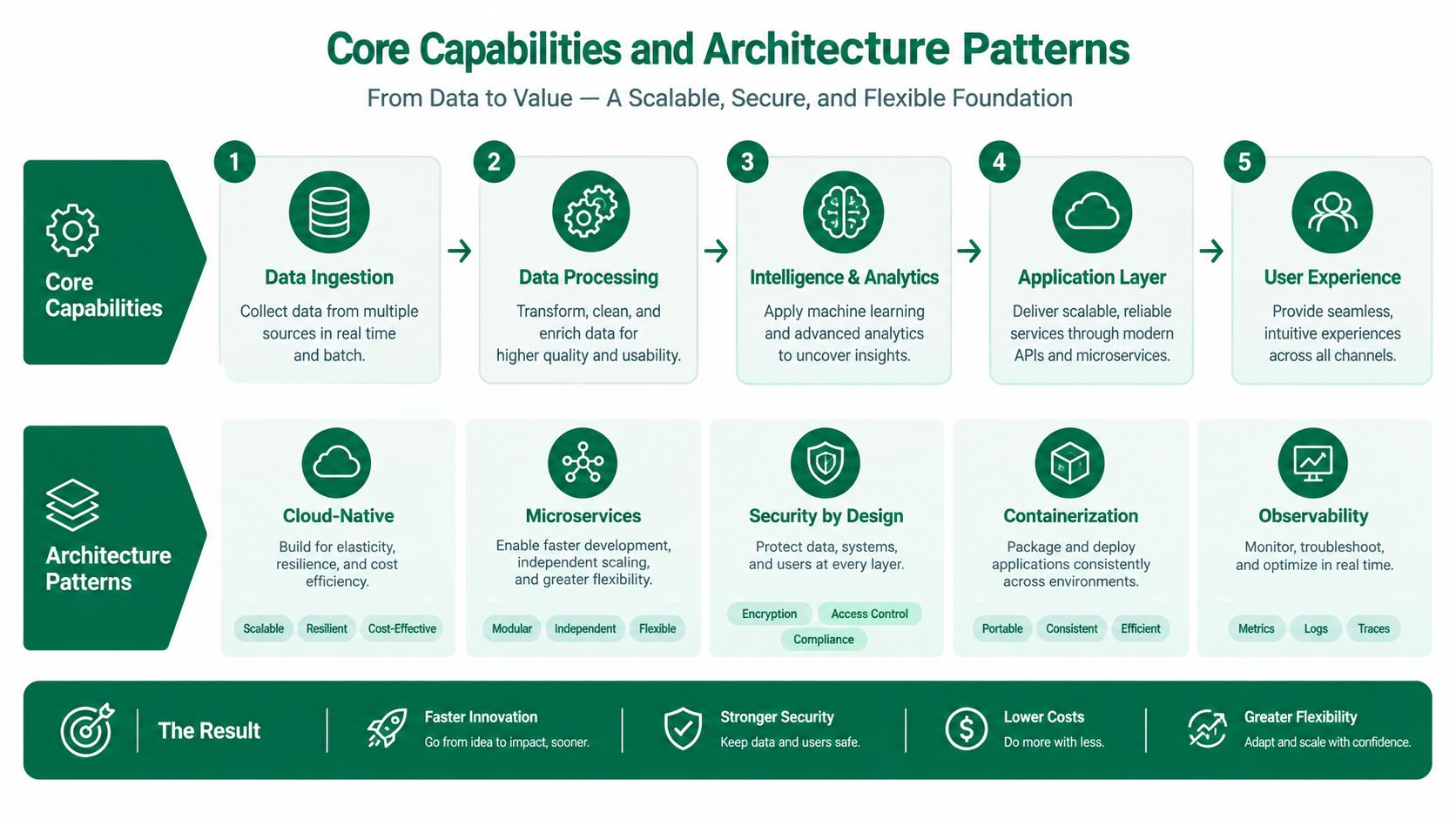
The architecture needs five connected layers
Start with customer events, including product actions, purchases, responses, and support interactions. Those signals feed decision logic, where propensity scores, eligibility rules, channel permissions, offer restrictions, and frequency limits determine what can happen next.
The next layer handles generation and selection. Approved models create or rank content variants, while policy controls limit what reaches customers. Experimentation then assigns holdouts and applies attribution rules established before launch. Finally, feedback routes outcomes into reporting and future decision policies.
Stopping at generation leaves the value question unanswered. Nearly 60% of marketers use AI multiple times per week, yet fewer than 10% have captured value across end-to-end workflows. (Marketing AI measurement survey) Frequent use shows access and activity. It does not show that automation changed customer behavior or produced additional revenue.
For nurture operations, AI agents for email nurturing offers practical context on qualification, follow-up, routing, and escalation. The design test is whether an agent operates inside a controlled journey with a defined objective, permission boundaries, and an auditable outcome.
An always-on system therefore needs event-driven pipelines, reusable decision policies, automated holdouts, and measurement that separates incremental outcomes from higher team activity. That separation determines whether adoption deserves more investment.
Real-World Implementation Cases and Outcomes
Effective implementations connect an AI capability to a defined marketing workflow and a business measure. Activity counts, such as prompts processed or content generated, show adoption. They do not prove that automation improved performance.
Ellevest used Writer to enforce brand consistency across 150+ annual articles produced by 20 writers, reducing style-guide error correction time by 50% to 70%. (Applied use cases) The practical result was narrower than a claim that AI created better content. Writer supported a recurring review process, helping the team identify and correct consistency problems before publication. The relevant measure was correction time at an established publishing volume.
That distinction changes how marketing teams evaluate similar deployments. A content workflow can produce more drafts while creating more review work. Ellevest's result points to a better test: compare the time spent correcting brand issues before and after automation, while holding publishing volume and review standards steady.
The same operating principle appears in Applied's case study of Omnicom's AI marketing platform on AWS. Architecture matters because it determines how models connect to owned workflows, but infrastructure alone is not an outcome. Teams still need a clear owner, a defined process, and a measure tied to operating cost or customer response.
A useful implementation review asks:
- Which workflow changed? For example, brand review, content production, campaign setup, or lifecycle-message approval.
- Where did the tool act? Identify the system, model, or review step rather than describing AI as a general capability.
- What remained under human control? Specify approvals, exception handling, and quality checks.
- Which baseline supports the comparison? Correction time, production capacity, conversion, qualified pipeline, or another measure should be defined before rollout.
- What would justify expansion? A lower activity burden is helpful, but additional investment requires evidence of incremental value.
This approach keeps marketing automation tied to business performance. A lead-scoring model may process more records without improving qualified opportunities. A personalization system may generate more variants without increasing response after accounting for audience mix and existing campaign performance. Measurement should therefore separate automation's incremental effect from volume created by the team.
Teams can explore 208+ additional implementations in Applied's AI use-case library. Use cases are most useful as comparisons of workflow design, ownership, and measurement, not as promises that every organization will achieve the same result.
Implementation Approaches and Tooling Considerations
Implementation usually follows one of two paths. Teams can add AI capabilities to an existing marketing automation platform, or build custom orchestration around generative models, event-driven pipelines, and a separate decision or analytics layer.
A platform-first approach is faster to govern when CRM records, campaign permissions, customer journeys, and reporting already share one product boundary. It fits teams improving lead scoring, email personalization, or content operations without rebuilding the customer data layer.
Custom orchestration provides more control over model selection, event timing, decision policies, and cross-system actions. That control brings additional ownership for identity resolution, consent propagation, observability, rollback, and model evaluation. Flexibility turns into operational debt when no team owns the interfaces or the failure modes.
Match the path to the workflow
A 2025 B2B benchmark found AI marketing automation adoption at 78% among enterprises with at least 1,000 employees, compared with 52% in the mid-market and 31% among small businesses. Among adopters, lead scoring reached 67% and email personalization 54%. (B2B AI automation benchmark)
These adoption patterns suggest bounded starting points. Lead scoring ranks decisions. Email personalization selects messages. Both are easier to constrain and evaluate than an autonomous system that changes budgets, prices, eligibility, and channel mix simultaneously.
| Approach | Works well when | Main trade-off |
|---|---|---|
| Existing automation platform | CRM and customer data are already reliable | Less control over model and decision architecture |
| Custom orchestration | Events span several systems and timing matters | Greater integration and governance burden |
| Generative content layer | Production volume is the bottleneck | More output does not prove commercial impact |
| Analytics and attribution layer | Teams cannot reconcile channel performance | Better visibility does not create incremental value |
Market maturity gives buyers more infrastructure to assess, but it does not remove implementation work. Vendor documentation and reference systems often reflect North American data-residency and consent patterns, so regional requirements should be checked before procurement. The buying decision should center on workflow fit, data quality, permissions, integration boundaries, and evidence of incremental value.
Before expanding, verify CRM connectivity, event freshness, consent management, API compatibility, identity matching, and exportable experiment data. A practical guide to AI workflow automation software can help teams compare orchestration requirements with the limits of individual campaign tools. A tool that increases activity without improving a defined business outcome belongs in a controlled test, not a broad rollout.
Proving Incremental Value Beyond Activity Metrics
A 2025 survey found that only 22% of teams planned to begin tracking AI ROI that year, while just 20% of teams using general-purpose AI tools said they could measure ROI. (AI ROI measurement survey)
That gap matters because AI activity can rise without improving revenue, margin, customer lifetime value, or media efficiency. More variants, channels, personalized interactions, and automated decisions may increase output while making attribution harder. Engagement can also rise because automation reached people who were already likely to act.
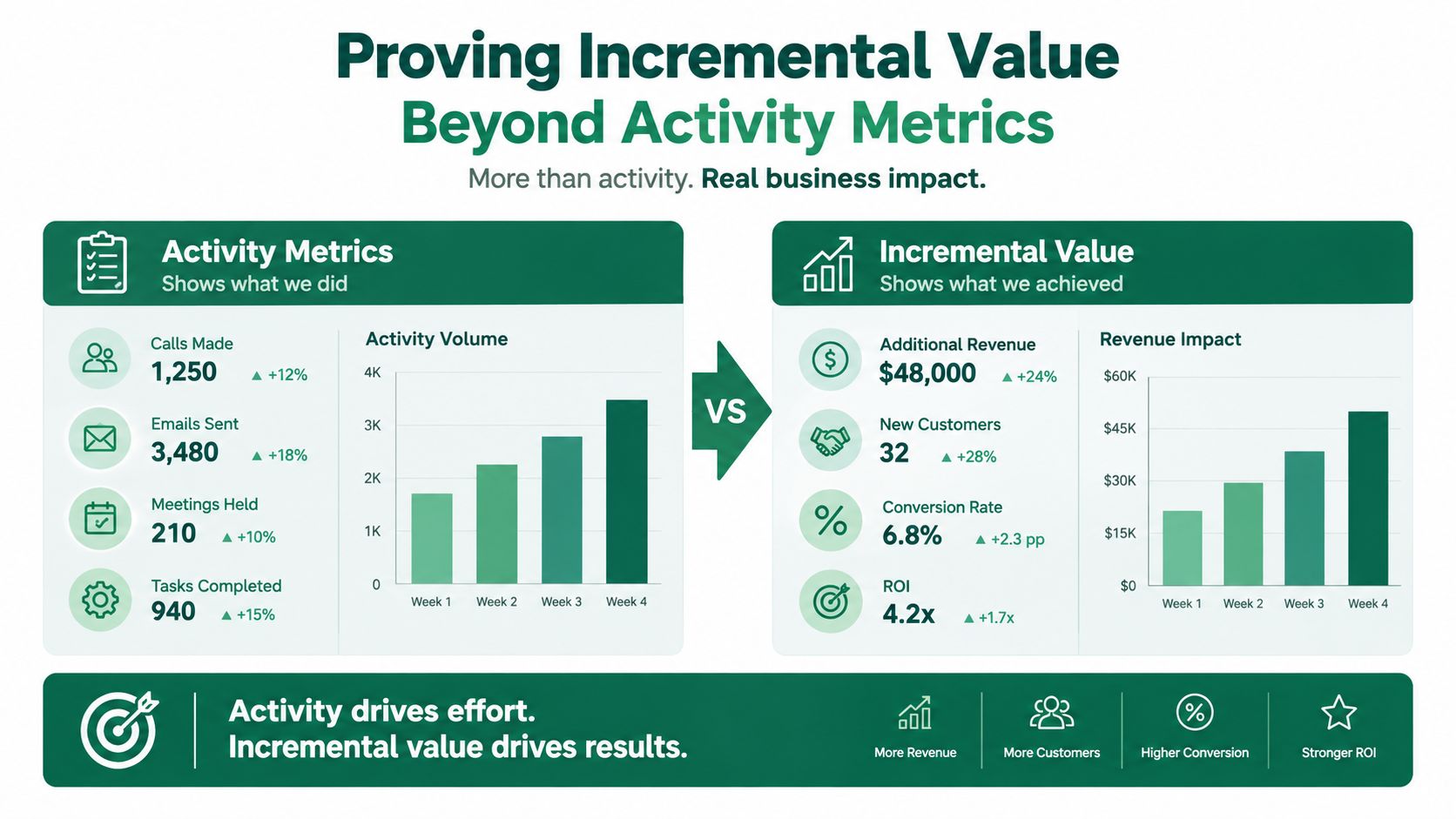
The operating question is simple: what changed because the system acted? A counterfactual gives the team a credible answer. Without one, the result may show correlation, not incremental value.
Measure the outcome, not the activity
Separate the business case into distinct outcome types:
- Labor savings: time removed from drafting, segmentation, reporting, or correction.
- Media efficiency: improved allocation or reduced waste.
- Conversion lift: additional action among comparable exposed customers.
- Revenue and margin: commercial value after discounts, costs, and cannibalization.
- Customer lifetime value: durable value rather than one immediate response.
Set the baseline before activating the workflow. Define the population, treatment, outcome window, exclusions, and decision threshold. Use a holdout group or randomized experiment where possible. If randomization is not feasible, document the comparison method and present the result as directional rather than causal.
Practical rule: If you cannot describe what would have happened without the automation, you have not proved incrementality.
A pilot should stop when engagement improves but qualified action, revenue, or margin does not move against the control. It should also stop when review and reconciliation consume more time than the workflow saves, or when poor data quality prevents reliable attribution. A short pilot has value only when it supports a clear decision to scale, redesign, or shut it down.
The AI business impact framework helps connect individual AI interventions with operational and financial outcomes. The measurement discipline is straightforward: track the value created by the system, not every interaction it produces.
Governance, Compliance, and Risk Management
AI marketing automation needs controls at the point where data becomes a customer-facing decision. Personalization creates risk when a system ranks offers, scores leads, sets prices, determines eligibility, or recommends actions using signals customers did not expect marketers to use. Disclosure supports accountability, but it does not by itself prevent discriminatory, opaque, or noncompliant outcomes.
The Canadian Marketing Association's 2025 guidance emphasizes transparency, consent, data minimization, purpose limitation, and opt-out mechanisms when AI affects significant consumer decisions, including financial-product or insurance eligibility and personalized pricing. (Canadian Marketing Association AI guidance)

The EU AI Act sets a specific transparency obligation. Article 50 requires disclosure when systems generate or manipulate image, audio, or video content that could falsely appear authentic, including realistic synthetic media. The requirement applies from August 2, 2026. (EU AI Act transparency guidance)
Governance should be visible in the workflow, not stored only in policy documents. Record the model's purpose, approved data fields, escalation rules, model version, inputs, decision, approval, and delivery. Test outcomes across relevant markets and demographic groups, provide customers with a route to question consequential decisions, and monitor changes in behavior, regulation, channel rules, and data quality.
Human review belongs around high-impact actions, especially eligibility decisions and regulated claims. The review rule should specify who approves an output, what evidence they inspect, and when the workflow must stop. Logs should make that decision auditable after delivery.
The Act follows a phased schedule. Prohibited practices and AI-literacy duties began applying on February 2, 2025, governance rules and obligations for general-purpose AI models began on August 2, 2025, and broader requirements including Article 50 apply from August 2, 2026. (EU AI Act implementation timeline)
Maximum personalization can raise short-term response while worsening customer trust. Set the operating target at minimum necessary data for a useful decision, with explicit limits on sensitive signals and human review for high-impact actions. Teams working through consent mechanics can use this GDPR cookie popup implementation guide for practical front-end guidance.
Enterprise Adoption Roadmap and Checklist
Enterprise adoption should progress through controlled stages, with each stage tied to a measurable business result. Start with data and measurement, test a focused workflow, then expand only when evidence supports broader autonomy.
Four phases for deployment
Foundation. Map customer events, identity relationships, CRM fields, permissions, and reporting sources. Select a frequent workflow with a clear owner, such as lead scoring, nurture routing, or content quality control. Define the commercial outcome before choosing a model, including the baseline and the decision that automation will change.
Pilot. Activate one controlled intervention. Establish a pre-AI baseline, reserve a holdout group, document the decision policy, and retain human approval where the risk requires it. Track intended benefits, failure conditions, delivery quality, and incremental results against the holdout.
Scale. Expand only after the pilot produces interpretable evidence. Connect related workflows, formalize governance, assign system ownership, and monitor data freshness, model drift, customer complaints, and business outcomes. Usage volume can support diagnosis, but it does not prove value.
Optimize. Improve segmentation, timing, personalization, and orchestration without dropping experimental discipline. Increase autonomy by decision type, not by enthusiasm. A system may choose a subject line while approval remains required for an eligibility decision or regulated claim.
Adoption checklist
- Data readiness: Confirm identity resolution, event freshness, field quality, and consent state.
- Tool fit: Compare platform features with the workflow, team skills, and administration capacity.
- Integration: Validate CRM, analytics, warehouse, advertising, messaging, and API connections.
- Governance: Define approved data, review thresholds, audit logs, disclosure rules, and rollback procedures.
- Measurement: Set baselines, holdouts, outcome windows, attribution rules, and stop criteria.
- Change management: Train operators, document ownership, and make review responsibilities explicit.
Avoid predictable mistakes. Do not buy technology before defining the result. Do not assume clean data because a CRM is populated. Do not treat privacy review as a final legal checkpoint. Do not scale a workflow that produces attractive activity metrics without defensible incremental value.
For teams assessing how AI can support winning product discoverability, define the commercial outcome first, then connect automation to the decisions that influence it. Applied catalogs 208+ verified case studies that follow this same structure.
Applied helps teams compare real AI implementations, tools, workflows, and measured outcomes instead of relying on adoption headlines. Visit Applied to explore relevant marketing automation patterns, identify a credible starting workflow, and build a measurement plan before scaling.