AI Hype vs Reality: What the Evidence Shows
See how AI hype vs reality compares on productivity, agents, model costs and ROI, with a checklist to test vendor claims before you buy.
November 4, 2026
The advice to adopt AI now and work out the business case later gets the sequence backward. A convincing demonstration establishes that software can perform a task under selected conditions. It doesn't establish that your team can operate it economically, recover from mistakes, or turn faster drafting into better business results.
AI hype vs reality is a question of operating boundaries, not belief. The useful question isn't whether AI works. It's which workload, cost structure, and level of supervision make it worth deploying.
Table of Contents
- Where AI Claims Meet Measured Results
- Why Productivity Numbers Overstate Business Value
- Model Upgrades That Pay Off and Those That Do Not
- Where Agent Autonomy Holds and Where It Breaks
- Where Gains Show Up in Real Workflows
- Full Cost to Check Before You Scale a Pilot
- Run a Hype Check Before You Commit Budget
Where AI Claims Meet Measured Results
Common AI hype claims against measured results
| Hype claim | What measured results show | Verdict |
|---|---|---|
| AI is already delivering value across the business | The Stanford 2025 AI Index reported that 78% of organizations used AI in at least one function in 2024, but the most common reported savings were below 10%. | Adoption is real; value is small and uneven. |
| Bigger reasoning models are the default upgrade | OpenAI o1 scored 74.4% versus GPT-4o's 9.3% on an IMO qualifying examination, at nearly six times the expense and 30 times the latency. | Consider the upgrade for difficult, low-volume decisions, not every request. |
| Agents can run long projects on their own | Leading AI systems scored about four times higher than human experts at a two-hour budget; humans outscored AI two to one at 32 hours. | Favor bounded, well-scoped tasks rather than open-ended ownership. |
| A successful pilot proves the business case | In a 2025 survey of 1,006 IT and business professionals in North America and Europe, respondents reported that an average of 46% of AI projects were scrapped between proof of concept and broad adoption. | A pilot shows feasibility, not return. |
| Productivity gains already equal business ROI | Deloitte's AI ROI reporting found that 66% of surveyed organizations reported productivity or efficiency gains; in a separate index, only 15% of generative-AI users reported significant, measurable organizational ROI. | Operational gains aren't equivalent to financial returns, and these are separate survey populations. |
The adoption figures are substantial. Stanford reported that organizational AI use rose from 55% in 2023 to 78% in 2024, while generative AI use rose from 33% to 71% over the same period. Yet the most common reported revenue increase was below 5%, alongside the modest savings shown above.
Those findings don't establish that AI is ineffective. They establish that access and impact are different measures. Licenses purchased, pilots launched, and employees trying chatbots describe deployment activity, not the amount of work completed correctly or the money retained afterward.
Read the boundary, not just the verdict
The reasoning-model and agent comparisons also concern particular evaluations, not universal rankings. Their operational lesson is to identify when a capability advantage stops compensating for expense, waiting time, or supervision.
Privacy can introduce another boundary before performance matters. For teams assessing consumer applications that handle personal images or body-related information, Robosize's resource on choosing body apps with privacy in mind provides a relevant starting point for procurement questions. Assess data handling separately from whether an application produces a persuasive result.
Hugo Santana built Applied to bridge the gap between AI hype and what companies are doing. That distinction matters because a narrowly useful deployment can still be valuable: it doesn't need to transform the entire business to justify its cost.
Practical rule: A narrow verdict isn't a rejection. It's a description of the conditions under which a deployment deserves consideration.
Why Productivity Numbers Overstate Business Value
The financial reality is narrower than the productivity narrative. McKinsey's 2025 global survey found that 39% of respondents attributed any enterprise EBIT impact to AI, and most of that group attributed less than 5% of organizational EBIT to it.
Savings in software engineering, manufacturing, or IT therefore shouldn't automatically become a company-wide earnings forecast. A department can finish an activity faster without reducing expenditure or increasing the volume of saleable output. Managers need to identify what happens to the released capacity.
The Federal Reserve Bank of St. Louis reported that surveyed workers' generative-AI time savings equaled 1.6% of total work hours, which it estimated could translate into a labor-productivity increase of up to 1.3%. The distinction matters: reported time saved is an estimate of effort, while the productivity effect is a modeled possibility, not an observed profit increase.
Replace activity metrics with operating measures
| Common metric | What it actually establishes | Better measure |
|---|---|---|
| Licenses purchased or seats assigned | Employees have access | Weekly active use inside the target workflow |
| Employees using a chatbot | Employees have tried the interface | Before-and-after cycle time on the same task |
| Pilots launched | Teams have started experiments | Production projects with a named owner and a scheduled six-month review |
| Average productivity gain | A result aggregated across different workers and tasks | Results segmented by workflow and worker experience |
| Self-reported time saved | Employees' estimate of effort avoided | Accepted output per person, alongside rework |
| Demo success rate | Performance on selected inputs | Performance on real, unedited inputs, including exceptions |
These replacements aren't interchangeable. Weekly active use can diagnose whether a rollout has reached employees, but it can't demonstrate economic value. Accepted output and rework address a different question: whether the organization gets more usable work.
Follow the released capacity
Say an analyst drafts a report faster but still waits for the same approval meeting. The analyst has recovered time; the customer hasn't necessarily received the report sooner. To claim a business improvement, identify whether that capacity supports additional output, avoids expenditure, or improves service.
Our guide to measures of value helps distinguish those outcome categories before teams choose a dashboard. The test for any productivity figure is straightforward: does it describe access, activity, or a change in the output the business is paid for?
Model Upgrades That Pay Off and Those That Do Not
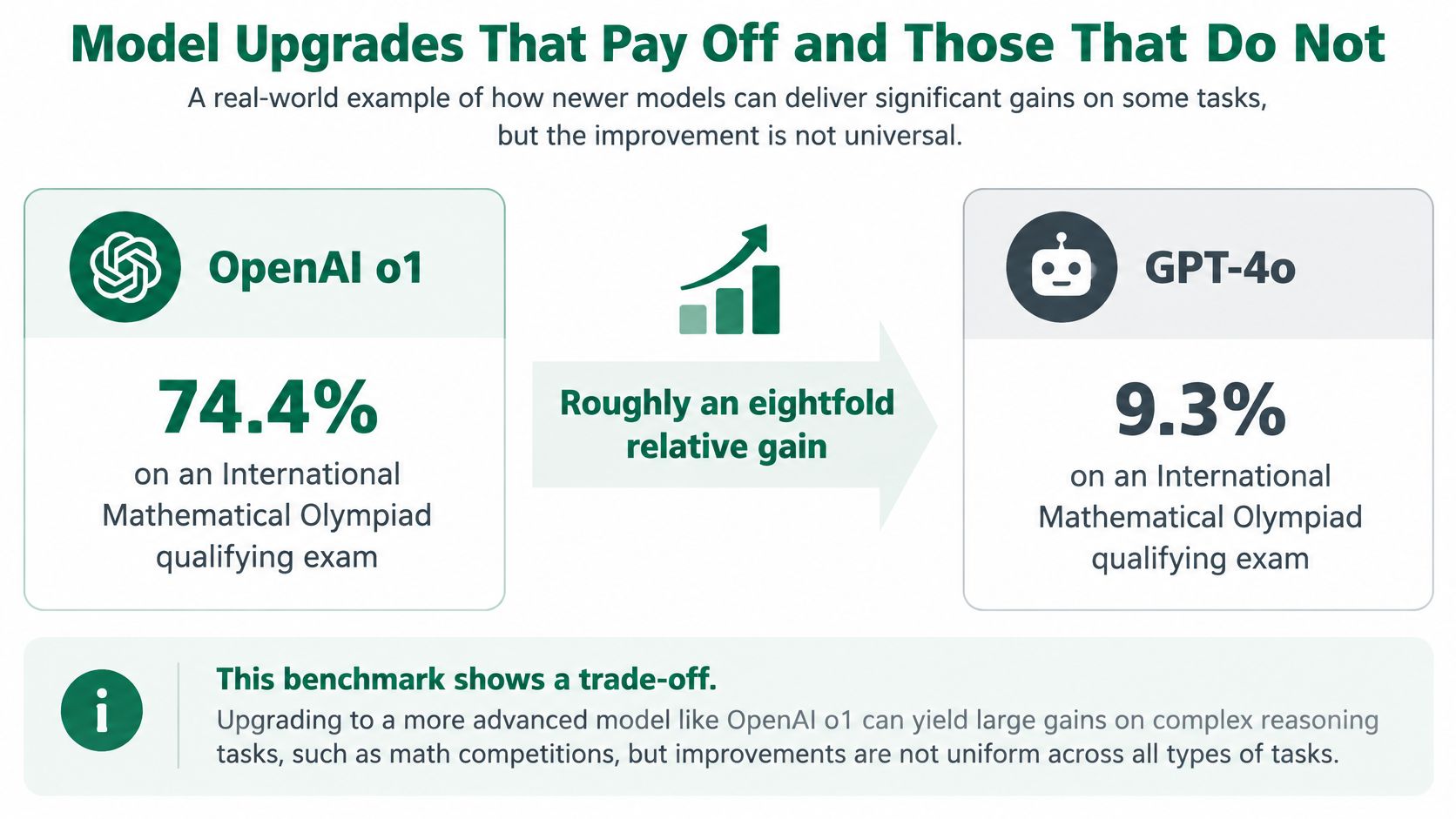
A stronger benchmark result can come with a weaker operating proposition. The Stanford AI Index technical-performance review reports that OpenAI's o1 scored 74.4% on an International Mathematical Olympiad qualifying examination, versus 9.3% for GPT-4o, roughly an eightfold relative improvement, while being nearly six times more expensive and 30 times slower.
That comparison doesn't mean the more capable model is a poor choice. It means the buyer must value the additional correctness enough to absorb the cost and delay. An examination score isn't a measurement of customer-service throughput or extraction accuracy on your documents.
The benchmark comparison makes the capability difference visible, but the operating trade-off must remain part of the decision.
Compare the workload, not the prestige
Model tier to consider by workload
| Workload | Typical volume | Model tier to consider | Check before rollout |
|---|---|---|---|
| Classification, extraction, routing | High | Faster, lower-cost model | Accuracy on a labeled sample, with monthly checks after rollout |
| Customer-service replies | High | Cost-efficient model with human escalation | Escalation rate and time to resolution |
| Difficult analysis or planning | Low | Reasoning model | Cost per correct decision |
| Financial, legal or safety outputs | Any | Any tier, plus deterministic checks or review | Severity of errors, not average accuracy |
Treat these as selection hypotheses, not guarantees. Test candidate models against the same labeled inputs, give them the same tools, and define what counts as an acceptable answer before comparing results.
Track accuracy, latency, inference cost, and failure severity together. Accuracy describes whether the output meets requirements. Latency establishes whether it arrives within the workflow's deadline, while inference cost determines whether repeated use remains economical.
Failure severity prevents a misleading average. Misrouting a routine inquiry and authorizing an incorrect payment shouldn't carry the same weight in an evaluation.
Verification isn't a premium-model feature
Stanford also identifies continuing reasoning-system failures on arithmetic, planning, and logic problems with provably correct solutions, particularly outside the training distribution. Paying for a stronger model doesn't remove the need to verify consequential outputs.
Use schema validation for structured extraction, deterministic calculations for totals, and explicit approval gates for consequential actions. For legal or safety-sensitive material, assign a qualified reviewer rather than treating fluent wording as evidence of correctness.
Choose the model tier from the cost of a wrong answer and the volume of work, not the leaderboard.
Where Agent Autonomy Holds and Where It Breaks
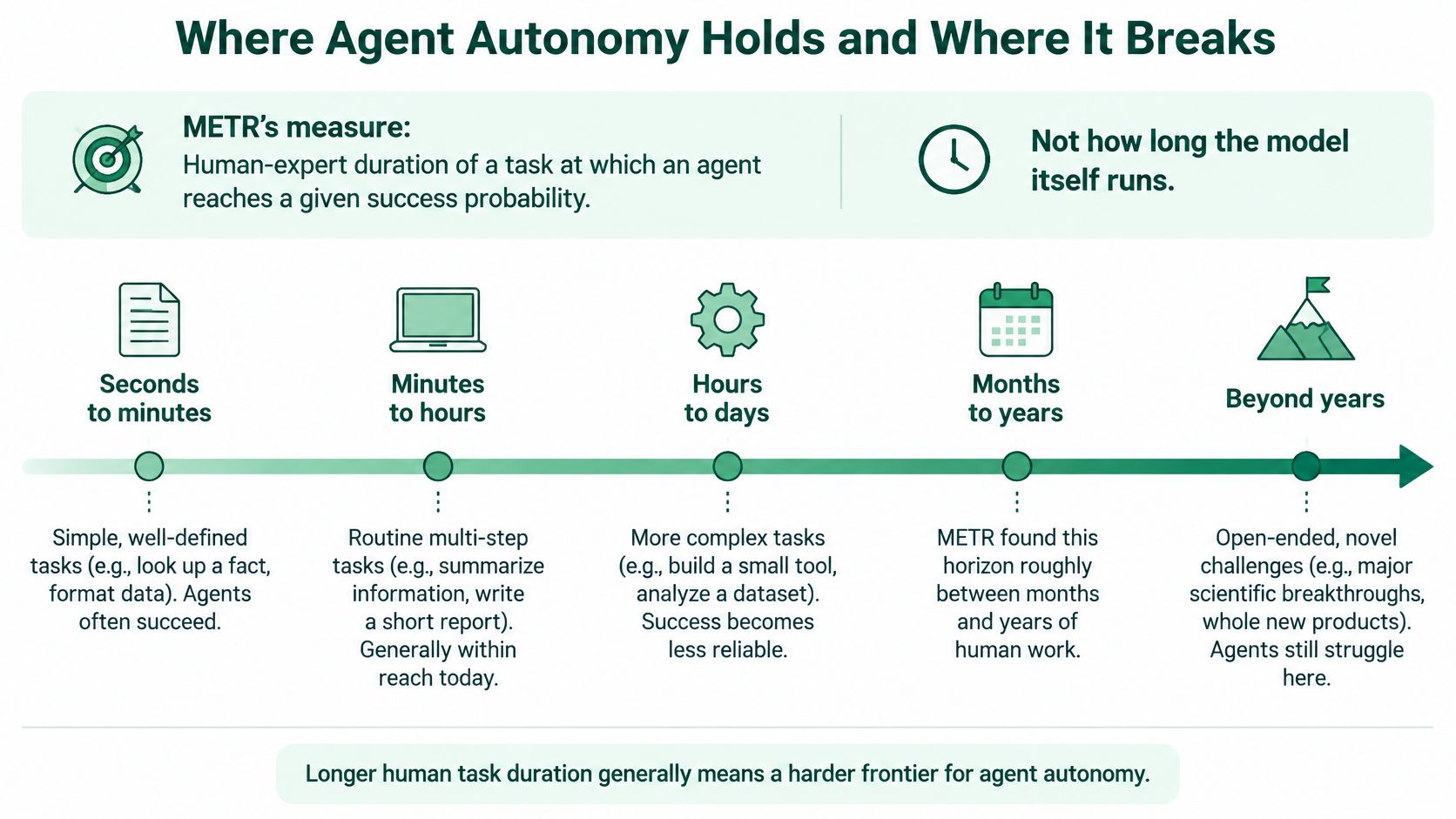
Agent progress is real, but its measurement is easy to misunderstand. METR's long-task evaluation found that the task-completion time horizon had roughly doubled every seven months over the preceding six years.
That horizon means the human-expert duration of a task at which an agent reaches a specified success probability. It isn't the amount of time the model runs, nor a promise that an agent can supervise an equally long business process.
The duration distinction is essential when interpreting agent capability.
Duration changes the evaluation
In the RE-Bench evaluation summarized by Stanford, leading AI systems scored about four times higher than human experts with a two-hour budget, while humans outscored AI two to one at a 32-hour budget. Those are evaluation-budget comparisons, not a universal deadline after which every agent fails.
For an operational pilot, longer tasks introduce more opportunities to lose context, encounter ambiguous instructions, or require recovery. A successful first action doesn't prove the agent can preserve the right state through later dependencies.
Use the following as a proposed test design, not published benchmark results:
- At 30 minutes, record completion rate and intervention count. Require an inspectable deliverable, not merely an agent's declaration of success.
- At two hours, measure completion and rework together. Compare the shape of your results with the benchmark finding without assuming your workflow is equivalent.
- Across a full workday, inspect intervention frequency, error recovery, and state handoffs. Check whether another operator can reconstruct what happened from the logs.
The cited evaluations don't supply results for those proposed short-session and full-workday pilot conditions. Your pilot must produce those measurements.
Give the agent an explicit stopping point
Define the tools it may call, the records it may change, and the conditions that require approval. An agent preparing a refund recommendation needs different permissions from one issuing the refund.
For the security side of that design, Foo Guard's guide to agent security is a useful companion to the workflow evaluation. Review permissions and sensitive-data exposure before allowing actions against production systems.
Our guide to agentic AI workflows provides a way to frame those operational handoffs. Scope agents around bounded deliverables, make their state inspectable, and keep a person responsible for exceptions.
Measure whether the agent finishes and recovers correctly, not how impressive its fastest successful run looks.
Where Gains Show Up in Real Workflows
The clearest productivity evidence concerns recognizable work, not an abstract digital employee. A six-month randomized field experiment across 66 large firms and 7,137 knowledge workers found that frequent AI users spent 3.6 fewer hours per week on email, a 31% reduction, and completed documents moderately faster, while access to AI didn't significantly reduce meeting time.
The same evidence summary describes a randomized study of 4,867 software developers at Microsoft, Accenture, and a Fortune 100 company, which found a 26.08% increase in completed tasks, with larger gains among less-experienced developers. These findings describe specific study populations and outcomes, not a guaranteed improvement for every team.
The operational contrast is between accelerating an individual task and improving the entire workflow.

Follow a task through its next handoff
Say an operations manager uses an assistant to summarize an email thread and draft an approval request. Drafting becomes easier, but the request still needs an authorized decision-maker. The redesign question is which replies can be prepared and routed automatically, and which decisions must remain with that person.
Document drafting raises a different question: who reviews the output, and how much work does review require? Compare the time to an accepted document, not the time to a first draft. Record factual corrections, missing requirements, and revisions requested by the recipient.
For software teams, faster implementation creates a reason to inspect code-review capacity. If developers submit changes faster than reviewers can assess them, additional task completion may create a queue rather than faster delivery. Track acceptance, defects, and deployment alongside implementation speed.
This video provides another format for considering AI workflows alongside the task-level evidence.
Coordination needs a process decision
The meeting finding is particularly useful because it limits the broader claim. An assistant can help prepare an agenda without determining who has authority to settle a disputed requirement.
- Email and approvals: Separate drafting from authorization, then remove unnecessary routing steps.
- Documents: Assign reviewers and define acceptance criteria before increasing draft volume.
- Software: Check whether review and testing can absorb additional implementation.
- Cross-team coordination: Identify unclear decision rights and handoffs instead of assuming better summaries will resolve them.
The pattern supports a narrower conclusion than universal productivity improvement: individually controllable, text-heavy tasks appear more amenable to assistance than coordination-heavy work in these settings. Measure end-to-end cycle time, rework, and downstream quality, so a faster local step doesn't conceal an unchanged delivery process.
Full Cost to Check Before You Scale a Pilot
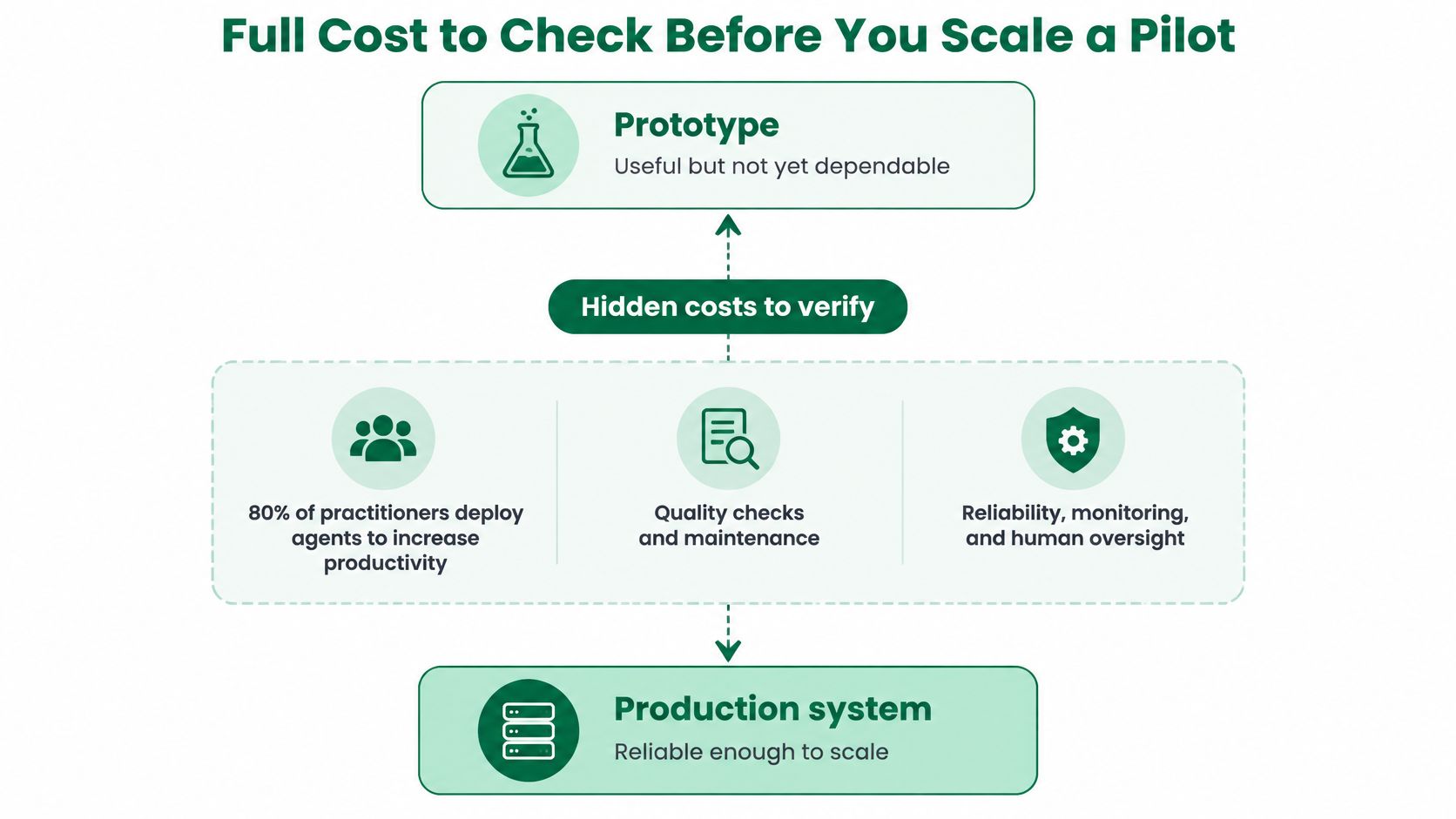
A prototype answers whether a system can produce a useful result. Production requires a separate judgment about reliability, ownership, and operating cost.
A 2025 study of AI agents deployed in production found that 80% of practitioners named increasing productivity as a deployment objective. That measures intent, not realized return; it doesn't establish a universal failure rate or the cost of governing your deployment.
The transition requires an explicit budget for the work surrounding model execution.
Budget the entire service
Cost lines in a production AI system
| Cost line | What it covers | How to estimate |
|---|---|---|
| Model inference | Charges that rise with request volume | Cost per completed task multiplied by monthly volume |
| Human review | Minutes spent checking flagged outputs | Monthly volume multiplied by exception rate, review minutes, and loaded cost per minute |
| Monitoring and evaluation | Ongoing accuracy and drift checks | Named owner's monthly hours multiplied by loaded hourly cost, plus evaluation tooling |
| Integration and maintenance | Connectors, prompts, and updates | Engineering hours per quarter multiplied by loaded hourly cost |
| Governance and compliance | Approval, audit trail, and access controls | Review cycles before each release multiplied by reviewer time and cost |
| Failure handling | Manual process when the system fails or escalates | Cases per month multiplied by manual handling time and loaded labor cost |
Keep the denominator consistent. Cost per completed task should include spending on failed attempts and retries, not only the successful final call. Otherwise, a system that repeatedly retries can appear cheaper than it is.
When comparing AI chatbot subscription costs from SupportGPT-1, treat the subscription as one budget line rather than the deployment's total cost. Add the integration, review, and fallback requirements of your own workflow before comparing alternatives.
Test the value of autonomy
More autonomous doesn't necessarily mean more valuable. A narrowly scoped assistant can be the better economic design when reliable handoffs cost less than monitoring a broader agent.
Model the assistant and the autonomous option against the same accepted-output standard. Don't credit either with labor savings that employees can't redeploy or that the business can't avoid paying.
Our total economic impact guide provides a framework for connecting those costs to outcomes. Include governance and compliance as real implementation work, but don't assign an industry-wide cost or failure percentage where the available evidence doesn't establish one.
Budget test: Scale on net savings after review, monitoring, maintenance, and failure handling, not on gross labor time apparently saved.
Run a Hype Check Before You Commit Budget
Ask for evidence on the task you're buying, not a general demonstration of model capability. A vendor can show a genuine success while leaving your input quality, operating constraints, and exception burden untested.
Hype check questions and the evidence that counts
| Question | Evidence that passes | Red flag |
|---|---|---|
| Which workflow, and what was the baseline? | Before-and-after cycle time on the same task | Satisfaction scores with no baseline |
| How many pilots reached production? | Named projects live for six months or more | Only demo or pilot counts |
| What is the cost per completed task? | Inference, review, and monitoring included | Per-seat price only |
| How does it perform on long or messy tasks? | Results at several task durations on real inputs | Benchmark scores alone |
| Who owns exceptions and fallback? | Named escalation path with a measured review rate | Fully autonomous claim with no fallback |
The production-history requirement is a proposed due-diligence standard, not a published success threshold. Use it to distinguish a dependable operating record from an attractive demonstration.
Make the next decision reversible
- Pick one workflow and record its baseline cycle time. Define the starting event, accepted deliverable, and quality requirements so the comparison remains meaningful.
- Run a bounded pilot with a named owner and a six-month production review. Give that owner authority to suspend the system when acceptance criteria aren't met.
- Calculate cost per completed task including inference, review, and monitoring. Include unsuccessful attempts rather than excluding them from the denominator.
- Set a go or stop threshold on cycle time and net savings. Agree on it before reviewing the results, and retain a manual fallback.
Don't scale merely because employees like the assistant. Scale when the workflow produces acceptable output at an economic cost, with exceptions someone can manage.
At Applied, we document verified AI use cases, tools, and quantified outcomes. Complete case studies, detailed metrics, and all use cases require joining through account sign-up; the full library of 456+ cases and detailed adoption-signal rankings are part of a paid plan.
Use Applied to explore source-backed AI implementations by industry, business function, and outcome, then create an account or subscribe to investigate the cases relevant to your workflow. Our consulting team also helps with AI strategy, education, and hands-on implementation, so you can turn a promising use case into a bounded deployment with measurable results.