Quantum Computing Future: Timelines, Risks and Readiness
Quantum Computing Future explained: realistic timelines to 2035, error correction, enterprise use cases, post-quantum deadlines and a leader's readiness plan.
October 28, 2026
Early 2025 government announcements for quantum technologies exceeded $10 billion, driven substantially by Japan's reported $7.4 billion commitment and Spain's planned $900 million investment, according to McKinsey's Quantum Technology Monitor 2025. That scale of public money changes the question for operations and technology leaders. You're not waiting to see whether governments treat quantum as strategic infrastructure. They already do.
The commercial return is less settled. McKinsey estimated quantum computing revenue and external funding could grow from approximately $4 billion in 2024 to between $16 billion and $37 billion by 2030, then to $28 billion to $72 billion by 2035. A range that wide isn't a forecast you can budget against directly. It's a signal that technical execution, especially error correction at scale, will decide which end of the range the quantum computing future reaches. Treat readiness as a security, workflow and skills program you start now, not as a purchase you make after a breakthrough headline.
Table of Contents
- Quantum Computing Timeline From Today to 2035
- Why Logical Qubits Matter More Than Qubit Counts
- Hardware Approaches Competing for the Lead
- Reading Vendor Roadmaps Without Hype
- Enterprise Workloads Most Likely to Pay Off First
- How to Build a Quantum Pilot Your Team Can Judge
- Post-Quantum Security Deadlines Leaders Cannot Ignore
- Confirm Your Quantum Budget Before the Next Cycle
Quantum Computing Timeline From Today to 2035
Quantum computing won't arrive as one moment. It'll arrive as a sequence of dated hardware targets, each testing whether vendors can turn noisy physical devices into reliable logical machines.
The timeline below separates those targets by year and status. Read the status column first. Every row is a company target, not a verified delivery.
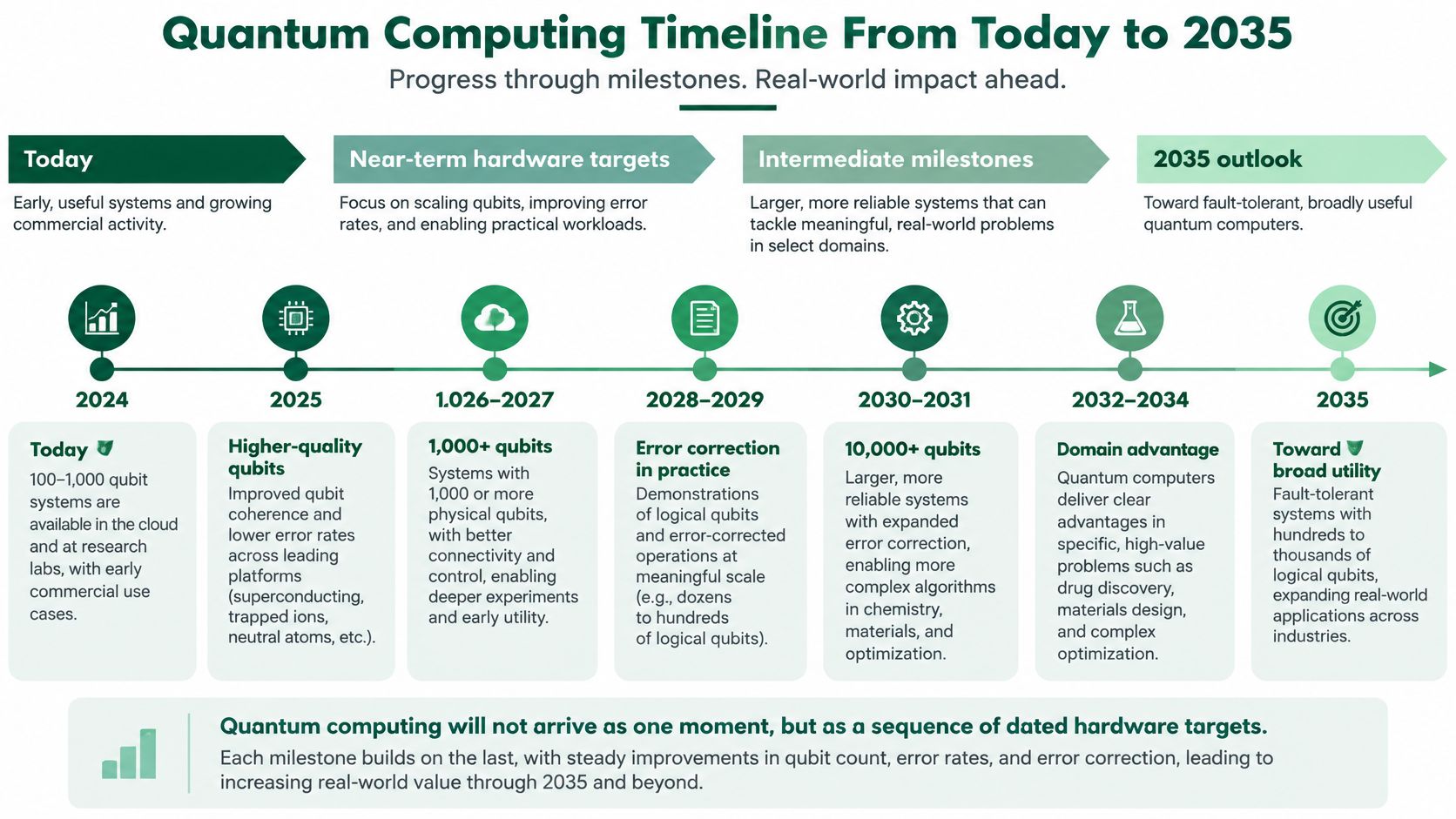
Quantum Hardware Milestones and Their Status
| Year | Milestone | Scale Target | Status |
|---|---|---|---|
| 2025 | Pasqal roadmap milestone | 1,000 physical qubits | Company target |
| 2028 | Pasqal roadmap milestone | 10,000 physical qubits | Company target |
| 2029 | IBM Starling | 200 logical qubits, 100 million gates | Company target |
| 2030 | Fujitsu superconducting system (fiscal year) | Over 10,000 qubits, 250 logical qubits | Company target |
| 2033+ | IBM Blue Jay | Up to 2,000 logical qubits, up to 1 billion gates | Company target |
Pasqal's early milestones measure physical qubits, the raw hardware units. They tell you about device scale, not yet about how many error corrected qubits a customer can program. That distinction controls how you compare Pasqal with vendors quoting logical figures.
IBM changes the unit of account in 2029. In 2025, IBM announced a goal to deliver IBM Quantum Starling by 2029, with 200 logical qubits capable of running circuits containing 100 million quantum gates. That's a claim about depth and reliability, not just size. A system that can sustain that many operations without errors overwhelming the result would mark the move from noisy processors toward fault tolerant operation.
Fujitsu follows with a mixed metric. In 2025, Fujitsu announced plans for a superconducting quantum computer exceeding 10,000 qubits and containing 250 logical qubits by fiscal 2030. For planning, the logical figure is the comparable one. The larger number describes the physical overhead needed to protect it.
IBM's longer horizon extends the same logic. Its roadmap projects Blue Jay for 2033 and beyond, with up to 2,000 logical qubits and circuits containing as many as 1 billion gates, as set out in IBM's quantum roadmap to 2030 and beyond. That is a strategic forecast, not an independently verified outcome. Treat 2029 and 2033 as checkpoints for evidence, not as dates to write into production plans.
Planning rule: Put vendor dates in your risk register, not in your delivery commitments, until a logical qubit target is demonstrated on a workload you can inspect.
The commercial stakes explain why vendors publish aggressive roadmaps, and why governments fund parallel programs. But market growth doesn't validate any single milestone. Your job is to track which targets convert into client accessible, error corrected capacity, and which slip, shrink or get redefined. The timeline is useful only if you update it when evidence arrives.
Why Logical Qubits Matter More Than Qubit Counts
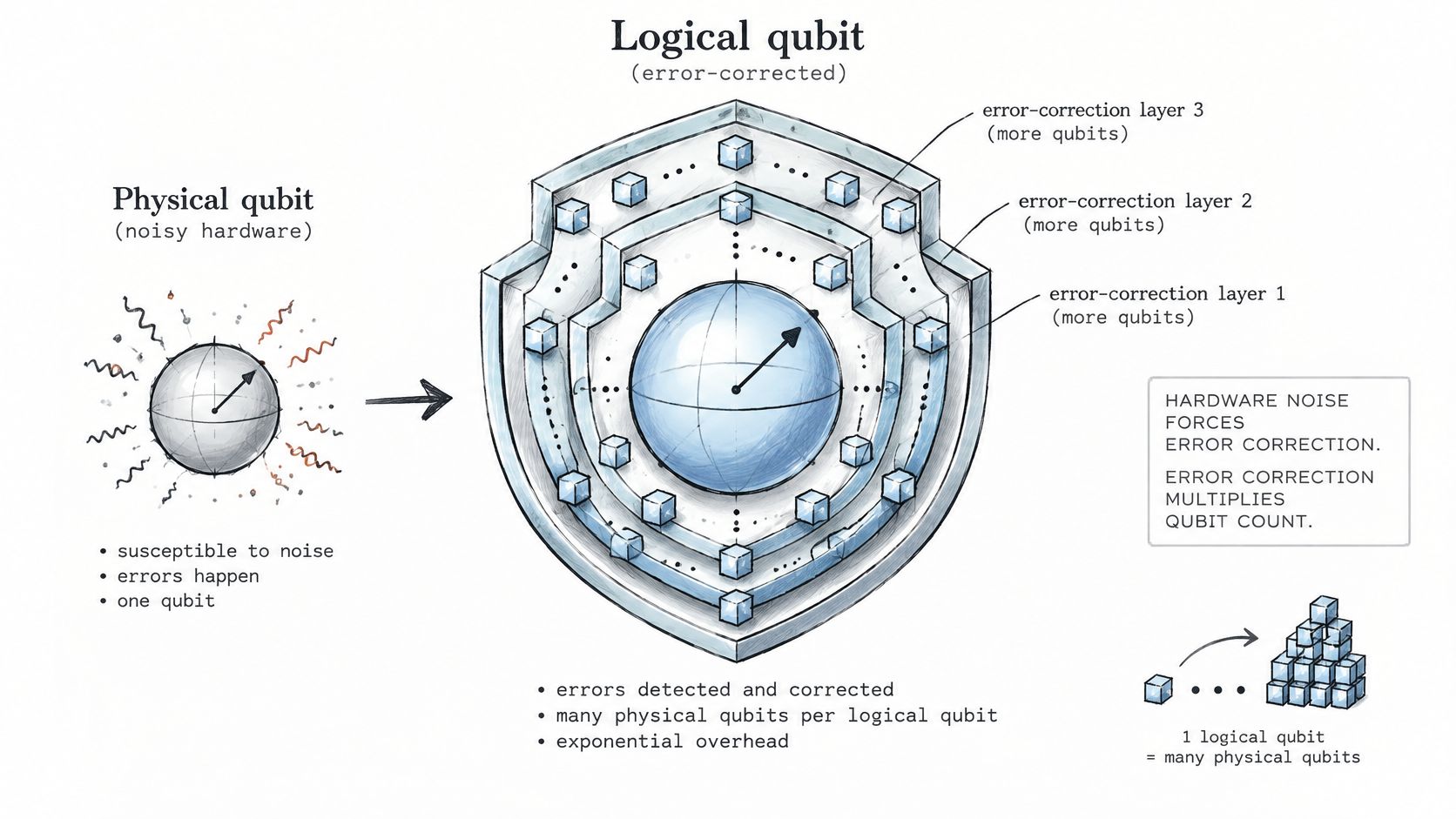
A physical qubit holds a state that interference, imperfect control and measurement errors can corrupt before a circuit finishes running. A logical qubit spreads that state across many physical qubits, with the group continuously checking for mistakes and correcting them before they propagate.
Fault tolerance has a price. Each logical qubit consumes many physical qubits plus fast classical decoding, so the gap between a chip's headline count and its protected capacity is exactly where vendor claims deserve scrutiny.
The visual below contrasts an exposed physical device with a logical qubit shielded by error correction layers.
What the Code Comparison Shows
Code choice changes the hardware bill dramatically. A 2025 NIST study on fault-tolerant hyperbolic Floquet quantum error correcting codes reported a [[400, 52, 8]] code: 400 physical qubits encoding 52 logical qubits at code distance 8, with a simulated error threshold near 0.1%. Under the same noise model and decoder, a honeycomb Floquet code required 1,924 physical qubits for comparable logical error suppression, roughly 4.8 times more.
Below a threshold, additional protection suppresses logical errors. Above it, extra hardware may not rescue the computation. A small gap in physical error rates can therefore outweigh a large gap in headline qubit counts.
The 400 qubit figure is a benchmark under a phenomenological noise model, not a product specification. Fabrication defects, leakage, measurement errors, control wiring limits and real time decoding demands can each push physical overhead higher in deployed hardware.
Why Headline Counts Mislead Buyers
A large quoted number can sound decisive while answering a different question from the one you asked. If the figure is physical, ask how many logical qubits it yields at a stated logical error rate. If it is logical, ask which code, distance and decoder assumptions produced it.
IBM's long-range target illustrates why the unit matters. In 2025, IBM published a networked quantum computing roadmap describing a system intended to run one billion operations on 2,000 qubits by 2033. Logical scale paired with circuit depth tells you more than a raw physical count, yet it remains a target. It does not demonstrate that code overhead, connectivity and decoding will perform as planned in hardware.
The primer below shows how error correction changes what a usable qubit means, before you apply the metrics that follow.
Three Metrics to Compare Instead
- Logical qubit yield: How many usable logical qubits does the system produce from its physical population at your required error rate?
- Decoder latency: Can classical hardware identify and correct errors fast enough to keep pace with the quantum circuit?
- Physical qubit efficiency: How much hardware, wiring and control effort does each logical qubit consume?
Two further questions sharpen the comparison when vendors disclose them. Check weight describes how many qubits a single error measurement touches, and connectivity describes how many neighbors each qubit can reach directly. Codes built on low weight checks and sparse connectivity place lighter demands on wiring and control than schemes requiring dense interactions. That advantage holds only if the device can run the checks repeatedly without opening new error channels, so ask for correlated noise tolerance alongside the yield figures.
A smaller machine with a better logical yield can be more useful than a larger machine whose qubits can't sustain a deep circuit.
Stop ranking vendors by the biggest integer in a press release. Rank them by protected computational capacity per unit of physical hardware, demand the assumptions behind every conversion, and build the scoring habit in vendor briefings and pilot evaluations before the hardware arrives. Teams that practice these questions now enter procurement with a working method rather than a forecast.
Hardware Approaches Competing for the Lead
No hardware route has won because each route trades a different strength against a different scaling constraint. The right question isn't which technology sounds most advanced. It's which constraint a vendor must solve before its logical qubit claims become credible.
Start with plain language analogies. Superconducting circuits are chip like electrical circuits driven by microwaves at extremely low temperatures. Trapped ions are individual charged atoms held in place and manipulated with lasers or electromagnetic fields. Neutral atoms are uncharged atoms arranged in optical grids, like pieces positioned on a board. Quantum annealing is a specialized search process that settles toward low energy configurations for certain optimization problems.
The comparison below puts those routes side by side on scalability, noise and error correction needs.
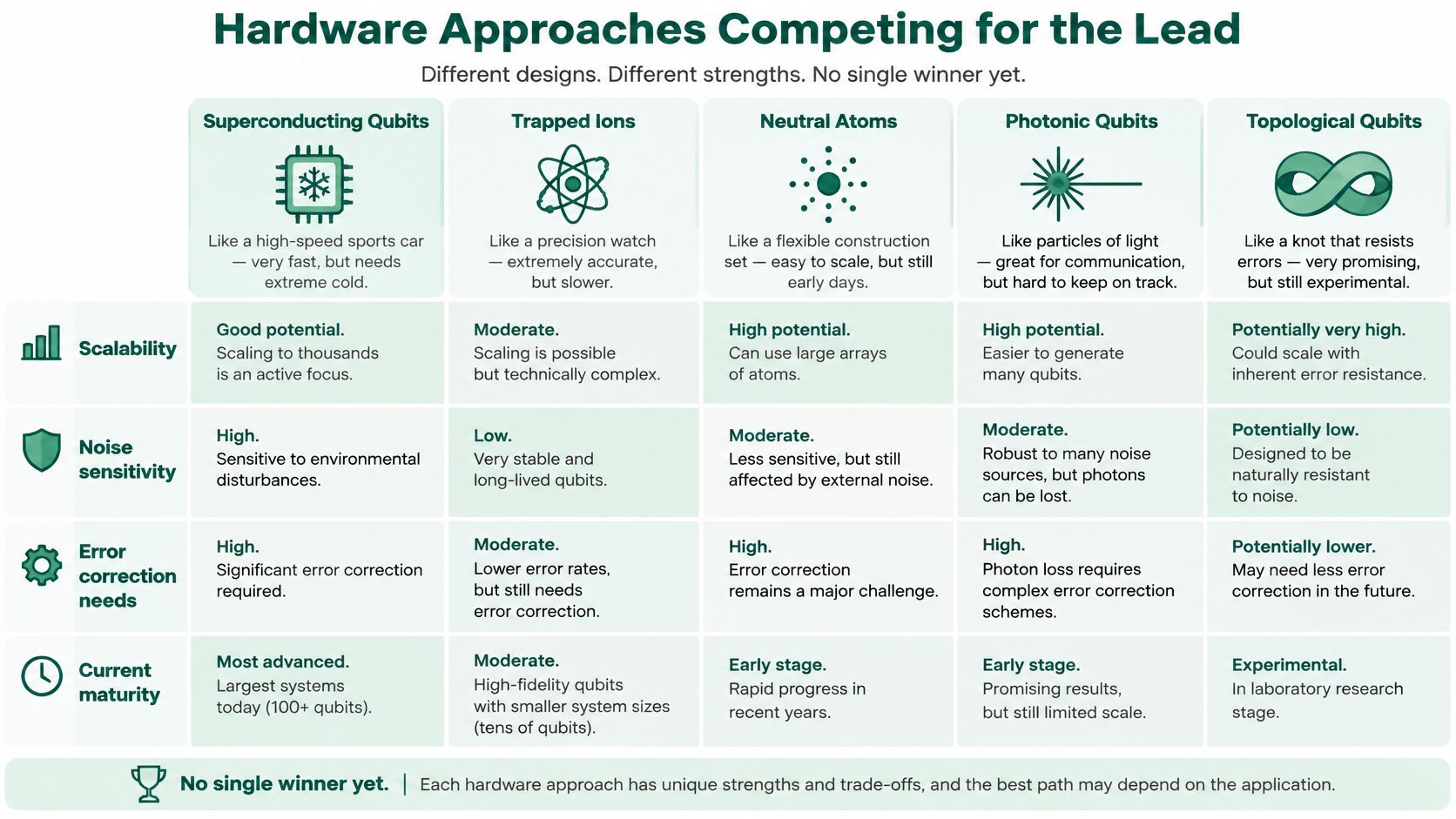
Main Quantum Hardware Approaches Compared
| Approach | Core Idea | Example Players | Main Constraint |
|---|---|---|---|
| Superconducting circuits | Microwave driven circuits chilled near absolute zero | IBM, Fujitsu | Cryogenic cooling and wiring density |
| Trapped ions | Individual charged atoms held and driven by lasers or fields | Trapped ion providers | Slower gate speeds |
| Neutral atoms | Atoms arranged in optical arrays | Pasqal | Keeping large arrays stable |
| Quantum annealing | Specialized search over energy landscapes | D-Wave | Narrower range of problems |
Superconducting systems benefit from semiconductor style fabrication knowledge and fast operations. Their constraint is physical infrastructure. As devices grow, teams must route control and readout lines into a cryogenic environment without adding heat, crosstalk or calibration burden. Wiring density becomes an engineering limit, not a footnote.
Trapped ion systems are known for high quality operations and strong connectivity between qubits in a chain or modular design. Their trade off is speed. Slower gates can mean longer runtimes and more exposure to drift during a circuit, even when individual operations are accurate. For deep fault tolerant workloads, you need to examine total logical cycle time, not fidelity alone.
Neutral atom arrays scale by arranging many atoms in reconfigurable patterns. That geometry can suit certain codes and simulation problems. The hard part is keeping large arrays stable, loaded, calibrated and measurable with uniform performance. A grid that looks elegant in a diagram still has to behave consistently across every site.
Quantum annealing doesn't compete on the same terms. It targets optimization shaped problems rather than general purpose gate circuits. That narrowness can be useful if your problem maps cleanly onto its energy model. It doesn't make annealing a substitute for a universal fault tolerant machine running arbitrary algorithms.
How to Use This Comparison
Ask each vendor two questions. First, which hardware route does the system use, and what is its binding constraint at the next scale step? Second, which error correction code do its logical qubit claims depend on, and does the device connectivity match that code?
A vendor that can't connect those answers is selling a component metric. A route wins only if its physical errors, connectivity, control stack and decoder fit together at scale.
Reading Vendor Roadmaps Without Hype
Apply three checks to every roadmap claim before you discuss price, access or timelines. First, does the claim count physical or logical qubits? Second, does it name the error correction approach it depends on? Third, is it a company target or an independently verified result?
Those checks sort the current claims quickly. They also prevent a common procurement error, comparing numbers that use different units.
Stated Quantum Roadmap Targets by Vendor
| Vendor | Stated Target | Target Year | Claim Type |
|---|---|---|---|
| IBM | Starling, 200 logical qubits, 100 million gates | 2029 | Company roadmap |
| IBM | Blue Jay, up to 2,000 logical qubits | 2033 and beyond | Company roadmap |
| Pasqal | 1,000 physical qubits, then 10,000 physical qubits | End of 2025, then 2028 | Company roadmap |
| Fujitsu | Over 10,000 qubits with 250 logical qubits | Fiscal 2030 | Company announcement |
IBM's Starling claim passes the unit check because it's stated in logical qubits and gate depth. It still fails any test that requires delivered evidence today, because it remains a future roadmap target. Blue Jay deserves the same treatment. Larger and later doesn't make it more certain.
Pasqal's claim needs translation before comparison. In 2025, Pasqal stated that its roadmap targets 1,000 physical qubits by the end of 2025 and 10,000 qubits by 2028. Those are physical scale milestones. Ask what logical yield, error rates and usable circuit depth they support, and check the end of 2025 milestone against published results rather than roadmap language.
Fujitsu mixes both units in one announcement. Compare the 250 logical qubits figure with other logical claims. Treat the larger physical number as context about overhead and engineering scale.
Access Matters as Much as the Roadmap
Most enterprises should begin with cloud access and short pilots rather than hardware purchases. That makes queue access, software stack maturity, data movement, support, and integration effort part of the product. A promising processor behind an awkward programming and orchestration layer will slow your team.
Use a profile such as the IBM Quantum tool listing on Applied to structure what a platform offers, then test claims yourself on a narrow workload. Shortlist two providers using different hardware routes. Run the same problem, with the same classical baseline and success criteria, on both.
Roadmap discipline: If a vendor won't state the code assumptions behind a logical qubit number, treat that number as marketing until proven otherwise.
Every figure in the table is a vendor claim, not a delivered result. Your evaluation should reward vendors who publish assumptions, report misses and show logical performance on repeatable benchmarks.
Enterprise Workloads Most Likely to Pay Off First
The plausible early workloads aren't a mystery. Teams usually start with optimization, such as routing, scheduling and portfolio selection, molecular and materials simulation, and risk analysis. The hard part is deciding which specific instance deserves money, because a category can be promising while your formulation is a poor quantum fit.
Screen each candidate before you discuss hardware. You need a classical baseline that is expensive, slow or inaccurate enough to matter, and a quantum formulation whose resource demands don't erase the benefit.
Screening Criteria That Expose Weak Candidates
- Logical depth: How many sequential logical operations must survive before you get an answer?
- Non-Clifford or T gate volume: How much of the circuit depends on operations that are costly in fault tolerant implementations?
- Rotation precision: How finely must angles be synthesized, and what overhead does that precision add?
- Data loading cost: How expensive is it to get classical data into the quantum state?
- Allowable output error: How accurate must the final answer be for a business decision?
Resource estimation turns those questions into a hardware bill. A 2025 study on improving hardware requirements for fault tolerant quantum computing by optimizing error budget distributions found that optimizing quantum circuits reduced gate counts by only 13% to 20% but cut estimated fault tolerant resource requirements by as much as 41%. Algorithmic work isn't decoration. It can change whether a workload fits a plausible machine.
Physical Qubit Requirements at Different Error Budgets
| Scenario | Error Budget | Physical Qubits | Runtime |
|---|---|---|---|
| Example circuit at 99.9% gate fidelity | 0.1% logical error target | About 5,000 | Not stated for this example |
| Representative circuit, loose budget | 10% | 30,600 | 82.0 ms |
| Representative circuit, tight budget | 0.1% | 112,104 | 205.2 ms |
The same technical research estimated that one example circuit executed with 99.9% physical gate fidelity and a target logical error rate of 0.1% would require approximately 5,000 physical qubits. That's a useful calibration point. Even a single example circuit, under stated assumptions, moves quickly into thousands of physical qubits once you demand fault tolerant accuracy.
The representative circuit shows the sharper lesson. Tightening the total error budget from 10% to 0.1% raised the estimate from 30,600 to 112,104 physical qubits, while runtime rose from 82.0 ms to 205.2 ms. Accuracy isn't a free parameter you tighten at the end. It's a cost driver you set during workload selection.
Benchmark accordingly. Compare end to end physical qubits, logical cycles, decoder workload, runtime and confidence intervals. Don't compare isolated processor size or a single gate fidelity number. A workload that needs deep circuits, heavy data loading and very tight output error is a later candidate, even if its business value looks large.
Simulation illustrates the right way to frame a candidate. The case of how Moderna uses IBM Quantum computing to advance mRNA medicine is relevant because molecular problems have quantum mechanical structure. That doesn't guarantee advantage for every chemistry workflow. It means the problem class deserves resource estimation against the best classical method, not a generic claim about drug discovery.
My judgement is that narrow simulation tasks, selected optimization instances with clean formulations, and risk calculations with tolerant output requirements are plausible earlier candidates for serious pilots. Broad optimization replacement, large scale chemistry and production risk engines belong later until resource estimates fall and logical machines exist to test. The quantum computing future will reward teams that sort workloads by cost to run, not by excitement in a workshop.
How to Build a Quantum Pilot Your Team Can Judge
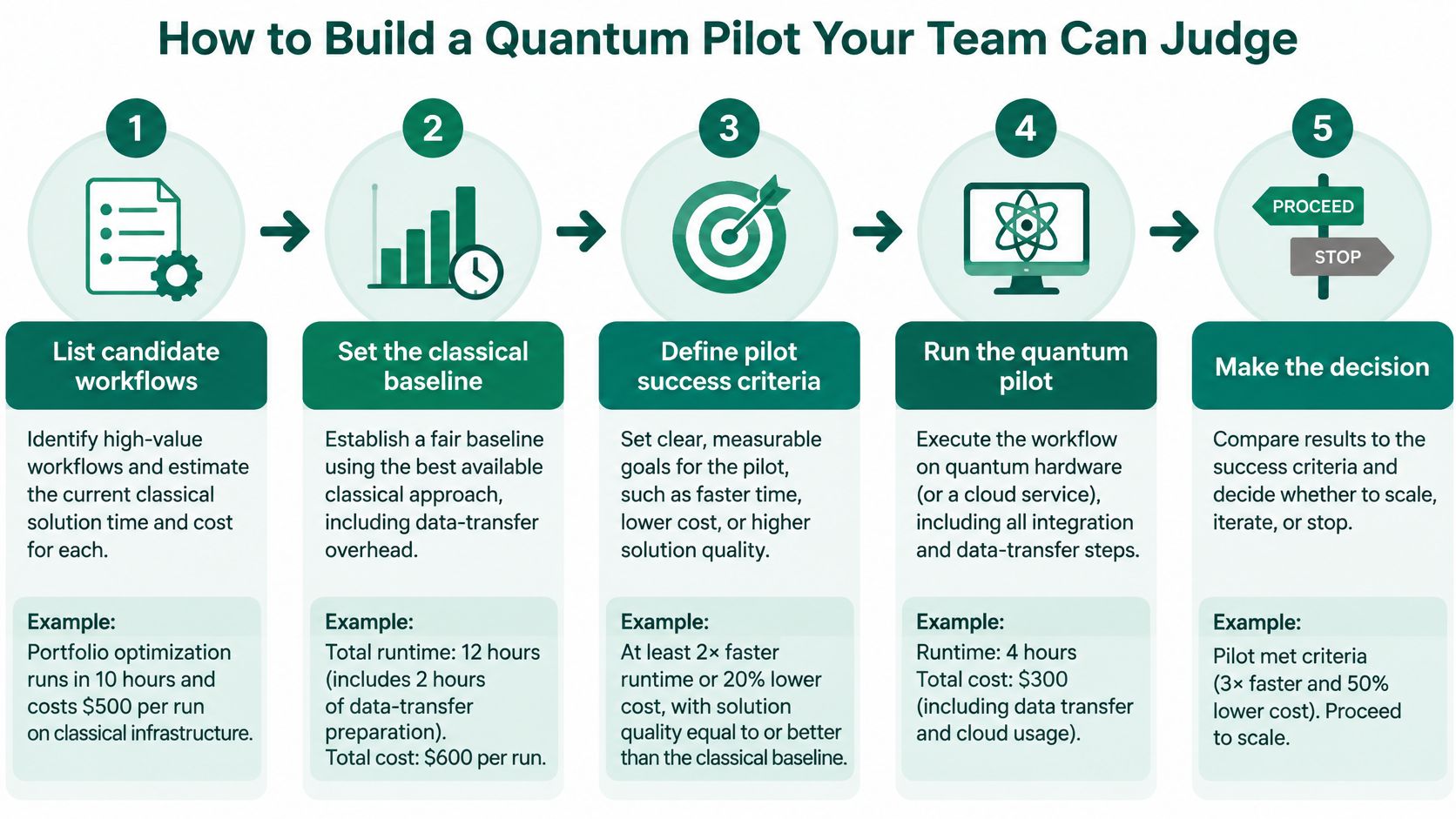
A pilot is only useful if its results can change a decision. Start by recording the cost, runtime and limitations of the classical method you would deploy. Without that baseline, a quantum result has no meaningful point of comparison.
The six-step sequence below takes a candidate workflow from selection to a decision on whether to stop or scale.
Six Steps Before You Scale Anything
- List candidate workflows: Record each workflow's classical solution time, cost, accuracy and business owner. These measures establish what a pilot must improve.
- Set the classical baseline: Compare against the best classical method you would deploy, including data transfer and preprocessing.
- Estimate integration cost: Include identity, data pipelines, orchestration, security review and support. Connecting a pilot to existing systems can cost more than the computation.
- Run a bounded cloud pilot: Test one narrow workflow with a fixed budget and time limit while the results are uncertain.
- Write decision criteria first: Set stop, scale and replace thresholds before results arrive, so expectations do not shift after the test.
- Build internal literacy: Assign a small team to assess resource estimates, question vendor assumptions and explain negative results.
The barriers are organizational as well as technical. An OECD analysis of business readiness for quantum computing reports workforce shortages for 40.6% of organizations, unclear business value for 39.6%, high implementation costs for 39.6%, and technology immaturity for 34.4%. These figures make workforce capacity, costs and a clear use case practical pilot criteria, not issues to defer until hardware access improves.
Set the baseline and decision thresholds before booking significant hardware time. Access alone produces a demonstration; a defined comparison makes the result useful to finance and operations leaders.
Vendor surveys show why expected returns need scrutiny. In a 2024 survey of more than 300 enterprise decision makers, D-Wave reported that 21% expected to use quantum computing in production within 12 to 18 months. Respondents also reported anticipated annual investments of $3 million to $6 million and expected benefits of $60 million to $65 million. These are respondent expectations, not verified results or a budgeting benchmark for your organization.
Use the survey as a hypothesis to test. It indicates optimism about optimization returns, but does not show that a particular routing, scheduling or portfolio problem will deliver them.
A pilot that cannot beat its classical baseline should be replaced, not extended with a new explanation.
Record negative results as carefully as positive ones. A stopped pilot can identify costly formulations, missing data pipelines and skills the team needs. Without a decision rule, extending a pilot adds cost without clarifying whether the workflow merits further investment.
Post-Quantum Security Deadlines Leaders Cannot Ignore
Encrypted data captured today may still be sensitive when capable machines exist, which makes quantum security a present planning problem rather than a future event. Harvest now, decrypt later collection applies to long lived personal data, trade secrets, health records, legal files and state related communications.
Your exposure depends on two clocks. One is how long data must remain confidential. The other is how long migration will take across certificates, software dependencies, hardware and suppliers. If those periods overlap with plausible quantum capability, waiting is a decision with consequences.
Post-Quantum Migration Deadlines in the U.S. Framework
| Deadline | Requirement | Applies To |
|---|---|---|
| 2030 | Quantum vulnerable public key algorithms deprecated | NIST standards and guidelines |
| December 31, 2030 | Quantum resistant key establishment adopted | Federal high value assets and high impact systems |
| December 31, 2031 | Quantum resistant digital signatures adopted | Federal high value assets and high impact systems |
| 2035 | Quantum vulnerable algorithms disallowed, migration complete | NIST standards and federal systems under NSM-10 |
The federal path runs in phases. NIST's post quantum cryptography project sets out that quantum vulnerable public key algorithms are to be deprecated after 2030 and disallowed under NIST standards and guidelines after 2035, with the broader federal objective under National Security Memorandum 10 to complete migration to quantum resistant cryptography by 2035.
High value federal systems carry earlier, dated requirements. Under the U.S. transition framework described in Nextgov's report on NIST's post quantum roadmap, agencies must adopt quantum resistant key establishment by December 31, 2030, and quantum resistant digital signatures by December 31, 2031. These are mandated compliance dates, not forecasts about when a cryptographically relevant machine arrives. Key establishment protects the shared secrets behind encryption. Digital signatures provide authentication and integrity. They solve different problems, so they migrate as separate workstreams with separate owners.
Those requirements travel through procurement. Cloud services, networking equipment, identity platforms and managed security products all inherit them. If you sell into government or regulated supply chains, a customer's deadline becomes your product deadline.
Uncertainty Doesn't Remove the Obligation
Expert timing remains disputed. NIST's post quantum cryptography migration FAQ describes views ranging from cryptanalytically relevant systems possibly emerging by 2030, to many placing feasibility within 15 to 20 years, to others expecting more than 30 years. A responsible migration plan cannot rest on any single forecast date.
Nor will the transition be a clean jump from noise to full fault tolerance. IBM's discussion of the error correction continuum reports hybrid error correction and mitigation producing an approximately 10 fold reduction in effective error rates and a 63 fold reduction in inferred sampling overhead compared with mitigation alone. Intermediate gains like these can expand useful workloads well before full fault tolerance, which is why capability monitoring belongs inside the security program rather than outside it.
Start with work that pays off under every forecast in that range. Inventory the cryptography your environment runs: which systems depend on vulnerable public key algorithms, where certificates are issued and renewed, which hardware cannot be updated in the field, and which data must stay confidential past the early 2030s. Then rank migration by data lifetime and system criticality. Every item on that list is progress you control, whichever hardware forecast proves right.
Confirm Your Quantum Budget Before the Next Cycle
Quantum computing will matter for specific workloads and for security well before it matters across the whole enterprise. Fund preparation now. Don't fund production quantum systems on roadmap confidence.
Put money into three tracks in urgency order. First, post quantum security. Build a cryptographic inventory covering certificates, software dependencies and hardware, then map it against the 2030, 2031 and 2035 milestones that affect your systems and suppliers. This track has dated external requirements and protects data already moving across your network.
Second, skills. Train a small, named team to read vendor roadmaps, challenge logical qubit conversions, run resource estimates and maintain classical baselines. You don't need a large quantum department. You need enough internal judgement to stop weak pilots and recognize credible evidence.
Third, a bounded pilot. Choose one shortlisted workload, access hardware through the cloud, cap the spend and write stop, scale and replace criteria before work begins. Compare two hardware routes if you can, but keep the problem and baseline identical.
What would change this allocation? A logical qubit milestone delivered on schedule with inspectable performance, or a pilot that beats its classical baseline repeatedly under production like constraints, would justify moving money toward production testing. A bigger physical qubit headline wouldn't.
Until then, keep budgets small, reviewable and tied to evidence. Create an account with Applied to access its library of AI use cases and tools organized by industry, business function and outcome, and use those deployment patterns to compare how adjacent technologies move from experiment to operations. The quantum computing future won't reward the loudest forecast. It'll reward teams that prepared their cryptography, workflows and judgement before advantage arrived.
Applied helps operations, engineering and strategy leaders see how organizations deploy emerging technology in practice, with verified implementations and tools organized by industry, business function and outcome. Create an account to explore the library, compare adoption patterns and bring the same evidence discipline to your quantum readiness decisions. Start at Applied.