Dynamic Pricing Models Explained: Five Types Compared
Learn how dynamic pricing models work, which of the five types fits your data, and how to test, govern and deploy one safely.
October 24, 2026
You're reviewing a pricing proposal, and every option sounds reasonable. Your sales lead wants faster competitor matching, your data team suggests machine learning, and customer service wants prices people can understand. You need to choose something that works with the data you have, without creating a pricing decision nobody can explain.
Dynamic pricing models differ less in how often prices move than in how they decide what to charge. The right starting point depends on your records, commercial objective, and disclosure obligations, not which algorithm tops a benchmark.
Table of Contents
- What Dynamic Pricing Models Do Each Time a Price Moves
- Five Dynamic Pricing Models Compared
- How Rules, Forecasts and Elasticity Models Set Prices
- How Bandits and Reinforcement Learning Learn From Prices
- Data Needs and Cold-Start Rules by Model
- Metrics and Experiments That Prove a Model Works
- Fairness, Disclosure and Regulatory Limits to Plan For
- Tooling and Workflows by Rollout Stage
- Pick Your First Model and Roll It Out in Stages
What Dynamic Pricing Models Do Each Time a Price Moves
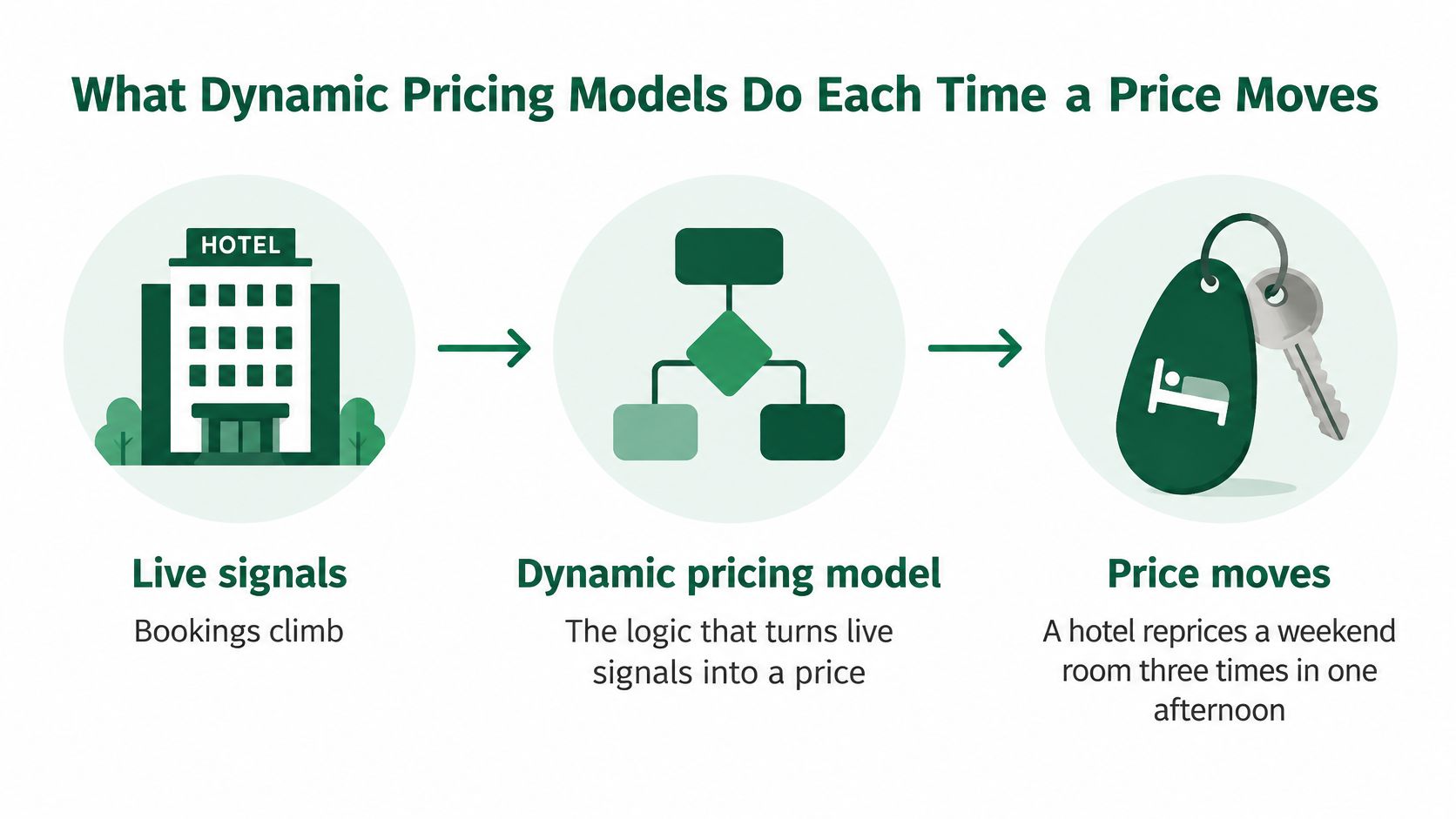
Suppose you manage a hotel, and your system reprices a weekend room three times in one afternoon as bookings climb. That's an illustrative scenario, not a recommendation about update frequency. The important question is what happens between each booking signal and the next published rate.
A dynamic pricing model is the logic that turns changing conditions into a price. Think of a thermostat: it senses conditions, compares them with a target, adjusts, and checks again. A pricing system needs the same feedback discipline, except its target might involve margin, occupancy, or revenue.
The process connects incoming signals to a controlled price decision.
Follow the decision loop
LatentView's explanation of dynamic pricing describes a closed loop connecting operational signals, price calculation, publication, and outcome measurement. For the hotel, that translates into these stages:
- Collect signals. Gather bookings, available rooms, competitor rates, and time until arrival.
- Interpret conditions. Decide whether booking demand is stronger or weaker than expected.
- Calculate a price. Apply the selected model to the current situation.
- Publish within limits. Check the recommendation against approved floors and ceilings.
- Measure the result. Feed subsequent sales or margin performance into the next decision.
When demand accelerates or capacity tightens, the system may recommend a higher price. When demand weakens or excess inventory builds, it may recommend a reduction. The direction isn't predetermined, and an increase isn't automatically evidence that the model is working.
Automation isn't the whole distinction
Depending on the infrastructure, updates can happen hourly, by the minute, or faster, as the linked LatentView explanation describes. But speed alone doesn't make a pricing process intelligent. A tool that repeatedly publishes prices without tracking their consequences is missing the feedback step.
For an accessible companion explanation before evaluating vendors, Reddog Consulting Group's guide to how dynamic pricing works provides a useful starting point.
Vendor test: Does the tool measure outcomes after a price change, or does it only calculate and publish prices?
Five Dynamic Pricing Models Compared
The main differences are decision logic, data requirements, and build complexity. Treat the following comparison as a selection guide, rather than a ranking from inferior to superior.
Dynamic pricing model types compared
| Model | How it sets price | Data it needs | Best fit | Build complexity |
|---|---|---|---|---|
| Rule-based | Fixed if-then conditions on inventory, calendar, or competitor triggers | Current inventory, calendar, and competitor snapshots | Stable catalogs, fast launch, audit-heavy teams | Low |
| Elasticity-based | Estimates how volume responds to price, then selects for margin or revenue | Price and volume history with real price variation | Retail and B2B catalogs with fairly stable demand | Medium |
| Forecasting-based | Predicts demand and prices against the forecast and remaining inventory | Sales history, seasonality, and booking pace | Airlines, hotels, fuel, and other time-sensitive inventory | Medium to high |
| Contextual bandits | Chooses among price options for a context and learns from outcomes | Context features and logged results for every offer shown | Offer ranking and price tests at scale | High |
| Reinforcement learning | Learns a policy across sequential decisions and future consequences | Long interaction histories, a simulator, and strict guardrails | Large multi-product platforms with fast feedback | Very high |
Read the data column first
Start with what your team can observe reliably. If you only know today's stock position and approved calendar events, a rule-based approach is a realistic candidate. If you have historical transactions but almost no price changes, an elasticity model deserves skepticism.
Then read build complexity. This includes more than model development: you'll need integrations, testing, monitoring, and someone who can investigate an unusual recommendation. A technically feasible model can still exceed your team's operating capacity.
Combine models when the job requires it
These categories aren't mutually exclusive. You might forecast demand, estimate the likely response to candidate prices, and then apply rules that prevent an unacceptable recommendation from reaching customers.
Bain's dynamic pricing overview describes a range from explicit rules to more complex approaches using multiple market variables. The practical trade-off is straightforward: simpler logic is easier to inspect, while more flexible logic needs stronger data and governance.
My recommendation is to start near the top of the table. Move toward learning models only when you can explain what additional decision they'll improve and which records will support that improvement.
How Rules, Forecasts and Elasticity Models Set Prices
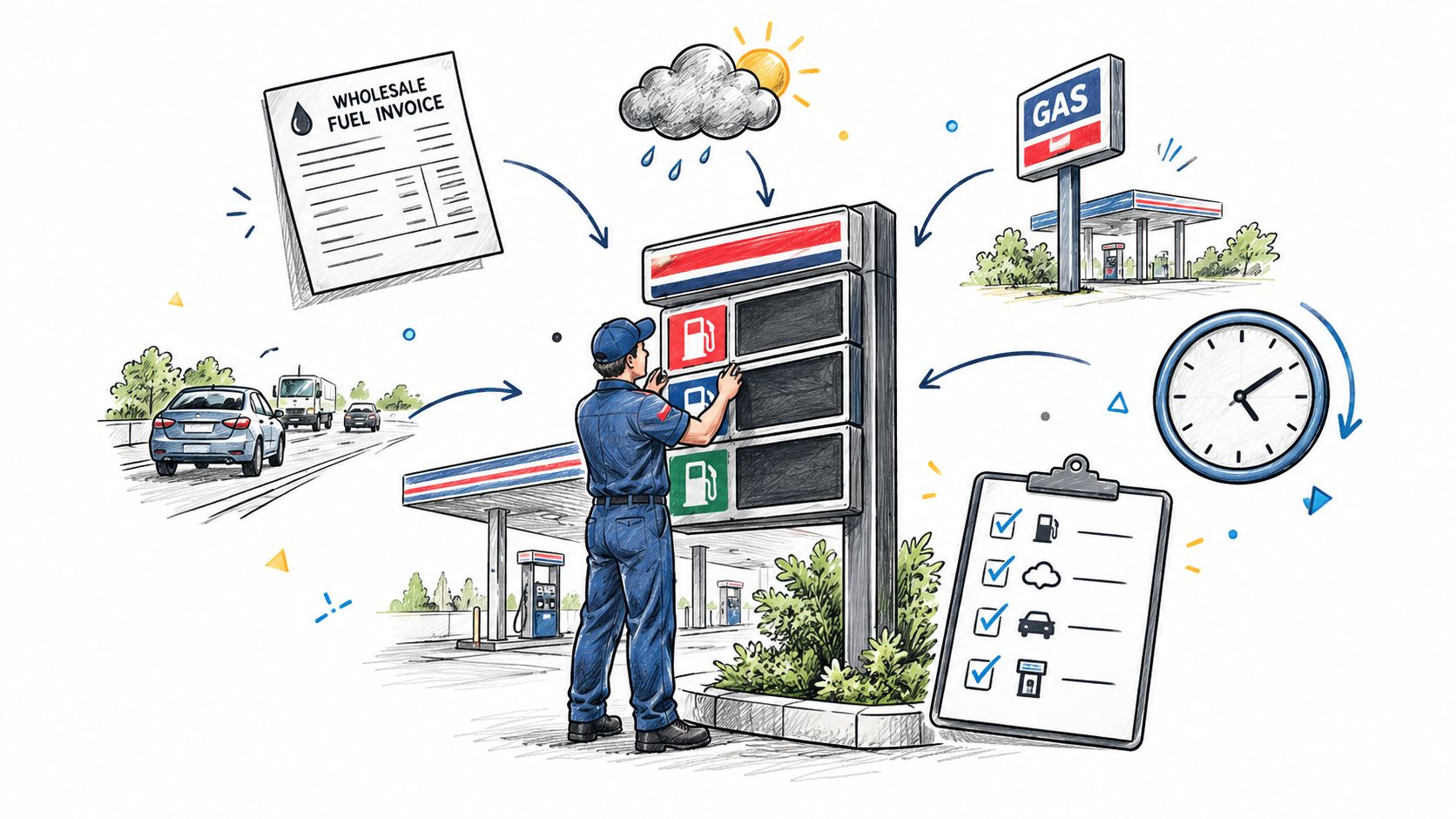
A fuel retailer offers a concrete starting point. As Bain's overview describes, street prices may change throughout the day in response to wholesale costs, weather, traffic, and competitor reactions. A rule-based system translates selected conditions into explicit actions.
The visible price change is only the final step.
Rules make the reasoning explicit
An illustrative rule might say: when replacement costs rise, recalculate the minimum acceptable selling price before considering a competitor match. Another might prevent a promotional discount from taking the product below its approved margin floor.
The advantage is traceability. A pricing manager can inspect the condition, identify the input, and explain the action. The weakness is that a rule won't necessarily reveal when its underlying assumption stops being useful.
For an implementation-level example in online retail, Dotstore explains how to create WooCommerce discount rules. Keep the distinction clear: automating a discount condition doesn't mean the system has learned demand or price sensitivity.
Forecasts account for what may happen next
Airline revenue management developed after U.S. domestic air travel was deregulated through the Airline Deregulation Act of 1978, which encouraged a more complex allocation of seats across fare products, according to this history of airline revenue management.
The forecasting problem is easier to understand than the terminology. An airline needs to decide whether selling a seat now is better than keeping it available for a possible later booking. Once the aircraft departs, an unsold seat has no remaining selling value.
Salesforce's airline pricing explanation identifies inputs including historical demand, time until departure, booking velocity, competitor fares, seasonality, and remaining capacity. In an illustrative decision, stronger-than-expected advance bookings could justify restricting cheaper fares; weak bookings near departure could justify considering a reduction.
Neither outcome should be treated as an automatic rule. The relevant comparison is actual demand against expected demand, not merely whether departure is getting closer.
For more on preparing those predictive inputs, use this guide to AI for demand forecasting.
The following video provides an additional format for exploring the pricing topic.
Elasticity estimates the response to a change
Price elasticity describes how sensitive purchase volume is to price. Instead of asking how much demand to expect, you ask how demand might differ if you charge more or less.
Suppose a retailer raises a product's price and sales decline. That observation alone doesn't establish price sensitivity: a promotion may have ended, a competitor may have restocked, or seasonal demand may have weakened.
An elasticity model therefore needs meaningful price variation and a way to account for other influences. Even when lower prices could increase revenue, they don't necessarily increase profit. Evaluate the estimated response against product costs, not just sales volume.
How Bandits and Reinforcement Learning Learn From Prices
A learning model isn't automatically a better pricing model. It earns its complexity only when your team can supply enough feedback, define a suitable objective, and limit the cost of exploration.
Consider a shopkeeper choosing among approved shelf prices. A contextual bandit learns which option performs best under the observed circumstances. A reinforcement-learning policy addresses a longer problem: how today's choice changes the options and outcomes available later.
Immediate feedback versus sequential decisions
A bandit balances exploration, trying options to learn, with exploitation, favoring options that currently look promising. The context might describe a product, sales channel, or market condition. It doesn't have to include an individual shopper's personal information.
Reinforcement learning adds an explicit sequence of decisions. For a seasonal retailer, a discount today affects both immediate sales and the stock left for later. That makes the objective closer to planning the whole selling season than picking the strongest current offer.
| Decision question | More natural starting point |
|---|---|
| Which approved offer performs best in this context? | Contextual bandit |
| How does today's price affect later inventory and returns? | Reinforcement learning |
| Can we explain every action through a fixed condition? | Rules |
These are useful design distinctions, not guarantees of performance. A poorly specified reward can encourage either learning approach to optimize something the business doesn't want.
What the Tmall experiment demonstrated
In a field experiment across thousands of products over several months on Alibaba's Tmall platform, researchers compared DQN and DDPG pricing policies with manual pricing; against a control normalized to 1.00, average dynamic revenue-conversion rate was 6.07 for DDPG and 5.03 for DQN, according to the Tmall reinforcement-learning pricing study.
The same study reported that continuous price actions outperformed discrete price menus and that dynamic revenue-conversion rate, or DRCR, was a more suitable optimization target than revenue alone. DRCR incorporates both realized revenue and conversion behavior.
Those are field results, not a promise that adopting the named algorithms will reproduce the outcome. The commercial lesson is to match the reward to the decision you want improved, then test whether the policy delivers that improvement in your setting.
A learning model optimizes the objective you give it. It doesn't decide whether that objective is good for your customers or your business.
Continuous actions also create an execution requirement. Your platform must support sufficiently granular prices, while your approval logic must constrain volatility, unfair outcomes, and experiment exposure. If those controls aren't ready, a limited menu of approved prices may be the more practical deployment choice.
Data Needs and Cold-Start Rules by Model
A pricing team with three years of logged offers and outcomes can run models that a team with six weeks of receipts cannot. Your records decide which models are even candidates, so audit the data before comparing benchmark scores.
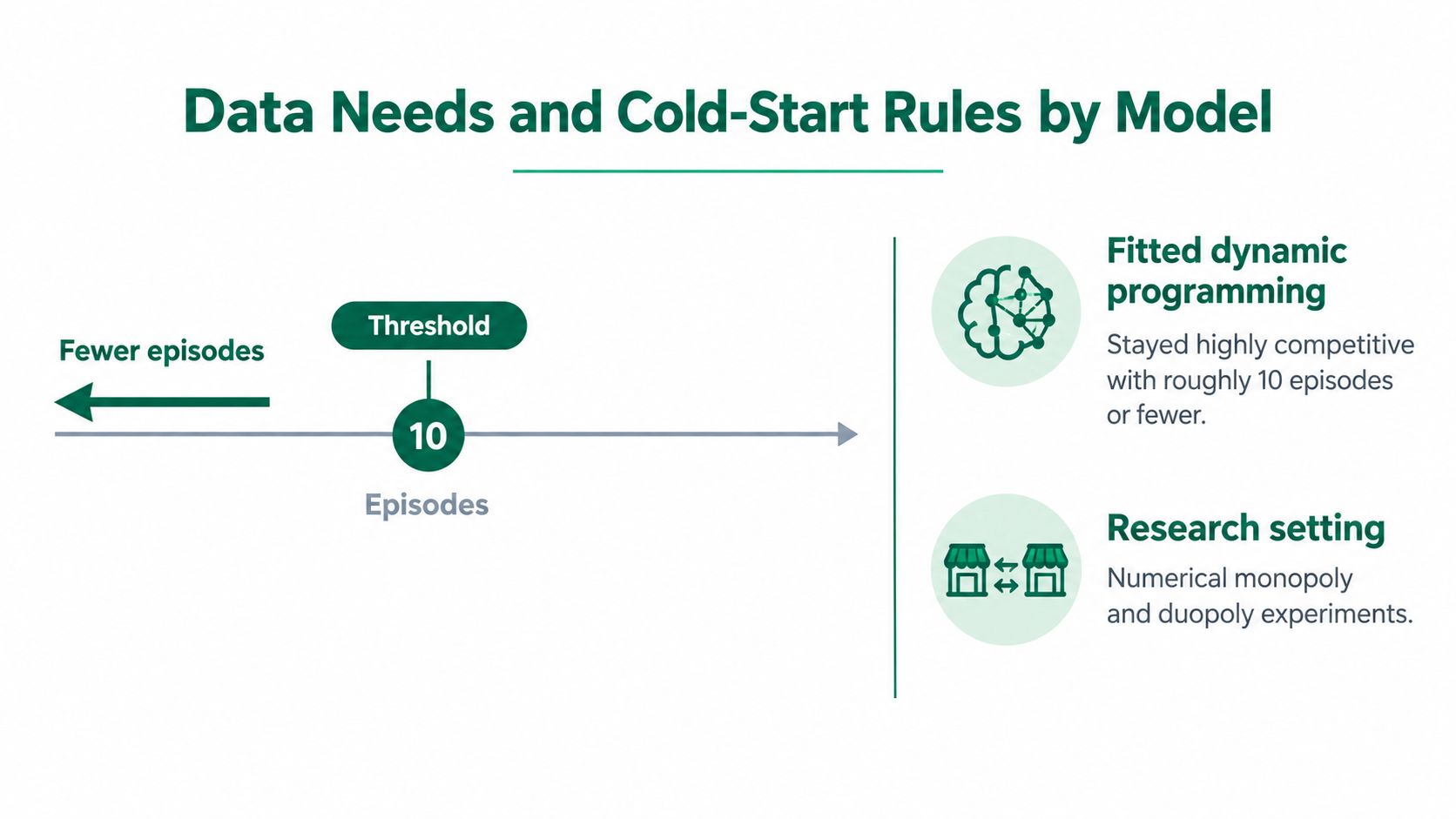
Start with a baseline when experience is scarce. In numerical monopoly and duopoly experiments, fitted dynamic programming remained highly competitive with approximately 10 episodes or fewer; reinforcement learning generally surpassed it around 100 episodes, with PPO strongest in that range; and leading algorithms including TD3, DDPG, PPO, and SAC reached roughly 90% or more of the optimal benchmark around 1,000 episodes, according to the dynamic-pricing algorithm comparison.
An episode is one simulated selling period in that research setting, not a calendar day or a single customer visit. Those thresholds describe simulated markets only. They do not set a warmup quota for bandit or forecasting deployments, where readiness depends on what your data covers rather than on any fixed count.
The cold-start result supports a staged approach, not a mandatory learning curve.
Match inputs to the intended design
The following requirements describe practical inventory-aware implementations. They aren't mathematical requirements for every possible version of each model.
Data requirements by model type
| Data input | Rules | Elasticity | Forecasting | Bandits | Reinforcement learning |
|---|---|---|---|---|---|
| Inventory or capacity levels | Required | Optional | Required | Optional | Required |
| Historical price and volume pairs | Not needed | Required, with variation | Helpful | Helpful | Required |
| Competitor price snapshots | Common input | Optional | Helpful | Optional | Optional |
| Customer or session context | Rarely needed | Segment-level | Optional | Required for personalization | Required for personalization |
| Logged result for every price shown | Not needed | Not needed | Not needed | Required | Required |
| Ready to learn when | Day one; runs on logic alone | Price history shows enough variation to estimate response | History covers the demand patterns being forecast | Logged outcomes accumulate; it keeps improving | Value estimates hold up in simulation, then live testing |
Read down the rows before choosing a model. Inventory connects recommendations to what's sellable; price-volume history supports response estimation; competitor snapshots add market context. Customer-level context introduces a separate personalization decision, since individualized prices carry disclosure and fairness duties that a rule-based price does not. Offer logs reveal responses to prices that didn't produce purchases.
Repair the records before increasing complexity
The elasticity trap is an archive of transactions at an almost unchanged price. The bandit trap is a purchase-only dataset: without offers that customers declined, you can't reliably compare exposure with response.
Before modeling, run these checks:
- Align timestamps. Connect the price shown, inventory available, and outcome to the same decision moment.
- Reconcile inventory. Explain differences among sales, cancellations, returns, and available stock.
- Measure competitor coverage. Identify missing products, stale observations, and incomparable offers.
Use rules or a model-based baseline while repairing those gaps. Then benchmark a learning candidate against that baseline, rather than treating accumulated records as automatic permission to deploy it.
Metrics and Experiments That Prove a Model Works
Metrics for judging a dynamic pricing model
| Metric | What it reveals | Common trap |
|---|---|---|
| Revenue per visitor | Money earned per session | Can rise while conversion and loyalty fall |
| Conversion rate | Share of visitors who buy | Ignores margin on each sale |
| Gross margin per unit | Selling price less product cost | Incomplete cost treatment can obscure discount effects |
| Dynamic revenue-conversion rate (DRCR) | Revenue and conversion behavior together | Needs a stable control baseline |
| Price-change frequency | How often a price moves | Frequency isn't evidence of value |
| Complaint and cancellation rate | Customer reaction | May lag behind price changes |
| Inventory sell-through | Share sold before expiry or season end | Encourages underpricing if used alone |
Choose a primary metric before testing. The earlier Tmall example illustrates why revenue alone may be insufficient; for cost-sensitive decisions, SellerAI's explanation of how landed costs affect profitability is a useful accounting companion.
Build a comparison you can trust
Randomize at the product, store, or customer level, choosing the unit that best limits interactions. Keep a holdout on the previous rule or a fixed price.
As a practical starting design, run the test for at least two full weeks to include weekday and weekend demand. Don't treat that duration as proof of sufficient evidence: volume, seasonality, and uncertainty still matter.
- Check spillover. Separate markets where feasible, and investigate whether treatment changes shift holdout sell-through.
- Define stop conditions. Set complaint, cancellation, and sell-through guardrails before launch.
- Promote conditionally. Require improvement on the primary metric without a guardrail breach.
Use a documented AI model evaluation process so a positive headline result doesn't override an unreliable experiment.
Fairness, Disclosure and Regulatory Limits to Plan For
A hotel room that costs more during a festival weekend irritates people. A price that rises because of a shopper's own browsing history angers them. The first is market-condition pricing. The second is personalized pricing, and it draws the sharper scrutiny.
Maryland shows where that scrutiny is heading. Orrick's analysis of algorithmic pricing restrictions reports that the state's Protection from Predatory Pricing Act takes effect on October 1, 2026, barring food retailers and third-party delivery providers from using consumer personal data, collected or purchased, to set higher prices. The scope is narrow, but the target is not: legislatures are moving against personal data used to raise prices, not demand-based repricing. Treat it as a template other jurisdictions may copy.
Survey numbers need the same care. In YouGov's April 2024 survey, 42% across 17 markets called dynamic hotel pricing fair. In CivicScience's March 2024 data, 44% of U.S. adults aware of dynamic pricing strongly agreed it constituted price gouging, in research aimed at restaurant brands. Different samples, wording, and industries mean the figures don't trade off against each other. The safe reading: acceptance depends on context and on whether customers understand why a price moved.
Disclosure improves process judgments, not outcomes
A study of algorithmic transparency and perceived pricing fairness finds that explaining the algorithm improves how customers judge the pricing process without settling whether the outcomes are fair. Disclosure is a starting condition, so test what customers experience:
- Compare outcomes across customer segments.
- Audit features for prohibited inputs and proxies.
- Escalate large changes for human review.
- Offer an appeal route and monitor complaints.
Give counsel a defined checklist: does each selling market restrict personal-data pricing, require disclosure that an algorithm sets prices, or apply sector rules like Maryland's? A documented AI regulatory compliance workflow should map each answer to the features and markets you use.
Tooling and Workflows by Rollout Stage
Choose tools for the stage you've reached, not the model you hope to build. A traceable rule engine can be more useful than an advanced learning library if your team still can't reconstruct why a customer saw a particular price.
Tool categories by rollout stage
| Stage | Tool category | Purpose |
|---|---|---|
| Rules | Rule engine with audit log | Enforce floors, ceilings, calendar triggers, and change caps |
| Holdout testing | Experimentation platform | Randomize by product, store, or customer and report guardrails |
| Forecasting | Time-series and demand-forecasting libraries | Predict demand and remaining inventory for price calculations |
| Learning | Bandit and reinforcement-learning libraries with a simulator | Evaluate policies once complete offer-outcome logs exist |
Add experimentation capability before promoting an adaptive model. Forecasting tools become useful when sales history and booking pace are sufficiently complete; learning libraries come later, with offline policy checks and controlled live exposure.
Make ownership part of the workflow
Research reviewing dynamic-pricing implementation barriers identifies challenges spanning data infrastructure, organizational readiness, cultural resistance, and consumer response. Tool procurement alone doesn't address those problems.
I'd establish these operating routines alongside the software:
- Shared monitoring. Put price-change frequency and complaint rates in the same dashboard so commercial and customer-service teams see the same picture.
- Weekly pricing review. Include pricing, legal, and customer-service owners, with explicit decisions and follow-up responsibilities.
- Versioned decision records. Preserve the data, features, rules, approvals, and model version behind each live price.
The test is practical: when someone disputes an offer, can your team reconstruct the decision without asking an engineer to investigate from scratch?
Pick Your First Model and Roll It Out in Stages
Choose the simplest model your data supports today. Start at the top of the comparison table, then require a clear reason for adding complexity: a decision the current approach handles poorly, sufficient supporting data, and an acceptable governance burden.
Use this sequence to keep model selection separate from deployment ambition.
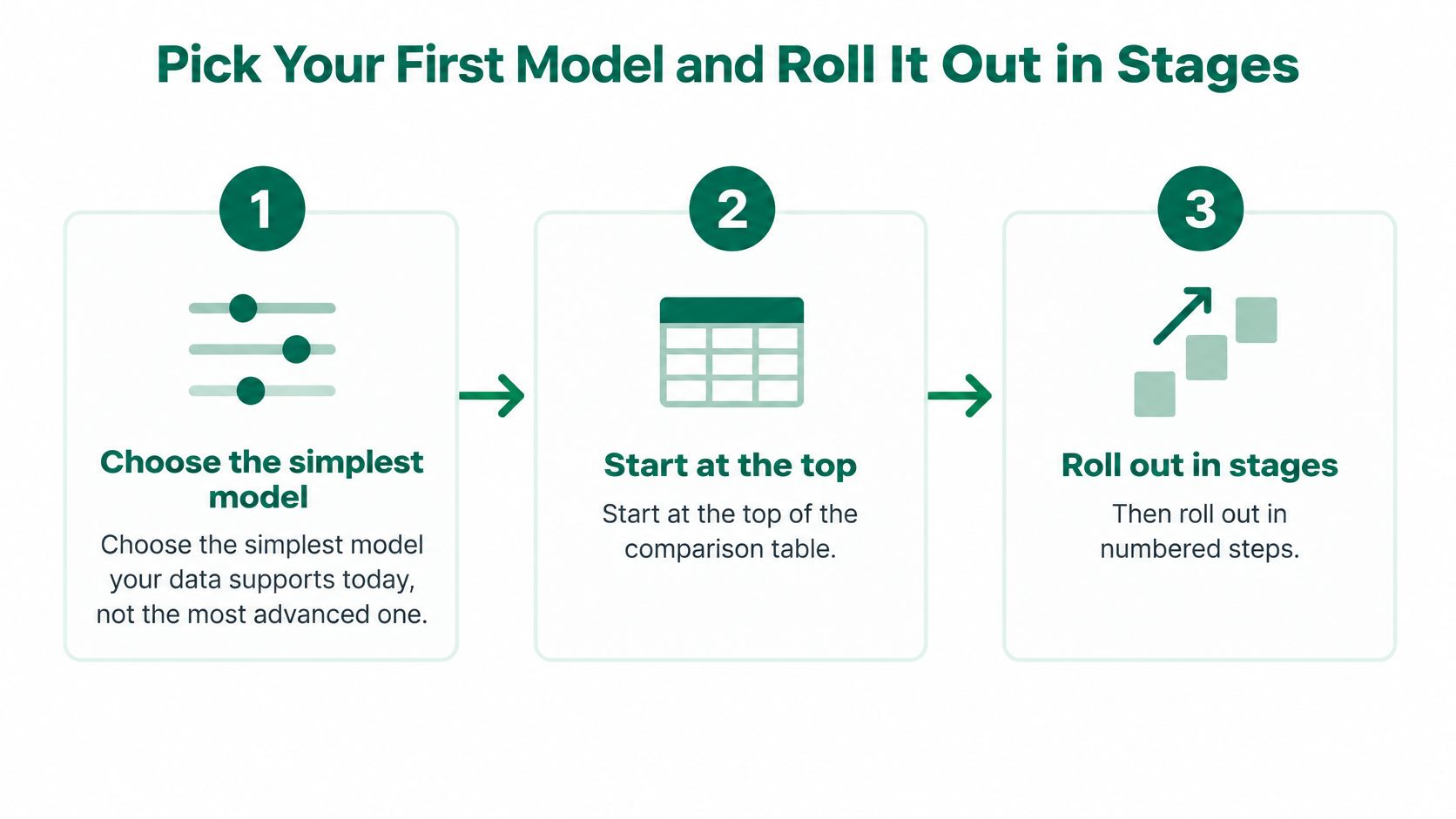
- Match data to the model. Use the requirements table to identify missing inputs before committing to an approach.
- Set price floors, ceilings, and a maximum daily change. Treat these as customer-experience decisions, not merely technical parameters.
- Assign approval and rollback ownership. Write the triggers and name the people authorized to act.
- Benchmark the candidate against your current rule or manual process. An improvement over a weak simulation isn't enough.
- Run the holdout test. Use the duration and guardrail approach described earlier, extending the test when evidence remains uncertain.
- Expand gradually into additional segments or markets only after the existing deployment passes its checks.
- Repeat fairness and disclosure review. A new audience or jurisdiction can change what's acceptable, even when the underlying model hasn't changed.
The best first model is one your team can operate, evaluate, and explain, not merely train.
Your immediate next step is to write a short decision record: the chosen model, available inputs, prohibited inputs, primary metric, guardrails, and accountable owner. That document gives vendors a concrete requirement to answer and gives your colleagues a decision they can review.
Applied offers a curated library of real AI use cases and tools organized by industry, business function, and outcome. Create an account at Applied to access the library, then use your pricing decision record to shortlist tools and vendors that match your data readiness and governance requirements.